We are back with our Rookie Review and Tool Grades series, where we review rookie performances and their long-term fantasy outlooks. The 2026 rookie class is stacked compared to recent years, with 26 rookies registering at least 2.0 fWAR this season. For comparison, just 14 rookies reached that mark in 2025. After going year by year through the FanGraphs rookie leaderboards, 2026 has the most rookies with at least 2.0 fWAR in any season dating back to 2010, speaking to the volume of quality talent coming up this season.
Our dynasty tool grades are used frequently throughout this series. For clarity, the definitions of each hitter and pitcher tool are below. The grades incorporate data from the previous and current seasons, along with future projections using our custom aging curves over a five-year window. This gives us a longer-term view of each player’s skill set and is consistently being updated for stronger results.
DoubleScoop Hitter Tools
- Hit – Player’s ability to put the ball in play and make quality contact.
- Power – Mix of a player’s raw power and his ability to translate the power into games.
- Discipline – Player’s ability to maintain a quality approach and make good swing decisions.
- Speed – Mix of player’s raw speed and their baserunning ability.
DoubleScoop Pitchers Tools
- Induced Contact – Pitcher’s ability to limit the quality of contact allowed.
- Contact Prevention – Pitcher’s ability to generate swings and misses and prevent contact.
- Control – Pitcher’s ability to throw strikes and limit walks.
- Arsenal – Quality and diversity of a pitcher’s full pitch mix.
Past 2026 Rookie Reviews
Hitters
Kevin McGongile
Kevin McGonigle is in the middle of a rookie season that will be remembered by Tigers fans for a long time. His 5.1 fWAR, courtesy of FanGraphs, currently puts him 15th among the best rookie seasons since 2000 and inside the top 100 rookie seasons of all time. I got the chance to watch McGonigle in the AFL in 2025 and labeled him as an impact player with the potential for multiple All-Star appearances. One of the more impressive things I saw in the AFL that year was a foul ball he hit out of the stadium at 118 mph exit velocity, showing the surprising power he can generate despite his smaller stature.
So far during his rookie season, he has shown an excellent approach with more walks than strikeouts. This plus approach, combined with his elite hit tool, gives him plenty of opportunities to get on base, with a 13.7% BB rate and .376 OBP. This has helped him compile 94 runs through 147 games as the table setter in the Tigers lineup. Though the run production has been strong, he has been around average as a base stealer, with 12 SBs on the season.
His dynasty tool grades reflect an elite hit tool and discipline, with league-average power and speed. Despite his average power and speed grades, I expect there is more power in the tank, given he is still just 22 years old and have already seen his ability to lift the ball. There are a lot of similarities to Mookie Betts in that they both have near-elite hit tools, great discipline, and can make the most of their raw power by consistently driving the ball in the air at optimal launch angles.

We currently have McGonigle ranked No. 3 in our latest dynasty SS rankings, with confidence that he can be a consistent year-to-year contributor across all categories. He should maintain a well-above-average hit tool and could push for a batting title during his peak while hitting 20+ HRs each year. For those who had McGonigle before his debut, the investment has been well worth the wait, and he should be one of the most valuable players in dynasty/keeper leagues.
Travis Bazzana
The 2024 first overall pick made his way quickly through the Guardians system, debuting at the end of April after slashing .287/.422/.511 in 23 Triple-A games with the Columbus Clippers. Since being called up, he’s been a useful player but hasn’t quite shown the star potential you would associate with a former first overall pick.
The bat has been above average during his rookie season, with a 113 wRC+ and .249/.342/.408 slash line through his first 115 games. His strong 11.2% BB rate has helped drive his above-average OBP, giving him opportunities to use his speed with 19 SBs on the season. He should be able to maintain a strong BB rate throughout his career, as he has already shown a good eye and avoids chasing pitches out of the zone.
Looking at his pitch-type splits, Bazzana does a good job against fastballs, with a .343 xwOBA and 17.8% whiff rate against all fastballs. However, he has really struggled against offspeed and breaking pitches, with his whiff rates climbing above 30% against both pitch types. Pitchers and teams appear to be taking notice of this hole, as he has seen noticeably fewer fastballs since the start of July, being attacked with more breaking and offspeed pitches. This indicates Bazzana will need to adjust to the better secondary pitches he is seeing in MLB.
I view Bazzana as a high-floor vs high-ceiling player, given his strong on-base skills and value on the basepaths. Looking at his player comps through our dynasty tool grades, the development of his power will be the key to how much upside he ultimately has, with Brice Turang as the best current comp for his future skill set.

Overall, Bazzana is holding his own as a rookie this season, with more value in OBP leagues due to his strong BB rate. He remains a strong dynasty/keeper option, as there is reason to think there could be further growth as he learns to handle MLB secondary pitches and becomes more aggressive on pitches in the zone. He currently ranks as our No. 6 dynasty 2B as of our July update and is still a buy in dynasty/keeper leagues.
Carter Jensen
Jensen was on many people’s draft radars before the season given his 20-game sample in MLB in 2025, when he slashed .300/.391/.550 with a 159 wRC+. While it may have been unreasonable to expect something close to this level of production over the course of a full season, there were still good reasons to buy into him. His underlying data was strong, with 74.8 mph bat speed, a 17.4% K rate, and 20.8% barrel rate.
Over the course of his first full season, his K rate has regressed closer to his MiLB averages, but he has continued to show above-average power and discipline, with 25 HRs and an 11.1% BB rate. Looking at rookie seasons among catchers since 2000, he currently ranks third in HRs, showcasing the power potential he showed throughout the minors and during his 2025 debut.
This season, he has also been a staple in the Royals lineup, playing nearly every day. His 141 games played rank third among catchers this season, while he ranks sixth in PA, showing the ability to stay healthy and grind through a full season. I would expect him to continue getting opportunities at DH on days he is off behind the dish, especially with Salvador Perez nearing the end of his career, which could open up more opportunities to rest his legs while keeping his bat in the Royals lineup. Volume at the catcher position can be tough to find, so his consistent playing time adds to his fantasy value.
His dynasty tool grades show plus power and discipline, with the discipline helping make up for his below average hit tool. He compares similarly to sluggers Max Muncy and Kyle Stowers, both of whom have 30-HR upside but also have low batting-average floors.

Jensen should continue to be an everyday catcher with a strong enough bat to get opportunities at DH on his days off, helping boost his counting stats. He has a pretty safe floor as a 20+ HR hitter and could reach 30+ HRs during his peak seasons. He currently ranks as our No. 13 dynasty C in our latest July update and is a strong candidate to move higher in our next update.
Sam Antonacci
Antonacci was another player I was able to watch during the 2025 AFL season. Outside of Kevin McGonigle, Sam Antonacci and Josh Adamczewski were two of my favorite players I watched. In my AFLL hitter notes, I labeled Antonacci as an everyday major leaguer with a high floor, noting his balanced swing and feel for using the full field.
After playing in the WBC with Team Italy, he started this season in Triple-A but quickly found himself called up by mid-April and has not looked back. Through 112 games, he is slashing .271/.367/.392 with 8 HRs and 18 SBs. While he ranks in the bottom 25% of the league in hard-hit rate and average exit velocity, he shows a great feel for contact, with an 89.9% in-zone contact rate and 15.1% whiff rate.
His dynasty tool grades are led by his plus hit tool, with the only below-average tool being his power. However, our model sees room for him to grow into average power as he ages into his mid-to-late 20s. I do have some doubt regarding the model’s power growth. He will need to make more noticeable changes to his swing and approach to really tap into league-average power as he has below-average bat speed and his average attack direction is 7 degrees to the opposite field.

Even if the power remains below average, he still projects as a productive real-life and fantasy player. His player comps based on the dynasty tool grades are Luke Keaschall and Jakob Marsee, both of whom have plus hit tools with above-average speed and discipline.
As of our latest July dynasty rankings update, he is our No. 30 OF, though he is likely to retain some multi-position eligibility at 2B depending on league eligibility rules. He is not a high-ceiling player but can be a high-floor option who should contribute to AVG/OBP, runs, and SBs. The improved White Sox offense should also help his overall floor over the next few years.
Pitchers
Nolan McLean
Nolan McLean is a budding ace for the Mets, who are searching for positive signs from a lost season in which they currently sit last in their division. McLean, a former multi-sport athlete at Oklahoma State University (the real OSU), was a redshirt on the football team his freshman year. He was also a two-way player during college, primarily as a hitter. He only started focusing on pitching full-time during the 2025 season, the same year he would make his MLB debut. Now in 2026, he ranks third in pitcher WAR behind only Parker Messick and Peyton Tolle, who have been having breakout rookie seasons of their own.
McLean has one of my favorite arsenals in MLB, throwing three different fastballs with plus velocity, three breaking balls with elite movement/plus velocity, and a changeup with good separation from his fastballs. It’s very rare for a pitcher to have three above-average pitches, but in McLean’s case, he has five above-average pitches according to Stuff+.
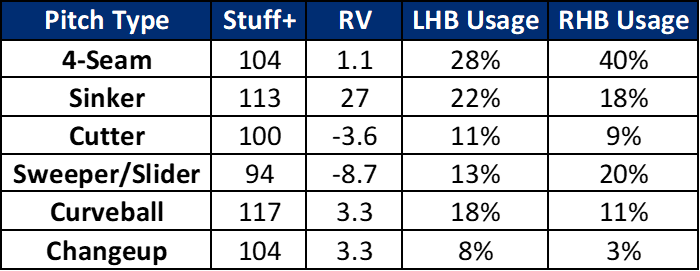
For reference, our dynasty tool grades rank his arsenal as the sixth best among pitchers, behind only Garrett Crochet, Peyton Tolle, Tarik Skubal, Eury Pérez, and The Miz.
Looking closer at his pitch heat maps, he appears to have average command of his four-seam and sinker, with the hot spots on his heat maps being relatively concentrated. When looking at his secondaries, the hot spots are more sporadic, indicating less command of those pitches. This could be due in part to the large movement profiles of his secondaries, as pitches with more movement can be harder to control and land consistently in the zone. This seems like something he should be able to improve as he continues to gain experience on the mound.
Pulling up his dynasty tool grades, he compares similarly to Zack Wheeler who shares almost the same exact pitch movement and velocity. As McLean continues to develop, I would expect his command to push closer to league average. Given the success of his sinker, I expect him to continue using it as his primary fastball, which could limit his overall whiff totals at a glance.

McLean is well positioned to be the Mets’ ace for the foreseeable future and should put up above-average K rates. He has one of the best arsenals in MLB and just needs to continue refining his command to really take the next step forward. I’m confident that he is a pitcher to target, as he should provide volume and Ks with a strong ERA/WHIP. He currently ranks as our No. 11 SP in our July dynasty rankings.
Trey Yesavage
I find Trey Yesavage to be a polarizing pitcher. He made his debut late in the 2025 season and stood out in that year’s playoffs, going 3-1 with a 3.58 ERA and 39 Ks in 27.2 innings. This included two 10+ K games against the Yankees in the ALDS and Dodgers in the World Series. Jumping forward to this season, I’ve seen him struggle to touch the zone, including two starts in which he walked seven hitters. All that said, he has shown positive signs during his rookie year with a 3.65 ERA, 1.14 WHIP, 23.6% K rate, and .180 batting average against. On the downside, his 4.56 SIERA is almost a full run higher than his ERA, while his 11.9% BB rate and .215 BABIP raise some concerns about the sustainability of his current results.
Yesavage stands out for having an extremely over-the-top arm angle at 66 degrees, registering as the highest arm angle among right-handed pitchers this season and second only to Alex Vesia in MLB. He currently uses a three-pitch mix with a four-seam, splitter, and slider, though he is primarily a two-pitch pitcher when breaking down his repertoire against LHB and RHB.
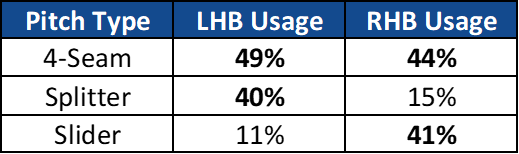
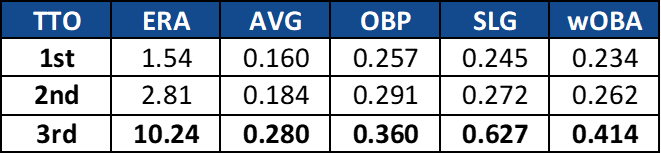
While he generates a whiff rate above 40% with his slider against RHB and splitter against LHB, the limited mix raises concerns for me long term as hitters make adjustments and see him multiple times. His limited pitch mix against each side of the plate also leads him to become very four-seam heavy when behind in counts. This could leave him susceptible to hitters sitting on the four-seam in advantageous counts. Though the data is limited, his career times-through-the-order splits also show that he has had a tough time facing hitters for a third time.
His dynasty tool grades compare similarly to José Soriano and Kyle Bradish, though it’s worth noting that all three pitchers have vastly different arsenals and arm slots. While Yesavage currently has a 35 Command grade and 50 Arsenal grade for 2026, our dynasty model sees growth in both categories over the coming seasons, likely aided by the fact that he is still just 22 years old. Improvement in his command and/or adding more depth to his arsenal would go a long way toward increasing my confidence in him as a long-term starter, as I still have some doubts with his current profile.

Yesavage is certainly a unique pitcher who can generate plenty of whiffs but also has some major flaws. At just 22 years old, there is plenty of time for him to add new pitches to his Arsenal, diversify his pitch usage, and improve his Command. As it stands now, Yesavage is not someone I am currently targeting in fantasy leagues, as I have a hard time buying into a starter with his current level of command and lack of arsenal depth. He is our No. 52 dynasty SP in our latest update, and 2027 should tell us a lot about whether he can make adjustments to his pitch mix or show improvement in his Command.
Walbert Ureña
Ureña has burst onto the scene in 2026 with a strong rookie season. He came as a surprise for me, as he was ranked as the Angels’ No. 23 prospect by FanGraphs entering 2026. On the season, he has pitched to a 2.88 ERA and 4.31 SIERA with an 11.0% K-BB%, suggesting he could be due for some regression based on his underlying performance.
Ureña has a four-pitch mix, leading with his changeup 34% of the time, followed by his sinker (33%), four-seam (19%), and sweeper (14%). He has strong velocity, averaging over 97 mph on both his four-seam and sinker, as well as plus velocity on both his sweeper and changeup. Stuff+ grades three of his pitches as above average, with the sinker, sweeper, and changeup all grading above average among SPs. Both of his secondaries have also been effective this season with whiff rates above 30%, indicating there could be room for improvement from his current 22.4% K rate.
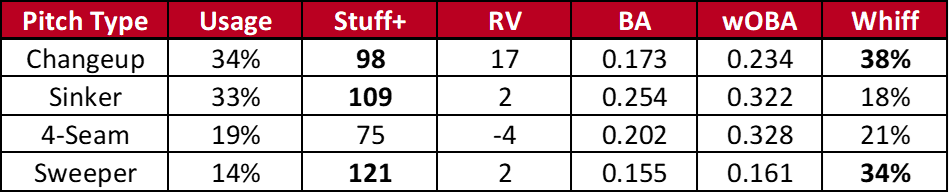
His changeup/sinker-heavy pitch mix does a great job of generating ground balls, with a 55.1% GB rate on the season, while also limiting hard contact with a 36.4% hard-hit rate and 5.6% barrel rate. This ability to generate ground balls and limit quality contact has been a big reason why he has been able to outperform his ERA indicators this season.
Our dynasty tool grades show Ureña as a pitcher who excels at limiting quality contact. Other RHPs who prevent quality contact at a similar level with otherwise average-ish tools Our dynasty tool grades show Ureña as a pitcher who excels at limiting quality contact. Other RHPs who prevent quality contact at a similar level with otherwise average-ish tools include Landen Roupp and Drew Anderson. Of this group, Ureña easily has the best velocity, averaging around 98 mph on his fastballs. However, his four-seam shape lacks ride and arm-side run, leaving his sinker as his best fastball.

Ureña is going to have plenty of chances to succeed, even if he runs into some poor stretches, as the Angels do not have a lot of established starting pitching outside of Reid Detmers. There is even a chance Detmers gets traded, potentially leaving Ureña with an opportunity to pitch at the top of the rotation by the start of next season. Ureña will likely be most useful for fantasy due to his volume, as he currently lacks the K and win upside of higher-end fantasy starters. However, his ERA and WHIP ratios should remain useful, and he could provide more value in quality-start leagues than leagues that use wins. He is currently outside our top 75 dynasty SPs as of our July update but is likely to find himself on the list in our end of the season update.
Jake Bennett
Boston has been spitting out quality left-handed pitching lately, with Peyton Tolle, Jake Bennett, and Connelly Early (traded to the Nationals for Curtis Mead) all having strong 2026 rookie seasons. Bennett had a strong track record of success in the minor leagues, posting a 2.27 ERA in 2025 across High-A and Double-A and a 1.60 ERA in Triple-A this season. Despite the success, he ranked as the Red Sox’s No. 9 prospect heading into the season. In his first 19 starts in the big leagues, he has thrown 109.2 innings with a 3.78 ERA and 90 Ks against just 20 BBs. While striking out hitters at a below-average rate, he has been able to succeed by mixing speeds and commanding his deep pitch mix.
Bennett is a big dude, listed at 6’6″ and 235 lbs. He has a big frame along with a smooth delivery, giving him a great foundation to work with. His velocity is just below average for a LHP at 92.8 mph, but I could see him gaining a tick over time. While lacking plus velocity, he has found success keeping hitters off balance with the six-pitch mix shown below.
His best pitches by run value are his sinker and changeup, which he uses a combined 50% of the time. He primarily uses his four-seam to attack the top of the zone, while he does a great job locating his changeup at the bottom or below the zone. The sweeper and changeup are both strong swing-and-miss pitches, with whiff rates above 30%. Paired with a strong 37.4% chase rate, there is reason to think he could improve upon his current 20.4% K rate.
Our dynasty tool grades give him two above-average to plus tools, really liking his command and induced contact. He profiles similarly to Trevor Rogers, who shares many of the same traits, including his size, pitch mix, and dynasty tool grades. I don’t think Bennett is likely to have a season like Rogers did in 2025, when he went 9-3 with a 1.81 ERA in 109.2 innings. However, both profile as valuable mid-to-back-end rotation pieces who are more useful in deeper fantasy leagues.

Patrick Sandoval is a free agent at the end of the season, giving Bennett a better chance to stick in the rotation next year. I imagine he slots in near the back of the Red Sox rotation in 2027 behind Garrett Crochet, Peyton Tolle, Sonny Gray, and Ranger Suárez, pending any free-agent signings. For fantasy, I like him more as a streamer who can be started in favorable matchups and will have more value in deeper leagues or draft-and-holds. He is currently outside our top 75 dynasty SPs in our latest July update.
Past 2026 Rookie Reviews
Follow us on X @2BScoopBaseball and let us know any feedback or questions you have.
