Intro
We are over two months now into the 2026 season and us dynasty managers are either starting to boost our roster for a championship run, or starting to plan for the next few years. Here we will look at a few players who should be relatively cheap to acquire via trade or even possibly waivers/free agency depending on the league size. Regardless of the league size, these are players that I think should be owned in most dynasty formats and will provide strong value going forward. For this article, I tried to avoid including rookies and prospects who I will go into more depth later this season in prospect and rookie review articles where we will dive into rookie performances, dynasty outlooks, as well as player comps.
As a reminder, I often times reference skill grades in these articles which are our own custom player indexes that we have broken down into the below tools on a 20-80 scale.
Hitters: Hit, Power, Discipline, Speed
Pitchers: Induced Contact, Contact Prevention, Command/Control, Arsenal
With that, let’s dive into the June 2026 Dynasty Player Targets.
Hitters
Curtis Mead
Mead (25) is starting to get consistent everyday playing time with the Nationals and starting to finally come through on some of the prospect pedigree. As a Rays prospect, Fangraphs had him as a 55-grade FV player with a 50 future hit tool and a 55 future game power with 60 future raw power.
During 2023-2025, Mead showed an average hit tool but graded below average in power and discipline while playing 2B/3B. Ultimately, this level of production was not enough and he was eventually traded to the White Sox organization. He must have taken some tips from Miguel Vargas before he left, as this year he has gone on a breakout fueled by more power and improved, but still average discipline.
This year, as of the time of writing, he has a career low 58.6% zone-swing rate (67.0% is MLB average) and 24.7% chase rate (28.5% is MLB average), indicating not only is he laying off pitches outside the zone better, but also being more selective on the pitches he swings at in the zone. More specifically, he has been able to lower his chase rate on low pitches out of the zone.
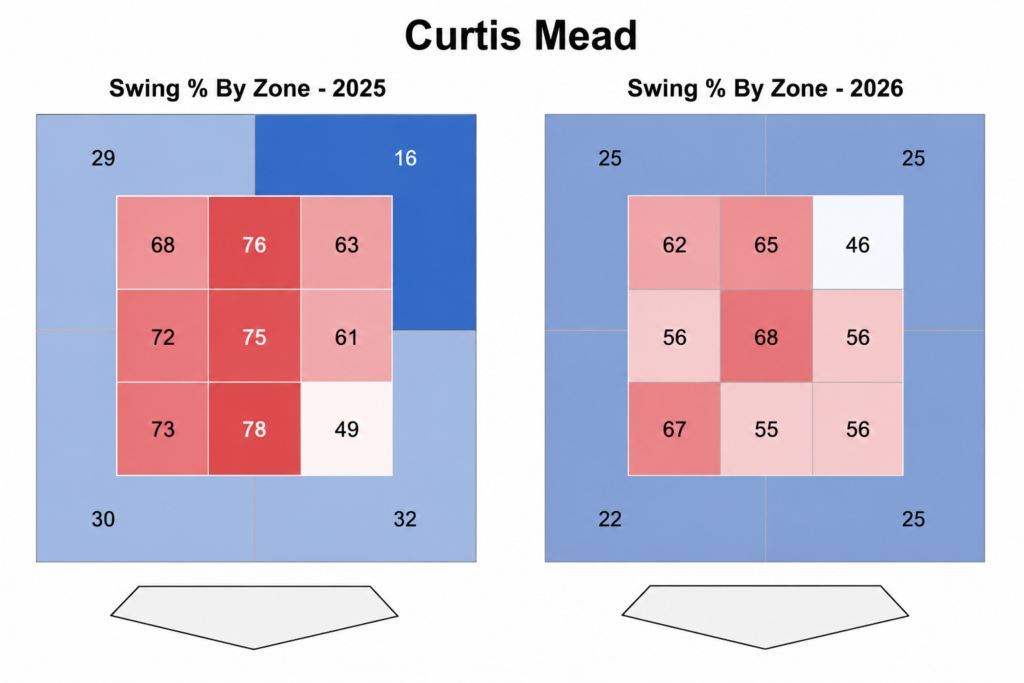
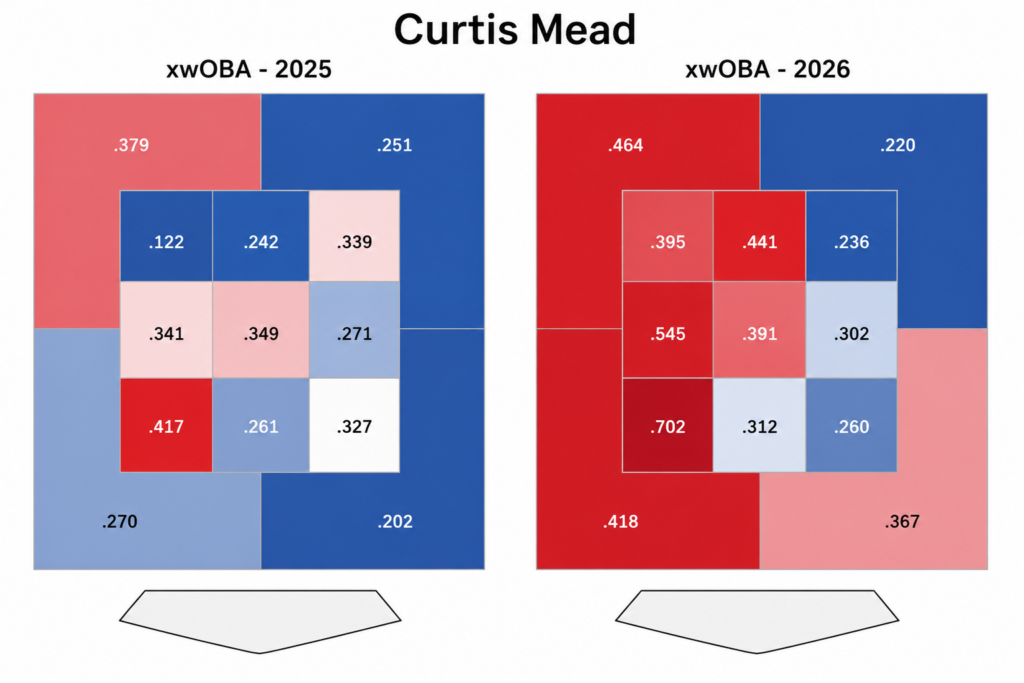
This shows that Mead is honing in his approach and looking for more specific pitches on the middle and inside part of the zone where he does most of his damage. This is also reflected in his career-high 46.7% pull rate, up from his 38.5% career average.
With these changes, our custom player skill grades (present/future) now grade him:

These grades look very similar to Miguel Vargas in 2025 with slightly worse discipline, and we see Mead as a strong buy right now in dynasty leagues.
Cam Smith
Cam Smith (23) had tons of hype going into the 2025 season as he had a great spring training and earned himself a spot on the opening day roster. The overall results were not great in 2025 with a .298 wOBA, 9 HRs, and 8 SBs in 134 games, and I even suggested that a demotion may be in order for him to work on his approach during his 2025 Rookie Review.
Smith showed plus bat speed last year and has improved his average bat speed by significantly increasing his fast-swing rate by 25%, averaging 77.0 mph which puts Cam Smith into the upper echelon of bat speed. He has also made some adjustments at the plate by setting up roughly five inches deeper in the box and about two inches farther off the plate allowing him more time to see pitches.
While these changes have not led to large increases in production with a .296 wOBA on the season there are some under the hood improvements to be excited about. His xwOBA has increased to .337 signaling he will have some positive regression in the second half of the season. His barrel rate is also up from 6.9% to 13.3%, almost doubling year over year, showing that he is starting to translate his raw power into game power.
Our custom player skill grades built off 2026 data (present/future) now has him at a 40/45 hit, 60/75 power, 50/55 discipline, and 55/60 speed. The present/future grades have him similar to Byron Buxton, who always had plus raw tools but struggled to stay healthy long enough to put together a complete season.

Cam Smith is a great buy for dynasty managers looking to build for future seasons and has the potential to put together a 30-30 season during peak seasons.
Jakob Marsee
Marsee (25) is off to a slow start in 2026 with a .200/.330/.300 slash line after posting a great .292/.363/.478 slash line during his debut season in 2025. While the performance is not where fantasy managers want it to be, he is still showing a great knack for getting on base and stealing bases with 17 SBs through 70 games played.
Unlike some other speed-first players such as Chandler Simpson, Victor Scott, Jake McCarthy, and Brenton Doyle, Marsee also pairs his top-end speed with above average hit tool and discipline, with both grading out at 55 on the 20-80 scale. While the power has dipped year over year, with the barrel rate falling from 8.1% to 3.5%, I believe Marsee can still have stretches where he can get to average power and put up ~15 HRs during the course of a season.
Part of the production decrease could be that pitchers are less willing to challenge Marsee. Last year during his rookie season, pitchers were challenging Marsee with 53.8% of pitches in the zone compared to this year at 48.4% which is right there next to league average. The hot rookie year and batting near the bottom of the Marlins order with minimal protection behind him are certainly reasons for him not seeing as many pitches in the zone which limits his opportunities to put a good swing on a pitch.
Overall, our skill grades still see a strong player who can contribute to all categories with the below present/future skill grades.

This may just be a slow stretch to start the 2026 season as the league starts adjusting to him. I recently picked up Marsee in my home league (16 teams) off waivers (after trying to trade for him in the offseason) to replace Oneil Cruz who recently went on the IL. I can see Marsee putting up a strong second half this season and restore his fantasy value.
Evan Carter
Evan Carter (23) has long been a fantasy favorite, with many managers expecting big things after his breakout 2023 playoff performance, however with injuries limiting his playing time, he hasn’t fully capitalized on his raw ability. The bad news this year, he is slashing just .176/.292/.321. The good news this year, he has already played a career high in games in his short MLB career and is still showing signs of power and speed with 6 HRs and 10 SBs. Over a full 162 game season that paces out to around a 15 HR/25 SB season which is plenty valuable in fantasy leagues.
Looking into his 2026 struggles, his wOBA against off-speed and breaking balls is .180 and .256, respectively vs a .325 wOBA against fastballs. Looking at the new BaseballSavant swing data, he is swinging over the top of off-speed pitches 25% of the time compared to just 6% in 2025. Pair this with the whiff% by zone and we can see that the lower part of the strike zone is a weak spot for Carter. Pair that with pitchers are attacking below the zone most frequently of any other location and we have some understanding of where pitchers are going to plan to attack Carter.
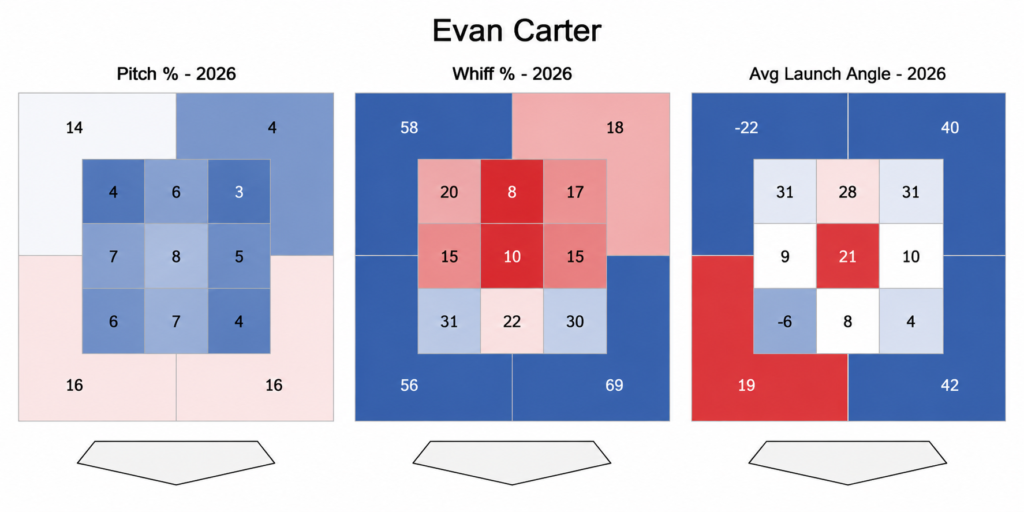
One beneficial adjustment for Carter could be moving farther up in the box to help him get the ball at a slightly more elevated point, especially on off-speed and breaking balls as he is currently standing 27.7 inches deep in the box with 27.9 inches as the MLB average. Carter has a strong eye, shown by his 19.3% chase rate this season, and now just needs to make an adjustment to be able to do more with the lower part of the zone.
At just 23 years old, he still has time to continue to develop and make adjustments. Our skill grades still like Carter, showing a present/future value below:

Like Marsee, he has the potential to be an all-around contributor, though with less hit tool and slightly more power upside. Evan Carter is a good buy-low and hold player for dynasty managers in deep leagues looking to build for coming seasons.
Honorable Mentions
Trent Grisham
Garrrett Mitchell
Pitchers
Logan Henderson
Henderson (24) is the one exception to my rookie rule for this article, as I feel he has been flying under the radar compared to other Brewers pitching standouts like Jacob Misiorowski and Kyle Harrison, who have been dominating the league.
Through his first 5 starts in 2026, Henderson is rocking a strong 33.3% K-rate, 6.7% BB-rate, and a strong 2.74 ERA supported by a 2.41 FIP. Known primarily as a FB/CH pitcher, with FanGraphs rating his CH as a 70-grade pitch on the 20-80 scale, Henderson has also increased usage of his FC and introduced a new SL this season with over 15 additional inches of induced horizontal break.
| Year | Velocity | Induced VB | Induced HB |
| 2025 – Slider | 83.3 mph | -1.8 inches | 0.5 inches |
| 2026 – Slider | 80.7 mph | -3.9 inches | -16.1 inches |
This new slider gives him a breaking ball with serious movement that he can utilize against RHB while providing significant separation from his fastball and changeup. For a pitcher who has historically relied heavily on his elite CH, this will give hitters another pitch to worry about and keep them from sitting/guessing on his FB/CH.
He pairs this upgraded arsenal with already solid and still improving command. Last year our skills grade had his command as a 55 and has improved to 60 this year through his limited starts, which aligns well with Fangraphs present/future command grades of 55/60.
Even without the premium velocity that many fantasy managers look for, he has plus movement/shapes on all four of his pitches and has plus command which puts him in a strong position to slot into the top three of the Brewers rotation along with the Miz and Kyle Harrison for years to come. I tried warning everyone to pick up Kyle Harrison back in early May, now this is your warning to go grab Logan Henderson.
Dustin May
May (28) returned in 2025 after missing two full seasons due to multiple surgeries and displayed reduced FB velocity, averaging 95.5 mph, along with an elevated 9.6% BB-rate. So far this year the FB velocity is back to averaging 97+ mph while also improving his BB-rate to 6.6%. I often hear command is the last thing to come back when recovering from serious arm injuries/surgeries, and this was likely the case with May as well who happened to also be down a few ticks. After his first normal offseason not spent recovering in years, he has shown there is still plenty left in the tank for a once-promising pitcher.
Our skill grades last year had May’s arsenal graded at a 50, putting him around MLB average, with a just below average 45-command grade. This year those have ticked up to a 60-grade arsenal and 50-grade command, and are backed up by an improved 6.6% BB-Rate, increased fastball velocity, and a deeper arsenal, now throwing 6 pitches with the addition of a more vertical CB that he hasn’t thrown since 2019.
While never missing bats at a strong rate, May has a lot to build off with a plus arsenal and average command. This season he is showing fairly drastic splits against RHB versus LHB, with his K-BB% almost 10% higher against RHB (22.2%) vs LHB (12.8%). With the deep arsenal, I believe he can continue refining his approach against LHB by reducing FF usage and leaning more heavily on the rest of his arsenal as hitters currently have a .361 xwOBA against his FF this year.
With the velocity, command, and arsenal all showing improvements early in 2026, now is a great time to buy in on a pitcher who has some of the strongest upside when considering the little cost it will take to acquire him. He has a ton of similarities in his arsenal to one of the top young dynasty arms, Nolan Mclean, and just needs to make a few adjustments against LHB to really take off. May is a strong buy/stash option for dynasty managers looking for pitching in the second half of the year and on.
Honorable Mention
Reid Detmers
Comment on the post or reach out to us on X if you have any fantasy related questions!