I skipped the October rookie review as I got lost watching Arizona Fall League live streams, which I will recap soon. Due to the missed month, I am adding more players to this month’s review. Links to past 2026 rookie reviews are below if you want to catch up on all 27 rookies we’ve covered across our August, September, and November reviews. This month, we feature the NL Rookie of the Year, Sal Stewart, among other strong rookie hitters. Our pitching section features five rookie pitchers who all happen to be left-handed.
As always, I want to mention that our dynasty tool grades will be used frequently throughout this series. For clarity, the definitions of each tool for both hitters and pitchers are included below. These grades are based on 2025 and 2026 data, with a custom aging curve used to project long-term skills.
Past 2026 Rookie Reviews
DoubleScoop Hitter Tools
- Hit – Player’s ability to put the ball in play and make quality contact.
- Power – Mix of a player’s raw power and his ability to translate the power into games.
- Discipline – Player’s ability to maintain a quality approach and make good swing decisions.
- Speed – Mix of player’s raw speed and their baserunning ability.
DoubleScoop Pitcher Tools
- Induced Contact – Pitcher’s ability to limit the quality of contact allowed.
- Contact Prevention – Pitcher’s ability to generate swings and misses and prevent contact.
- Command – Pitcher’s ability to throw strikes and limit walks.
- Arsenal – Quality and diversity of a pitcher’s full pitch mix.
Hitters
Sal Stewart
The 2026 NL Rookie of the Year, Stewart had a great season, hitting 32 HRs, 15 SBs, and 112 RBIs with a .263/.330/.457 slash line. While other rookies may have had stronger advanced statistics, Stewart was still a deserving winner in a strong rookie class. Defensively, he split his season between 1B and 3B and will be eligible at both positions in 2027. He also appeared in eight games at 2B, potentially opening the door to a third position, though I think that’s unlikely.
Stewart separates himself from other sluggers with similar power by having average hit, discipline, and speed tools, leaving no glaring holes in his game. He posted strong barrel rates and EVs, but his closer-to-average bat speed of 72.1 mph and below-average pull-air rate of 13.6% signal room for improvement. Two things I particularly like about his profile:
- He did a great job hitting fastballs, posting a .377 wOBA.
- He showed power to all fields, with 18 of his HRs going to CF/RF.
His dynasty tool grades are very similar to those of Shea Langeliers, who has improved over the past two seasons and become an above-average hitter.

Stewart has the ability to contribute across all fantasy categories with multi-position eligibility and should be considered a top-three dynasty third baseman. In 2027 redraft leagues, I view him more as a top-five third baseman, but his underlying skills back up his strong rookie season.
Munetaka Murakami/Esmerlyn Valdez
I’m combining Murakami and Valdez because their profiles and comps are so similar that there’s no point in writing two separate outlooks. Both rookies posted 20% barrel rates and max exit velocities of 114 mph in 2026, though Valdez recorded that max EV at Triple-A. They even finished 2026 with similar slash lines, walk rates, and strikeout rates.

They share the same elite power and strong plate discipline, but also the same concerns with their hit tools. Their well-below-average hit tools will likely limit their batting averages to the low .200s while contributing to high strikeout rates. One thing worth noting that differentiates these hitters is that Valdez had drastic month-to-month splits, while Murakami was a little more consistent. As I’ve said before, hitters with hit tools this poor are more prone to streaky production, though I think Murakami has an edge in consistency given his experience in the NPB.
Their comps based on our tool grades include Kyle Schwarber and Nick Kurtz. Kurtz looked well on his way to building on his success before injuries derailed his season, while Schwarber has been one of the league’s best home run hitters over the past five seasons.
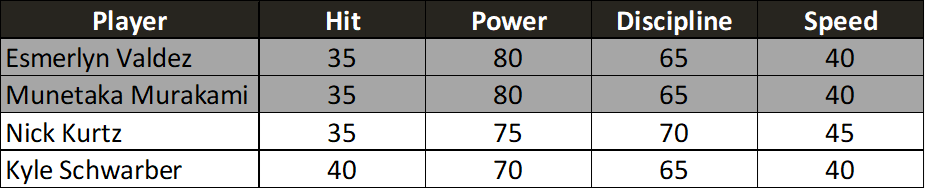
Both Valdez and Murakami are positioned to contend for homerun crowns on a yearly basis in the coming years. If you own either player, they’re strong holds, especially in OBP leagues where their plate discipline should help offset their low batting averages. In redraft leagues, I favor Murakami, though Valdez may offer similar power potential at a lower ADP.
AJ Ewing
One of my favorite breakout rookies in 2026, Ewing’s strong rookie season was overshadowed by some of the other impressive rookie performances, including those of his teammates Carson Benge and Nolan McLean. In 120 games, he hit 11 HRs and stole 25 bases, which works out to roughly 15 HRs and 34 SBs over a full 162-game season.
Ewing has top-end speed, ranking in the 94th percentile in sprint speed, and was a strong defender in CF across nearly all defensive metrics. His speed is his strongest tool, but he combines that with average to above-average hit and power tools alongside good approach metrics (Z-O Swing).

Our dynasty tool grades compare him to Wyatt Langford and Blaze Alexander. While Ewing has an average hit tool right now, our aging curve projects further power growth, though it could take a few years to develop. Over a full season, Ewing has the potential to be a top-25 OF if everything clicks, with upside for 30+ SBs and 15 HRs. He has been one of the biggest risers in our dynasty OF rankings and is likely still underrated in your leagues.
Spencer Jones
Jones is in the same athletic mold as Nationals star James Wood, listed at 6’7″ and 240 lbs. He’s always had eye-popping tools and a strong minor-league track record, but his K rates around 30% have raised concerns. He really struggled out of the gate, posting a .167/.259/.167 slash line and a 27 wRC+ across his first 10 games. However, he bounced back with a strong second half, hitting 9 HRs and stealing 9 bases in 56 games with a .250/.311/.452 slash line.
I mentioned Jones was tooled up earlier, but to put some numbers to that, he posted a 28.9 ft/s sprint speed, ranking in the 89th percentile, and a 77.1 mph average bat speed, which would have ranked among the best in MLB had he qualified. He also puts a ton of balls in the air, with a 73.2% air rate (MLB average is 55.9%), allowing him to maximize his HR potential on balls in play. If he wasn’t interesting enough, Jones slashed a ridiculous .389/.441/.667 with 3 HRs in 59 PA against LHP this year. Obviously, the sample size is too small to take much from it, but it offers a glimmer of hope that he can earn more playing time against LHP in the future.
His rare blend of elite power and plus speed puts him in a category with some of the most physically gifted players in MLB. Our dynasty tool grades agree with the comps shown below, though his 35-grade hit tool is a significant limitation compared to the others and will be the biggest question for reaching his ceiling.
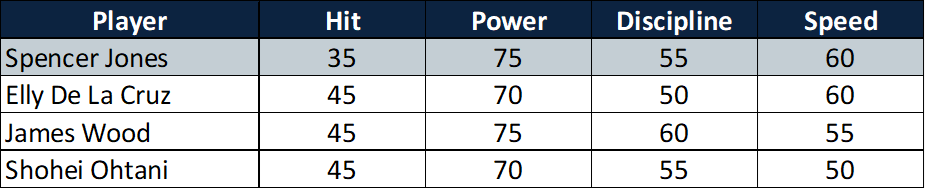
Jones is a unique player with a wide range of possible outcomes for his career. His upside remains extremely high, with 40+ HR potential and the ability to steal 20+ bases. Given the wide range of possible outcomes, it could be worth dangling Jones in trade offers this offseason to gauge his value. Your league mates could have vastly different valuations of him, creating potential buy or sell opportunities.
Cooper Pratt
Brewers’ postseason legend Cooper Pratt will be held in high regard by Brewers fans for years to come, even though he’s only played 74 regular-season games at the major league level. Pratt is entering his age-22 season and is in line to be the everyday shortstop for the Brewers, which should make him fantasy relevant.
Our dynasty tool grades see an above-average hit tool with plus speed. He showed off that speed with 19 SBs in just 74 games while only being caught three times. Not only does he have plus speed, at 6’4″ and 210 pounds, he’s one of the larger shortstops in the league, so an increase in power is within reason.

His current comps are underwhelming, with neither Richie Palacios nor Jared Triolo standing out as particularly exciting fantasy comparisons. He’ll need to tap into more of his raw power if he wants to become a universally rostered fantasy player. He can provide SBs with a decent batting average, but his lack of current power and a spot near the bottom of the batting order could really limit his run production. Pratt is more of a deep-league fantasy asset than a must-own player and is better suited for 15- or 16-team leagues and deeper or draft and holds.
Pitchers
Connelly Early
Connelly Early’s name is going to be mentioned a few times throughout this article as we go through skill comps across the five LHP today. Early is coming off a year where he threw 94.2 IP across 18 starts with the Red Sox and Nationals. He missed time during the 2026 season with forearm irritation and tightness but was able to return for one shortened start at the end of the season, with his velocity returning right around his season average.
He features an above average arsenal with a six-pitch mix and a fastball averaging 94 mph. His changeup and sweeper are his best secondary pitches, with his changeup featuring plus vertical movement and his sweeper sitting at a slightly above-average velocity of 82.5 mph. Against LHB, he primarily throws his four-seam, sinker, and sweeper, while mixing in his four-seam, sinker, changeup, and curveball more frequently against RHB. Even with his different approaches against both sides, he still struggled to get righties out. The good news is that his changeup was an above-average pitch against RHB, and his four-seam also graded above average according to Stuff+. This gives me some confidence that he can continue to improve against righties.

Both of Early’s closest comps based on our dynasty tool grades are pitchers we’ll be covering later, Gage Jump and Connor Prielipp. All of them have above average four-seam velocity and above average secondaries. Out of the three, Jump has the best fastball followed by Early. Early does have the best changeup of all three which should help him improve his splits against RHBs.

The Nationals targeted Early, and he should get a chance to establish himself in their rotation in 2027. He threw 100+ IP in both 2024 and 2025, giving him a solid innings foundation to build on assuming he stays healthy. The Nationals made major strides in player development in 2026, particularly on the offensive side, but also had success with Cade Cavalli and Andrew Alvarez taking big steps forward on the mound. Early is currently ranked No. 58 in our top 75 dynasty SP rankings and should be a long-term middle-of-the-rotation arm for the Nationals.
Gage Jump
Jump came up in 2026 as the Athletics’ top pitching prospect. While his overall results were not great, finishing with a 6-11 record and 5.47 ERA, he did post an above-average 24.7% K rate and an average 14.2% K-BB%, while throwing 136.2 IP across Triple-A and the MLB.
Jump has an overhand delivery with a 43-degree arm angle and two above-average breaking balls in his slider (87.2 mph) and curveball (82.3 mph). His four-seam doesn’t feature standout vertical or horizontal movement, but he makes up for that by averaging 96.3 mph, well above average for a LHP. To put that into context, Tarik Skubal and Jesús Luzardo are the only two qualified LH starters who had a higher average four-seam velocity, putting him in good company.
Jump’s biggest hurdle to becoming a more valuable fantasy pitcher is likely his home park in Sacramento. He had noticeable home/away splits, with worse numbers across the board at home. Interestingly, his barrel rates, hard-hit rates, and batted-ball distribution were all very similar between home and away, suggesting his home park may have played a significant role in his struggles.

Jump has the skills necessary to become a top of the rotation arm for the Athletics, which may be closer to a No. 2 starter for most teams. He has interesting comps in Carlos Rodón and Connelly Early. He has one of the better LH arsenals in the MLB to work with, and I can see him taking a step forward in 2027.

The Athletics aren’t expected to move to Las Vegas until the 2028 season, meaning Jump owners may need to hold tight before a larger breakout. It’ll be tough to trust him at home in 2027, but he could be a valuable road streamer, especially in deeper leagues with weekly pickups. He remains an interesting dynasty arm, particularly with the Athletics’ eventual move to a domed stadium in Las Vegas, which could help reduce some of his drastic home/road splits.
Noah Schultz
Schultz isn’t your average MLB pitcher. Standing at 6’10” and 240 pounds, he could easily be mistaken for an NBA player. He threw 74.1 IP in his first MLB season and totaled 119 IP when including his minor league innings in 2026. This was a career high for Schultz whose previous max was 88 innings in 2024.
He throws from a low 21-degree arm angle, creating a unique release point given his extreme height. He currently sets up on the third-base side of the rubber, which I’m guessing may help with his direction or strike throwing. However, I do see the potential to create some really tough angles for hitters if he were to set up more toward the middle or first-base side.
He features a deep east-west arsenal, averaging 95 mph with both his four-seam and sinker, while mixing in a cutter, changeup, and sweeper, each thrown at least 10% of the time. Despite his 55-grade arsenal, I think Schultz’s biggest issue so far in his career has been pitch execution. In 2026, he posted a 21.0% whiff rate, 28.6% chase rate, and 9.7% barrel rate, a below average combination that highlights his struggles to miss bats and limit hard contact.

His closest comps based on our dynasty tool grades are fellow lefties Connelly Early and Shane Drohan. Schultz currently lags behind in his ability to miss bats, which remains his biggest downside. He’s likely to fall outside our top 75 dynasty SPs in the next rankings, as he’ll need to show more swing-and-miss ability to move up. For now, he remains a speculative dynasty arm who looks more like a No. 4/5 starter than a potential top-of-the-rotation piece.
Connor Prielipp
Prielipp was an under-the-radar starter for the Twins in 2026, becoming one of their most consistent pitchers while throwing 125.2 IP over 24 games (22 starts). While his 4.87 ERA wasn’t particularly impressive, his FIP and SIERA were both around a full run lower, suggesting there could be room for improvement.
His pitch mix is led by his slider, which he throws 30% of the time and features above-average velocity at 87.9 mph. His four-seam and sinker both average 95+ mph, and he also mixes in a curveball and changeup at least 10% of the time. Overall, he has above-average stuff thanks to his plus slider and curveball, which stand out more for their velocity than their movement.
Lefties with plus velocity are always appealing, especially when they have average command and plus secondary pitches. Based on our dynasty tool grades, Prielipp profiles similarly to Shane McClanahan and Shane Drohan. Of the three, Prielipp has the weakest four-seam, making his command and secondary pitches key to his success.

After Joe Ryan, Pablo López, and Taj Bradley, the Twins’ rotation has a lot of uncertainty, with Dean Kremer, Bailey Ober, Connor Prielipp, Zebby Matthews, and Mick Abel all potentially competing for a spot. Prielipp is currently outside our top 75 dynasty SPs and is being drafted outside the top 100 pitchers based on NFBC ADP. He could be an interesting late-round draft-and-hold pick and a matchup-based streamer in 2027. Keep an eye on the Twins’ rotation during Spring Training, as Prielipp and others could offer good value if they win a spot.
Andrew Alvarez
The Nationals made a lot of improvements in 2026, and Alvarez should be considered one of their player development successes. A 12th-round pick in the 2021 draft, Alvarez completed his first full MLB season at age 27. He made his MLB debut in 2025, posting a 2.31 ERA across five starts. In 2026, his first full season, he pitched to a 3.43 ERA over 112.2 IP. He improved his K rate to 24.1% but also posted a 10% BB rate for the second consecutive season.
Alvarez has a high arm slot at 47 degrees and a breaking-ball-heavy arsenal, throwing his curveball and slider more than half the time. He doesn’t have premium velocity, but his secondary pitches do a good job generating whiffs and have posted positive run values. In addition to an above-average K rate, he’s also been able to limit barrels and generate a ton of ground balls.

His dynasty tool grades are similar to David Peterson’s, which could be good or bad depending on how you look at it. Peterson has made 20+ starts in each of the past four seasons, posting a 4.25 ERA during that span. Both his command and arsenal grade below average, which makes me think he could see some regression from his 2026 performance.
He should be capable of being a back-end starter due to his strong secondary pitches and ability to generate swings and misses. For fantasy, he’s better suited as a streamer in most leagues but could also be a late-round draft-and-hold pick, currently going as the 135th pitcher off the board in NFBC leagues.
Follow us on X @2BScoopBaseball and let us know any feedback or questions you have.