Kicking off our 2026 Rookie Analysis and Tool Grades series where we will take a closer look at this year’s rookie class. In these articles, we will provide a quick overview of each player’s season to date, assign tool grades, provide player comps, and fantasy outlook.
Our dynasty tool grades will be used frequently in these series. For clarity, the definitions of each hitter and pitcher tool are included below. These are calculated using data from the current season and applies a custom aging curve to project the players tools over a five-year window, inclusive of the current season. We can also compare these tool grades to previous seasons to evaluate how a player’s profile has changed.
DoubleScoop Hitter Tools
- Hit – Player’s ability to put the ball in play and make quality contact.
- Power – Mix of a player’s raw power and his ability to translate the power into games.
- Discipline – Player’s ability to maintain a quality approach and make good swing decisions.
- Speed – Mix of player’s raw speed and their baserunning ability.
DoubleScoop Pitchers Tools
- Induced Contact – Pitcher’s ability to limit the quality of contact allowed.
- Contact Prevention – Pitcher’s ability to generate swings and misses and prevent contact.
- Control – Pitcher’s ability to throw strikes and limit walks.
- Arsenal – Quality and diversity of a pitcher’s full pitch mix.
With that lets kick off the 2026 rookie review series.
Hitters
JJ Wetherholt
Wetherholt (23) has made an immediate impact in the MLB, trailing only rookie phenom Kevin McGonigle (4.7) in fWAR among rookie hitters with a 4.1 fWAR. Coming up through the minors, he showed no real weaknesses, posting a K rate under 15% at each level while maintaining a batting average over .300 and displaying a mix of power and speed.
To date in his rookie season, he is hitting .246/.349/.383 with 16 HRs and 12 SBs while leading off every day for the Cardinals. Earning the leadoff spot out of spring training showed the belief the Cardinals had in him, which was further reinforced by an eight-year, $112.5 million extension that has him signed through the 2034 season.
Our dynasty tool grades love Wetherholt, comparing him to Brice Turang, highlighting the all-around fantasy value he brings.

There are no clear holes in Wetherholt’s game, and he should be an all-around contributor in both fantasy and real life. The biggest area for growth is his home run production. At his peak, he could push toward a 25-30 HR season if he grows into more power, but even without reaching that ceiling, he should consistently provide 20+ HRs with strong slash lines and run production.
Wetherholt projects as one of the top fantasy second basemen for years to come, already ranking inside the top three at the position in our latest 2B dynasty rankings alongside Jazz Chisholm Jr. and Brice Turang.
Carson Benge
Carson Benge (23) had a strong showing in his first full season in the minors in 2025, slashing .281/.385/.472 with 15 HRs and 22 SBs. He was rumored to be the favorite for one of the Mets’ outfield jobs heading into the season and ultimately won the job out of spring training. I was thrilled with this news, as I had multiple shares of Benge in NFBC DC leagues and a ROTY wager that I placed in Vegas while on a work trip.
While starting the season near the bottom of the order, he shook off a slow April and has since spent the majority of the season in the leadoff spot. The slow start was no joke either. As shown by his monthly wRC+, he was roughly 50% worse than the average hitter through March/April, a start that could have been demotion-worthy in some organizations.
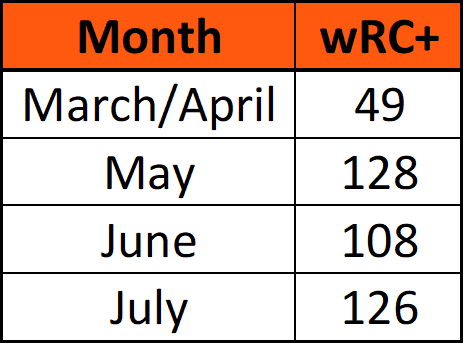
However, the Mets’ faith in Benge has paid off, with him producing as an above-average hitter in every month since while totaling 13 HRs and 18 SBs on the season.
With the Mets looking toward the future, Benge should be a big part of this Mets core going forward. Our dynasty tool grades love his profile as an all-around fantasy contributor, with similar grades to young outfielders Andy Pages and Daylen Lile.

Benge should play better in BA leagues than OBP leagues as his discipline grades out as his biggest weakness and is slightly below league average. However, he should consistently contribute 20+ SBs, with the potential to develop into a yearly 20+ HR hitter if he can tap into his pull-side power more consistently. Before the season, he ranked as our top OF prospect, and in our latest update, he has climbed into the top 25 dynasty outfielders alongside the likes of Michael Harris II, Mike Trout, Chase DeLauter, and Cody Bellinger.
Kazuma Okamoto
Coming over from Japan on a four-year, $60 million deal with the Blue Jays, there were expectations for Okamoto to contribute right out of the gate. While the Blue Jays have largely disappointed since their World Series appearance last year, Okamoto has at least proven he was worth the investment. Slashing .225/.298/.430 with 24 HRs and 70 RBIs, he has been a key run producer for the Blue Jays this season, providing much-needed thump in the lineup.
Okamoto has been able to translate his above-average 73.2 mph bat speed into game power, posting a 12.6% barrel-rate and 90.4 mph average exit velocity. The larger concern is his hit tool, as he has a 31.3% K rate on the season, contributing heavily to his low batting average.
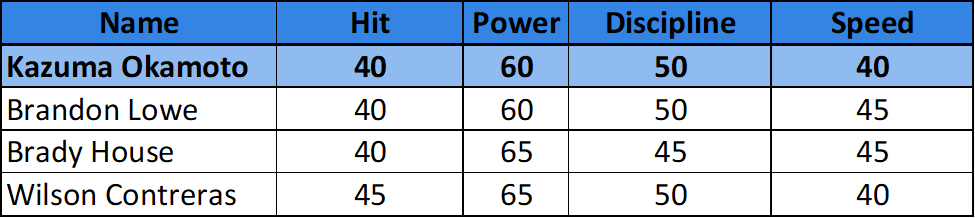
Our dynasty tool grades reflect that profile, comparing him to other slugging infielders Brandon Lowe, Wilson Contreras, and Brady House. There is plus power to his profile, but the rest of the tools remain average at best, limiting Okamoto’s fantasy value tied highly to his HR and RBII production.
With Okamoto already 30 years old, there is likely not much room for growth, with the hitter we are seeing now likely a strong representation of who he will be going forward. I could see some short-term gains in his K rate and batting average over the next year or two as he becomes more accustomed to MLB pitching, though he will likely continue to profile as a low-batting-average slugger capable of 25-30 HRs over the next few seasons. As of our latest 3B dynasty rankings, he is listed as a top 10 dynasty third baseman.
TJ Rumfield
TJ Rumfield is an older rookie at 26 years old and is in the middle of his rookie season with the Rockies after spending time in both the Phillies and Yankees minor league systems. While being an above-average hitter during his time in the upper minors, he never got his opportunity with the Yankees.
In his first taste of MLB action, he is slashing .299/.377/.464 with 13 HRs across 459 PA. While lacking the typical plus power of a first baseman, he has been productive by keeping his K rate under 15% and providing solid run production in the middle of the Rockies lineup.
Looking at his dynasty tool grades, Rumfield grades out with a plus hit tool but lacks another standout tool, with his discipline being his next-best attribute at slightly above league average.

For a long-term outlook, our tool grades see similarities to Brendan Donovan and Ozzie Albies. While Rumfield lacks standout bat speed, exit velocities, or barrel rates, he has been able to get to more of his power by consistently his pulling fly balls at a 21.4% rate. Albies is an interesting example of how this approach can maximize a below average raw power profile, as despite also receiving a 40 Power grade, he has produced two 30+ HR seasons while averaging a 23.2% pull-air rate in his career.
Rumfield should continue to have fantasy value due to a strong floor while batting in the middle of the order at Coors Field, but he lacks the raw tools to project as a fantasy star. He isn’t someone I would be targeting in trades or acquisitions, but he can be a back-end roster option who provides consistent ABs and run production without hurting your batting average.
Pitchers
Payton Tolle
One of my bigger recent fantasy regrets will be choosing Jonah Tong as a keeper over Peyton Tolle in one of my main keeper leagues that I co-manage with Kyle, one of our other DoubleScoop contributors. Funny enough, he has his own personal story of losing Tolle in a different dynasty league that we play in together as well.
Despite the DoubleScoop team’s inability to buy into Tolle early, we are changing course and have come to love what he has become in his first full season with the Red Sox. As of the time of writing, the 23-year-old has posted a 3.20 ERA with 124 Ks in 107 innings, along with a 1.10 WHIP and 21.8% K-BB%, all strong marks for a pitcher let alone one in their first full season.
Drafted out of TCU, Tolle was heralded for his great extension, measured this year at 7.4 feet, along with a plus fastball from the left side that now averages 96.0 mph. Similar to teammate Garrett Crochet, Tolle heavily relies on a three-fastball mix, with his four-seam (47%), sinker (22%), and cutter (20%) accounting for roughly 89% of his total pitch usage. When including his curveball and changeup, which are used more sparingly, all of his pitches grade out as average or better by Stuff+, highlighting the strong arsenal Tolle has at his disposal.

There is really no weak spot in Tolle’s game right now, as he does a good job limiting walks (6.7% BB rate) and hard contact (35.5% Hard-Hit rate), while also posting a solid 28.5% K rate. Our dynasty tool grades have him as one of only four left-handed pitchers with above-average grades in every category, putting him alongside some of the best left-handed starters in baseball.

Tolle still has room to improve his ability to miss bats and potentially reach an elite level given he is still just 23 years old. One example is increasing his curveball usage, which currently has a 48.5% whiff rate but is used only 9% of the time. Increasing its usage could give Tolle another weapon for generating whiffs and potentially push his strikeout rate to 30%.
Overall, Tolle is one of the most exciting young left-handed pitchers currently in MLB. In our latest Starting Pitcher Dynasty Rankings, he ranks as our No. 15 SP, with the upside to continue climbing as he further establishes himself. We expect him to serve as the long-term No. 2 behind Garrett Crochet as part of a strong Red Sox rotation.
Parker Messick
Parker Messick has been the most valuable rookie pitcher in 2026, accumulating 3.5 fWAR. He showed this potential after just missing the rookie cutoff in 2025, posting a 2.72 ERA with 38 Ks across 39.2 innings. Now in 2026, the Guardians would not be within reach of the AL Central lead without Messick’s contributions to the pitching staff.
Messick has found success by limiting walks throughout his MLB career with a 6.2% BB rate, while also limiting hard contact (32.2% hard-hit rate) and HRs (0.87 HR/9). His bread and butter are his four-seam, changeup, and sinker, with the four-seam and changeup serving as his primary combination against RHB. Against LHB, he relies heavily on the four-seam and sinker while increasing his slider usage, though the slider has been hit hard at times.
Interestingly, Messick has shown a reverse platoon split to date, with LHB (.297 wOBA) performing slightly better against him than RHB (.273 wOBA). This could be tied to his fastball/changeup-heavy approach being better suited to attack RHB, even though opposing teams are likely to continue leaning toward RHB-heavy lineups against the left-handed Messick.
Messick has also seen a velocity increase since 2025, with his average fastball velocity jumping from 92.8 mph to 94.2 mph, putting him slightly above average for left-handed pitchers. However, pure stuff isn’t what makes Messick a great pitcher. That’s likely part of why he never pushed toward the top of prospect lists and flew somewhat under the radar in fantasy circles. His biggest strength is his ability to limit quality contact at an elite level.
Looking at our dynasty pitching tool grades, Messick grades out similarly to Ranger Suárez, another left-hander known for limiting barrels and walks while maintaining respectable strikeout rates.

Messick has better velocity than Suárez, and it will be interesting to see how he continues to evolve an arsenal that is currently very reliant on the four-seam, sinker, and changeup. He introduced a new cutter this season, showing an ability and willingness to add new pitches to his repertoire. He could benefit from throwing his changeup more often to LHB, especially with his slider being hit hard by same-handed hitters this season. Developing a sweeper could be another option that improves his ability to generate whiffs against LHB.
Overall, Messick should continue to be a strong fantasy pitcher with top-30 upside in most seasons as long as he is healthy, providing solid ERAs and modest strikeout totals. Ranger Suárez with more velocity remains the best comp, and Messick ranks as our No. 36 SP in our latest 2026 SP Dynasty Rankings.
Bubba Chandler
Even with a similar mustache to LSU Paul Skenes, Bubba Chandler has not quite been able to channel his inner ace. Chandler showed some promise with a 4.02 ERA and 2.66 FIP across 31.1 innings in 2025 but has seen those numbers regress to a 4.26 ERA and 4.16 FIP in 2026.
Chandler has elite fastball velocity, averaging 98.5 mph, and pairs it with a solid low-90s changeup and 90.7 mph gyro slider that make up 85% of his pitch usage. Fangraphs liked his fastball and changeup as a prospect, assigning a 70 future grade to both pitches. Stuff+, on the other hand, likes his four-seam/slider combination, with both grading above average at 104 and 107, respectively. Despite the quality of the pitches, he has yet to fully realize their potential and has struggled to generate whiffs in 2026, posting a below-average 23.5% whiff rate.
This year, he has added a sweeper and sinker that have been used primarily against RHB, though they still represent only 11% of his total pitch usage. He also mixes in a mid-80s curveball 3% of the time. However, the sweeper and curveball lack significant separation from his slider and have yet to be used prominently, suggesting these pitches may still need refinement, The expanded pitch mix has yet to have a significant impact on his arsenal grade year over year.

One potential adjustment could be increasing his slider usage. Jared Jones and Jacob Degrom both have similar four-seams and sliders in terms of velocity and shape, but use their slider more than 35% of the time compared to Chandler at 21%.

Chandler’s strikeout production has yet to match his premium velocity and raw stuff, but I expect him to take a step forward as he continues to develop as an MLB pitcher. While he is not likely to match the 3.2% BB rate he showed in his 2025 debut, the current 12.2% rate is high even him, as he ranged from an 8% to 12% BB rate in the upper minors.
He should continue to fit into the Pirates rotation behind Paul Skenes, Braxton Ashcraft, and Jared Jones, giving him some of the most upside of any No. 4 starter in baseball. He currently ranks as our No. 56 SP in our updated Dynasty SP Rankings, largely due to our continued belief in his upside.
Foster Griffin
Foster Griffin was a nice success story for the Nationals this year after being signed out of the NPB in Japan following three seasons overseas. His breakout allowed the Nats to trade Griffin to the Guardians for a four-player haul, including left-handed pitcher Josh Hartle, who I think is a very underrated pitching prospect.
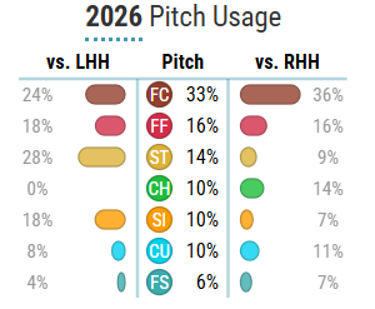
Griffin has found success with a deep seven-pitch mix that he uses to keep hitters off balance, led by his cutter at 33% usage. He also varies his pitch mix considerably based on hitter handedness, most notably leaning more heavily on his sweeper against LHH while increasing his cutter usage against RHH.
While only striking out 22.4% of the hitters he has faced, Griffin does a good job limiting walks with a 5.9% BB rate while generating ground balls at a 45.4% GB rate. His lack of velocity, averaging 91.5 mph on his four-seam, limits his upside, as hitters are still able to make contact in the zone at a respectable 83.8% rate.
Our dynasty tool grades have him profiling similarly to Orioles LHP Trevor Rogers, who also possesses strong command and a solid changeup. Griffin has a deeper collection of breaking balls to turn to, which could give him an advantage in generating additional whiffs and chase.

While Griffin has had plenty of success in 2026 with a 12-4 record and 3.31 ERA, most ERA estimators point toward regression, including his 4.08 xERA, 4.20 FIP, and 3.80 SIERA. At 31 years old, there also isn’t much developmental upside left to project. Griffin was not included in our top 75 Dynasty Starting Pitcher Rankings and is a good sell-high candidate for fantasy managers looking to capitalize on his strong first half.
Follow us on X @2BScoopBaseball and let us know any feedback or questions you have.

Leave a Reply