The 2025 season has been a showcase for electric rookie arms. Jacob Misiorowski, Chase Burns, Nolan McLean, Jonah Tong, Peyton Tolle, and Bubba Chandler have all made their debuts and flashed excellence at times. But beyond the headline prospects, a deeper group of rookie pitchers has quietly carved out meaningful roles.
This month’s Rookie Review shifts focus to some of the arms we haven’t covered yet this season, pitchers who’ve logged enough innings to graduate from prospect status and now deserve a closer look. We’ll dive into their season performance, pitch mix, and dynasty comps to help you assess their long-term value.
If you missed our earlier rookie breakdowns, you can catch up below:
- May Rookie Analysis & Grades
- June Rookie Analysis & Grades
- July Rookie Analysis & Grades
- August Rookie Analysis & Grades
Now let’s dive in!
Cade Horton
Cade Horton entered 2025 as the Cubs top pitching prospect. After a dominant stretch in Triple-A Iowa to open the season (1.24 ERA, 0.86 WHIP, 30.6% K-rate), Horton earned his call-up in late May and has been one of the top performing rookies in the National League since.
Through his first 22 MLB starts, Horton has posted a 2.67 ERA, 1.08 WHIP, and 97 strikeouts across 118 innings. His arsenal is headlined by a cut-ride four-seam fastball averaging 95.7 mph, a sweeper, and a changeup. Below is his full pitch movement profile courtesy of Baseball Savant:
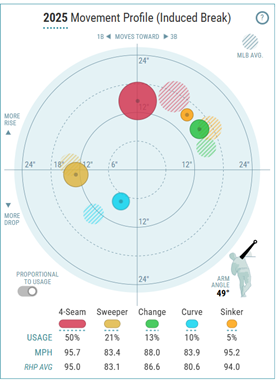
- His sweeper and changeup are his best pitches, generating whiff rates of 36.9% and 47.7%, respectively.
- The changeup’s success is amplified by the difference in horizontal movement with his four-seam.
Since the start of August, Horton has taken his game to another level:
- 1.28 ERA, 0.77 WHIP, .154 AVG against
- K-rate jumped from 17.3% to 25.1%
- BB-rate improved from 7.6% to 5.9%
He’s also begun tweaking his pitch mix, increasing the usage of his sinker. Against righties, he leans on the four-seam, sweeper, and sinker; against lefties, he mixes in the four-seam, changeup, and curveball. There’s room to incorporate the sinker and changeup more against both splits, especially to keep hitters off balance the third time through the order.

Horton has similarities with Kyle Bradish who also features a cut-ride fastball and a strong sinker/slider combo. Bradish leans more heavily on his sinker, and it’ll be interesting to see if Horton follows suit and leans further into his sinker in 2026. Below are some other similar pitchers in terms of arsenal and skill grades:

At age 23, Horton still has a wide range of outcomes for his career, but he is in the middle of his best MLB stretch to date. Heading into 2026, expect him to continue refining his pitch mix. Horton is a solid rookie pitcher with the upside of a No. 2 starter and the floor of a reliable mid-rotation arm.
Jacob Misiorowski
Jacob Misiorowski, nicknamed “The Miz”, took the league by storm in his debut, tossing five no-hit innings in his first start and following it up with six more before surrendering his first hit. Drafted by the Brewers in the second round of the 2022 draft out of Crowder College, Misiorowski has quickly become one of the most electric pitchers in baseball. At 6’7″ with long limbs and elite velocity, he’s one of the most entertaining arms to watch.
Misiorowski features an elite arsenal and draws strong pitch comps. His fastball is nearly identical to Hunter Greene’s, sitting above 99 mph, but it falls into the “expected movement” bucket, meaning it lacks standout ride or run. Without precise location, it can be vulnerable to hard contact and home runs, especially if hitters are sitting on it.

His slider is a true outlier, over two mph harder than any other slider in the league. While it doesn’t generate much movement or velocity separation from the fastball, the velocity alone makes it a plus pitch against righties. His changeup, however, might be the most underrated weapon in his arsenal. Despite his elite velocity, Misiorowski‘s changeup has held hitters to a .050 batting average and a .075 wOBA, while generating a 37.8% whiff rate. Heading into 2026, expect him to lean more heavily on the changeup given its elite results.
When healthy and in the rotation, the Miz has some of the highest upside of any pitcher in MLB. One of the only concerns is his command. He’s posted walk rates between 11–15% in the minors, and while he’s improved to 10.8% in the majors, any regression could lead to rough stretches. Increased baserunners combined with a fastball with poor shape, if not well located, could expose him to damage.

Still, the ceiling is immense. If the command holds and he continues to refine pitch usage, the Miz could emerge as a top-tier fantasy starter with elite strikeout upside.
Cam Schlittler
Cam Schlittler is a 6’6” hard-throwing rookie who was selected in the 7th round of the 2022 draft out of Northeastern University. While his fastball topped out in the mid-90s during college, it now sits at 98 mph in the majors.
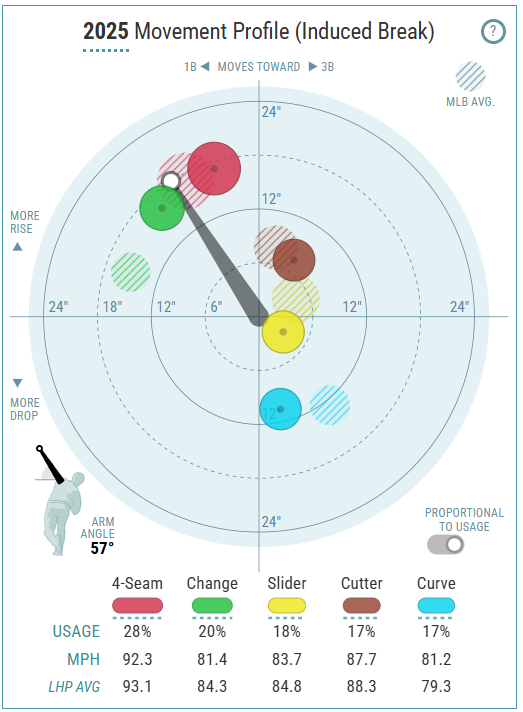
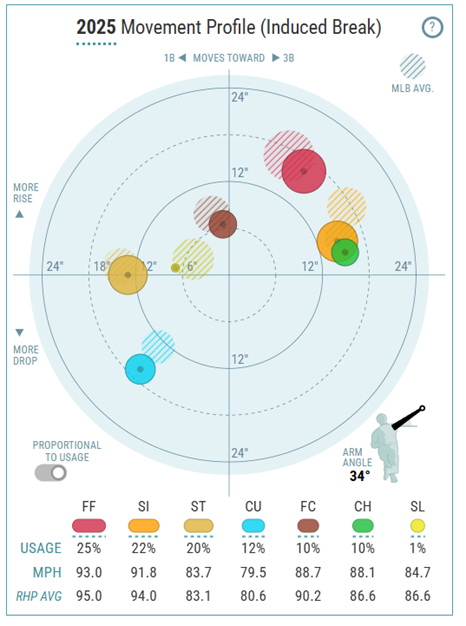
Despite the velocity, Schlittler features a loose, smooth delivery that should aid both strike throwing and long-term durability. In addition to his high-velocity fastball, he primarily mixes in a cutter, curveball, and sinker. His 2025 pitch movement profile from Baseball Savant shown below:
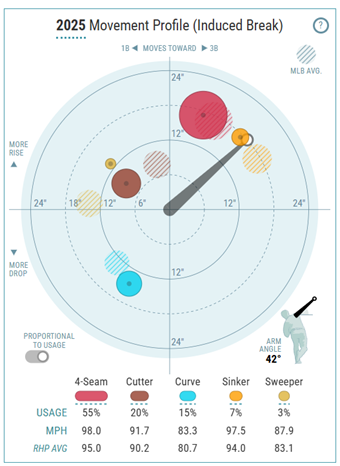
- His cutter operates more like a hard slider, with a velocity gap from the fastball that mirrors traditional slider usage. It also features plus glove-side movement.
- The curveball serves as his primary breaking pitch against lefties, showing solid depth and above-average velocity.
- The sinker is used sparingly but adds a different look down in the zone
To take the next step, Schlittler would benefit from developing a true off-speed pitch, ideally a changeup or splitter. This would help keep hitters off his fastball and breaking ball combo, which can become predictable for major league hitters. A viable bridge pitch would elevate his ceiling and push him toward top-tier starter potential.
Schlittler has stepped up alongside fellow rookie Will Warren, filling in admirably for Gerrit Cole and Clarke Schmidt, who’ve spent much of the season on the IL. With their emergence, the Yankees now boast an abundance of MLB-caliber starters: Max Fried, Carlos Rodón, Gerrit Cole, Luis Gil, Clarke Schmidt, Will Warren, and Cam Schlittler.
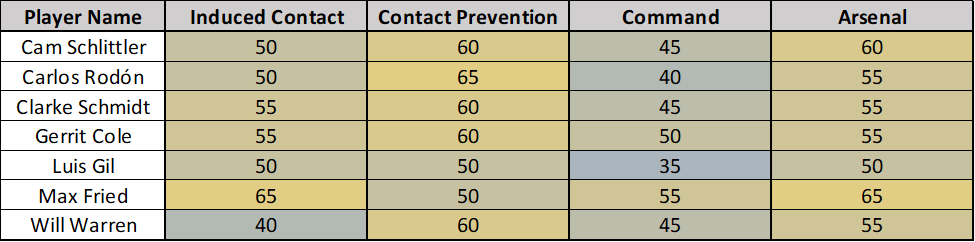
Looking ahead, the Yankees could trade Clarke Schmidt or Luis or consider moving them to the bullpen given their past struggles staying healthy over a full season. He has the floor of a dependable mid-rotation arm and the upside of a No. 2 behind Max Fried if he improves his breaking ball command and/or adds a viable off-speed pitch to round out the arsenal.
Braxton Ashcraft
Braxton Ashcraft has been one of the best comeback stories of 2025. After missing three seasons recovering from multiple surgeries, including Tommy John, a torn meniscus, and a left shoulder procedure, he has made an immediate impact with the Pirates in his rookie season. Over 65.1 innings split between the bullpen and starting rotation, he has posted a 2.62 ERA and 1.19 WHIP.
In his eight starts this year, he has an elite 2.16 ERA and a 1.14 WHIP. He is limiting hitters to a .226 average against while showing modest K (25.9%) and BB (7.4%) rates. One thing to note is he has averaged just over four innings per start, showing the Pirates are going to be cautious with his innings, with good reason.
His arsenal grades out well among rookie starters, highlighted by two high-velocity breaking balls. Both his slider (92.0 mph) and curveball (84.3 mph) sit well above average in velocity, giving him a power profile. He compares similar with other rookie pitcher Cam Schlittller, as well as the other power pitchers below in terms of their arsenals and skill grades.

Ashcraft will face stiff competition for a rotation spot in 2026 with a Pirates rotation that is currently top 5 in starters ERA on the season. Paul Skenes and Mitch Keller are locked in, while Bubba Chandler, Mike Burrows, Johan Oviedo, and Jared Jones will all be competing for spots at some point during the season.
Outside of Paul Skenes and Bubba Chandler, Ashcraft looks like he can be the highest upside pitcher in the Pirates organization. If he wins the job and stays healthy, he profiles as a useful fantasy arm with strikeout potential and strong ratios. The Pirates rotation could quietly continue to be one of the stronger staffs in the MLB and would keep Ashcraft on your draft radar.
Joey Cantillo
Joey Cantillo has been a prospect in the Guardians system since 2021, arriving via trade after being drafted by the Padres out of high school in 2017. He made his pro debut at age 17 and has quietly been climbing the organization ladder, posting 30% K-rates at most stops.
Cantillo began the 2025 season in the bullpen but has been a fixture in the Guardians rotation since July. Over 12 starts, he’s posted a 2.93 ERA, 1.27 WHIP, and 64 strikeouts across 61.1 innings.
He throws from a high arm slot, which helps generate strong vertical break, especially on his off-speed pitches. While he doesn’t have plus velocity, his changeup is a true plus pitch. It’s held hitters to a .168 batting average and generated a 49.1% whiff rate, making it one of the most effective changeups among in the majors.
Cantillo also features a big 12–6 curveball with 18 inches of induced vertical break and roughly five and a half feet of total vertical drop. He bridges his arsenal with an 84.9 mph slider, which he uses more frequently against left-handed hitters.
Here’s how Cantillo stacks up against similar left-handed starters using our dynasty skill tools:

Cantillo owns a borderline elite changeup and average-to-above-average breaking balls. His four-seam fastball remains his weakest pitch, allowing a .358 wOBA against. If he can add velocity it would elevate his ceiling significantly.
Without a premium fastball, Cantillo will rely on sequencing and off-speed command to maintain his strikeout rates. His strong second half gives him momentum heading into 2026, where he’ll compete with Parker Messick, Logan Allen, and Slade Cecconi for a rotation spot. Keep a close eye on his Spring Training velocity, any uptick in velocity would greatly improve his outlook.
Michael McGreevy
Michael McGreevy, known for his polish and command, has carved out a rotation role in St. Louis, posting a 4.08 ERA, 1.20 WHIP, and 53 strikeouts across 86 innings through mid-September. We previously mentioned him in a previous Dynasty Buy-Low post back in June.
While he doesn’t light up radar guns, his fastball averages 93.0 mph, McGreevy thrives on a deep pitch mix and plus command shown below from Baseball Savant:
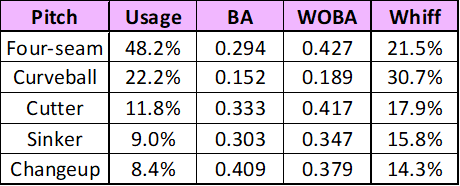
Against right-handed hitters he leans on a sinker/sweeper combo that’s been effective career to date, holding right-handed hitters to a .247 wOBA. However, left-handed hitters have been a challenge early in his career, with a .349 wOBA against.

The only pitch generating a sub-.300 wOBA against left-handed hitters is his cutter, which he throws 18.3% of the time to lefties. Refining his arsenal against opposite-handed hitters will be key to unlocking more consistency.
Using our custom tool grades, McGreevy profiles similarly to Zach Eflin, Miles Mikolas, and Bailey Ober, pitchers who rely on command and sequencing over raw stuff.

McGreevy will likely remain below average in terms of bat-missing ability, but his deep mix and strike-throwing give him value. With Miles Mikolas set to hit free agency, McGreevy is almost guaranteed a rotation spot heading into 2026, where he’ll have a chance to log his first full MLB season.
He fits the mold of a reliable innings eater who can anchor the back of a rotation. While his results may fluctuate based on defense and batted-ball luck, he’s capable of posting sub-4.00 ERA seasons and will be useful in formats where innings and consistent starts matter.
Jacob Lopez
Jacob Lopez has emerged as one of the more surprising rookie arms of 2025. After bouncing between Tampa Bay and Oakland in recent seasons, Lopez finally earned a consistent rotation spot with the A’s and has made the most of it.
Through 92.2 innings, the 27-year-old rookie has posted a 4.08 ERA, 1.27 WHIP, and 113 strikeouts. His 28.3% strikeout rate ranks in the 85th percentile, though his 9.3% walk rate remains below league average.
Lopez throws from a low three-quarters arm slot and relies heavily on his four-seam fastball and slider, while mixing in a cutter and changeup primarily against right-handed hitters. His slider features plus separation from the fastball and is his best pitch by nearly every metric, wOBA, xwOBA, AVG, SLG, whiff%, you name it. His changeup flashes above-average movement but functions more as a chase pitch than a reliably commanded offering.
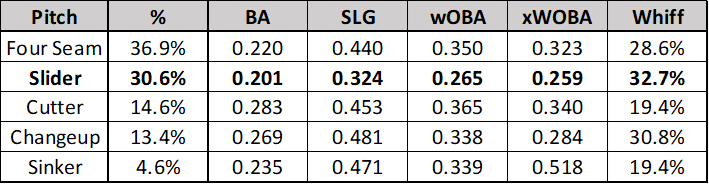
Lopez has enough swing-and-miss to carve out a role in Oakland’s thin rotation. However, his below-average velocity limits his long-term projection. Improving his command will be the clearest path to another step forward. Pitch comps include Andrew Heaney and Sean Manaea, both of whom share similar arm slots and fastball shapes.
Here’s how Lopez stacks up using our dynasty skill tools:

At age 27 and lacking league-average velocity, Jacob Lopez is likely close to maxed out skill-wise. Command improvement will be key to sustaining his success. With a Grade 1 flexor strain and the Athletics out of playoff contention, he’s unlikely to pitch again in 2025. Flexor strains can be precursors to Tommy John surgery, but Lopez should have a full offseason to rehab and prepare for 2026. Be cautious on draft day, Lopez carries real injury risk and could see some strikeout regression. Expectations should be tempered accordingly.
Brad Lord
Brad Lord entered pro ball as a low-end prospect, drafted in the 18th round of the 2022 draft with a 35+ future grade from FanGraphs. He’s beat expectations, posting a 2.43 ERA across Double-A and Triple-A in 2024 and earning an Opening Day roster spot in 2025.
Lord has split 126.2 innings across the bullpen and rotation with a 4.12 ERA, 1.28 WHIP, and 12.0% K-BB. He operates from a low three-quarters arm slot (20 degrees) and generates noticeable arm-side run on both his four-seam fastball and changeup, as shown in his 2025 movement profile via Baseball Savant:
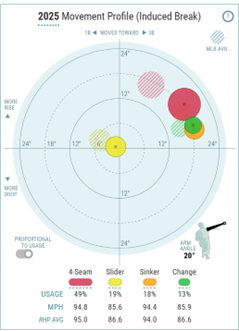
Despite the plus movement on the four seam, Lord’s pitches have been hit hard this year with the xwOBA against of all pitches all above .300. Adding a bigger breaking ball, such as a curveball or sweeper, would help him generate more strikeouts and improve his overall effectiveness.
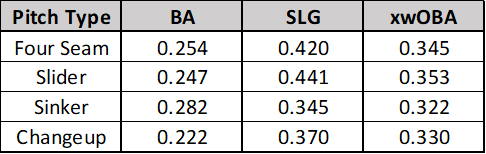
Using our dynasty skill grades, here’s how Lord compares to similar starter profiles:

Lord needs to improve his arsenal to stick as a long-term starter. A sweeper or curveball would be the most impactful addition, and if he’s able to develop a cutter as well, it could round out his pitch mix. Without those improvements, he profiles more as a spot starter or multi-inning bullpen arm.
With a fully healthy Nationals rotation, Lord is likely headed back to the bullpen and will serve as a depth piece moving forward. He can be left off most fantasy rosters headed into 2026 outside mono-leagues.
Follow us on X @2BScoopBaseball and @DoubleScoopBaseball on IG and let us know any feedback or questions you have.