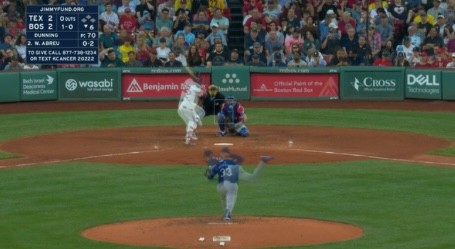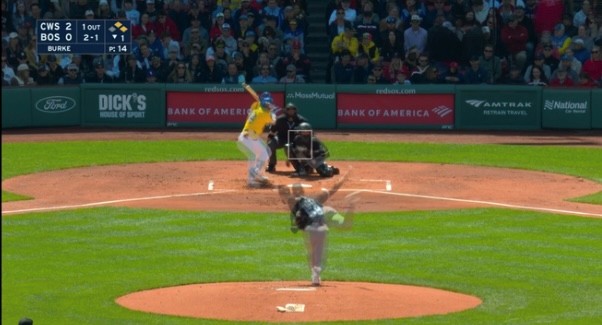
The 2025 rookie class continues to show out, with Shane Smith, Jacob Wilson, and Jacob Misiorowski being named to this year’s All-Star Game. Smith was spotlighted in our May Rookie Review and now will turn the focus to other rising stars.
From the Athletics’ exciting rookies, Jacob Wilson and Nick Kurtz, to emerging names to know like Agustín Ramírez and Noah Cameron, we’re breaking down season-to-date stats, custom tool grades, and long-term outlooks.
Please reference past rookie posts if wanting to learn more about the DoubleScoop tool grades.
Jacob Wilson
We flagged Jacob Wilson as an honorable mention in our April breakout list, noting:
“Elite hit tool comparable to Arraez and Kwan. Think there could be a little more power to develop in Wilson’s bat vs the others but would still cap Wilson at 15 homeruns at his peak.”
Now, just months later, Wilson has skyrocketed from sleeper status to superstar, voted as the starting shortstop for the American League in this year’s All-Star Game. He’s also emerged as the frontrunner for the AL Rookie of the Year, thanks to a slash line of .332/.375/.462 over 87 games, with 9 HR / 44 R / 42 RBI / 5 SB.
Wilson’s calling card is his 80-grade hit tool, rivaling Arraez in bat-to-ball precision. He’s posted an elite 91.2% contact rate and trimmed his strikeout rate down to 7.7%, both top-five metrics among qualified hitters. Beyond his hit tool, the rest of his profile is modest; his power, discipline, and speed grade out as below average which limit his fantasy upside.

Wilson has benefitted from Sacramento’s hitter-friendly dimensions. His HR/FB rate is notably higher at home, and Baseball Savant’s park-adjusted HR total suggests he is slightly overperforming in the long ball category. His average expected HR across all parks sits at 6.6 vs his actual 9.

Wilson should benefit the next few seasons from a good ballpark but long-term temper expectations on the power as it is currently an extreme contact first approach.
At 23 years old, Wilson has room to grow, but his current value hinges on his hit tool. He is unlikely to offer much help in power, speed, or fielding (currently sitting at -2 OAA and a .971 fielding percentage), though improved defense may be in his genes thanks to his father’s glove-first profile. He will continue to have a good home park and bat at the top of the core Athletics’ sluggers for the next few years which can help his run production.
Wilson is a potential sell-high candidate in dynasty formats. The All-Star nod and Rookie of the Year buzz are driving peak interest, making this a prime moment to shop him in your league. Long term, we view him as a borderline top 10 dynasty shortstop, but still lean toward more well-rounded options like Corey Seager, Gunnar Henderson, Francisco Lindor, Zach Neto, Mookie Betts, and CJ Abrams.
Agustín Ramírez
Rookie Agustín Ramírez has been a bright spot for a Marlins team searching for franchise building blocks. Splitting time between catcher and designated hitter, he has launched 14 homers and driven in 40 runs across just 66 games, posting a slash line of .249/.296/.487 with a 113 wRC+.
Ramírez burst onto the scene with a red-hot debut, delivering 3 homers and a 1.043 OPS in his first 8 games. Since then, his production has normalized with a .748 OPS and 103 wRC+, aligning more closely with 2025 expectations.
Ramírez boasts plus raw power thanks to above-average max exit velocity, bat speed, and barrel rates. That kind of pop allows him to earn extra time at DH, which boosts his volume and fantasy relevance.

While his OBP leaves room for improvement, Ramírez makes average contact and pairs it with strong quality of contact. He should not drag you down in batting average formats and projects comfortably in the .250 to .275 range.
He shares similar tools to Junior Caminero and Yandy Díaz. Like Díaz, Ramírez hits the ball hard consistently. The difference lies in batted-ball shape, with Ramirez posting a 46% ground ball rate compared to Díaz’s 50%. That added loft fuels his power upside.

With a foundation of quality contact skills, plus exit velocity, and hard-hit rates, Ramírez ranks as a top 10 dynasty catcher. His dual usage behind the plate and at DH allows for expanded playing time, resulting in strong counting stats. While he doesn’t offer much speed at the moment and the plate discipline is still developing, his offensive skill set is useful with catcher eligibility.
Make sure he is rostered in dynasty and redraft formats. Ramírez has the tools to settle in as a reliable 20-plus homer contributor who will not tank your batting average, while also taking advantage of lineup versatility in Miami.
Nick Kurtz
Nick Kurtz wasted no time announcing his arrival, torching the minor leagues with a .344/.440/.712 line across just 33 games from Single A to Triple A. A standout bat from Wake Forest, Kurtz was always viewed as an advanced hitter, but his quick rise has still been amazing.
Now fresh off being named the AL Rookie of the Month for June, Kurtz owns a 139 wRC+ with 17 home runs through 58 games. Projected over a full season, that power pace translates to a 47-homer campaign.
One of the most impressive aspects of Kurtz’s rookie season is his steady improvement. His OPS has ticked up each month so far, showing a positive development that validates his prospect pedigree and quick promotions. While the upward trend can’t last forever, early signs point to a slugger who is learning on the fly and evolving.
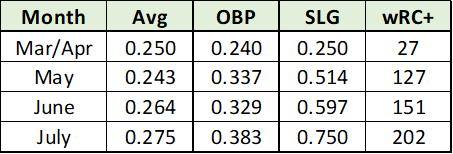
Kurtz checks every power box. With elite bat speed, barrel rate, and hard-hit metrics, he looks ready to join the league’s top tier of home run threats. His bat speed averages almost 78 miles per hour, which places him in rare territory for exit velocity potential.

This is the one concern in his profile. Kurtz carries a contact rate of 69%, well below the league average of 77%, and a strikeout rate north of 30%. Like many sluggers with big power and fringe contact skills, streaks and slumps may follow as pitchers adjust. Fortunately, Kurtz shows strong plate discipline and doesn’t chase, which will keep his on-base value afloat through cold spells

Kurtz profiles as the next-generation version of Matt Olson. Both bring elite slugging and mature approaches, but Kurtz may carry more risk in batting average due to his current contact limitations. That said, his raw power and bat speed could allow Kurtz power grade to play up more.

Kurtz slots in as a top 10 dynasty first baseman, anchored by his role in a young Athletics’ lineup featuring Jacob Wilson, Lawrence Butler, Tyler Soderstrom, Shea Langeliers, and Brent Rooker. Expect strong yearly RBI and homerun totals, even if the batting average fluctuates year to year.
Noah Cameron
Noah Cameron is quietly putting together an impressive rookie campaign, posting a 2.31 ERA and 1.00 WHIP through his first 12 starts. His early-season performance has helped him secure a spot in a surprisingly strong Royals rotation that ranks third in starter ERA at 3.37 for the season.
Cameron is a crafty left-hander with a deep pitch mix. He features a four-seam fastball (29%), changeup (20%), slider (17%), cutter (17%), and curveball (17%). His fastball velocity sits at just 92.3 miles per hour and lacks standout shape, resulting in the lowest four-seam usage rate among lefties with 30 or more innings pitched.
His changeup is his bread and butter, showing a 10+ mph separation from the fastball and delivering elite results with a 38.6 percent whiff rate and a .163 opponent batting average. While his slider and curveball are average in velocity and movement, they are serviceable weapons that each generate whiff rates around 30%.
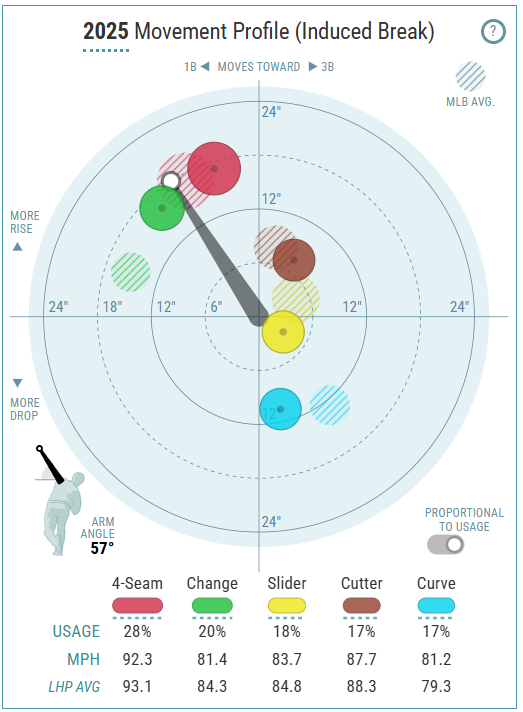
Through his early MLB outings, Cameron has displayed reverse splits, with left-handed hitters having more success against him than righties.

As a changeup-first lefty, his fastball and changeup combo naturally play better against right-handed hitters, which could sustain this reverse split trend. His lack of a good fastball to get hitters out will make commanding his breaking balls and off-speed pitches extremely important. Adding a sinker into his mix could possibly help his left-handed splits.
Cameron is a strong sell-high candidate. His current 2.31 ERA is unlikely to stick, with almost all projection models expecting an ERA north of 4 the rest of season. His .218 BABIP also signals regression is coming. Still, with Ragans and Lorenzon on the IL and an organization that’s biggest internal rotation challengers are Rich Hill and Dallas Keuchel, Cameron is likely safe for now.
In shallow fantasy leagues, ride the hot hand but view him more as a matchup-dependent pitcher vs a set and forget. In deeper formats, consider trading him while his numbers look great, especially as a secondary piece in a two-for-one deal.
Chase Dollander
Entering 2025 as one of baseball’s most promising pitching prospects, Chase Dollander was rated as the number 25 overall prospect by MLB Pipeline. But his rookie campaign has been far from smooth, posting a 6.68 ERA and 1.56 WHIP over 15 starts which led him to be demoted to Triple-A. As a member of the Rockies organization, Dollander faces the unique challenge of mastering his arsenal in the unforgiving environment of Coors Field.
Pitch Arsenal:
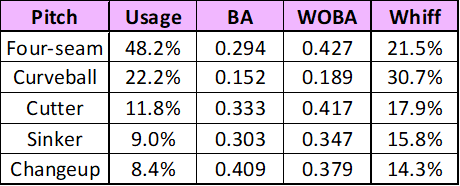
- Four-Seam Fastball: Thrown nearly half the time (48%) and averaging 97.7 miles per hour, this pitch has strong velocity and gets some arm-side run/sink.
- Curveball: Dollander’s most effective weapon. He throws it 22% of the time and generates strong horizontal break which has limited opponents to a .152 batting average with a 30.7 percent whiff rate.
- Cutter: At 89.5 miles per hour, his cutter features an intriguing mix of extra vertical and horizontal break compared to other similar pitches. The pitch acts as a hybrid cutter-slider, though it could be better converting into a true hard slider, similar to Jacob Degrom’s slider.
- Sinker and Changeup: The sinker and changeup are used at 9% and 8% respectively, with the changeup almost exclusively being used against LHB. Neither have generated strong results this season and are in need of some adjustment.
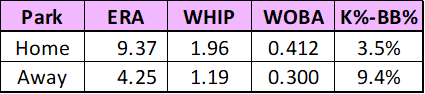
On the road this season, Dollander has been an around average starting pitcher with a 4.25 ERA and a 1.19 WHIP showing signs of a serviceable major league pitcher. At Coors it has been messy this season with over a 9 ERA. Coors can impact pitches, such as breaking balls typically lose movement. The hitter friendly environment and the Coors effect on his breaking ball could be a big reason why Dollander is struggling at home.
It’s hard to understand the Rockies sending Dollander back to AAA given their rebuilding status and his prospect pedigree. He is better off learning how to pitch in Coors and developing with the Rockies coaches. He has the arsenal foundation to be a capable starter but will need to develop stronger command/control of his breaking balls and off-speed and make some pitch mix tweaks.

In all fantasy formats, it is best to keep him on the waiver wire for now. Even if called up again his starts carry risk due to his home/road splits and poor team context. Until he makes some needed adjustments and can better handle Coors, Dollander remains a watch-list arm with more name value than usable fantasy value.
Follow us on X @2BScoopBaseball or @DoubleScoopBaseball on IG and reach out with any comments, feedback or questions!