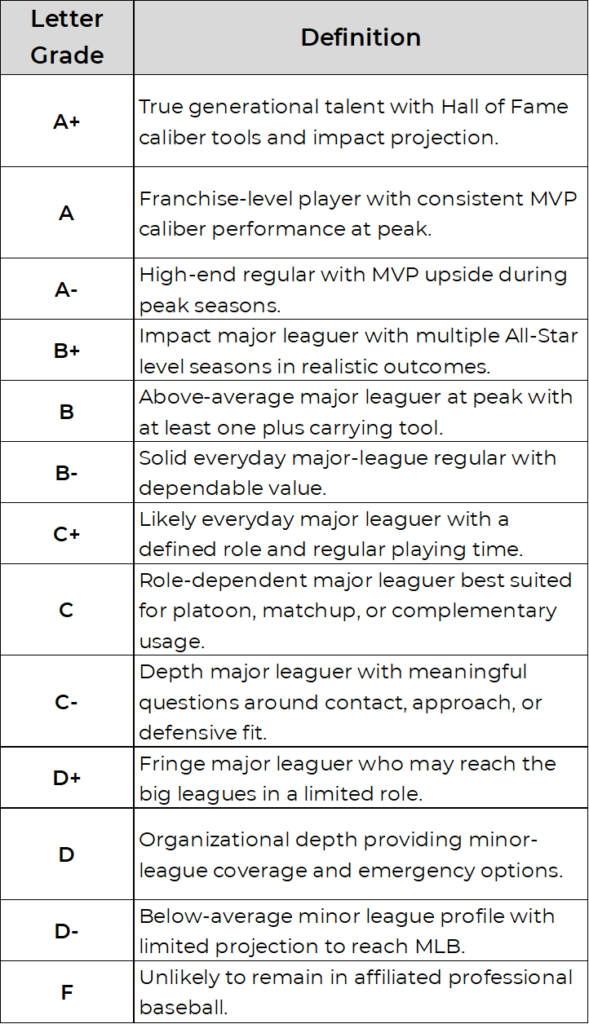
Continuing from the AFL hitters recap, we now move to the AFL pitchers scouting reports.
The Arizona Fall League presented a volatile pitching environment, with inconsistent command, and uncompetitive pitches common across most outings. Rather than repeatedly noting command issues for each arm, the player reports assume below-average command as the baseline unless stated otherwise.
The evaluations are focused more on a pitcher’s process over results, emphasizing pitch quality, usage, and execution. Pitchers who separated themselves did so by throwing strikes, maintaining a clear plan of attack, and mixing in quality secondary pitches.
Below is a revamped player grading key that is focused on pitchers.
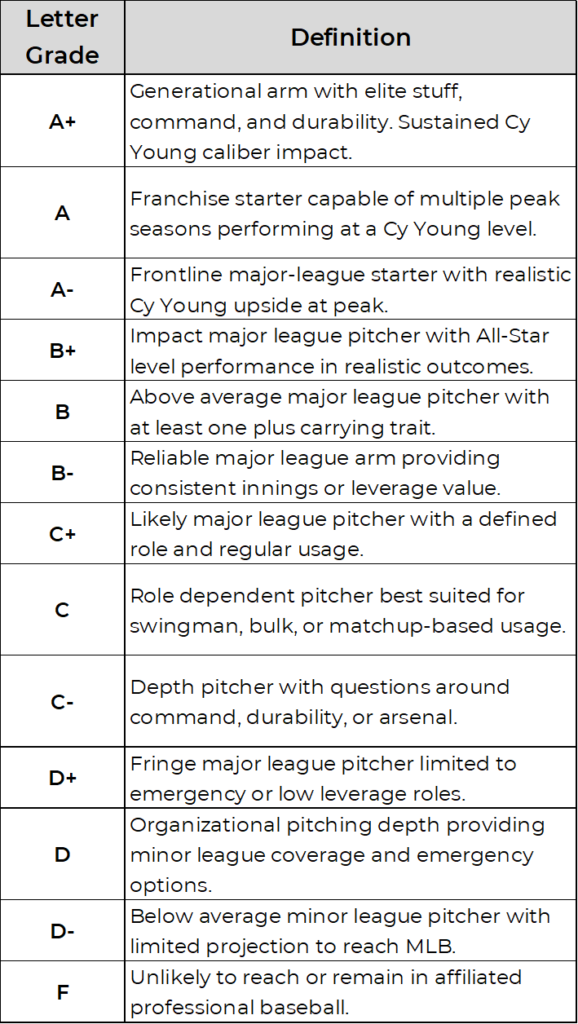
All AFL Statcast data was pulled using Prospect Savant, a valuable resource for MiLB Statcast data.
Arizona Fall League video archives and GameDay data, including pitch velocities and exit velocities, are available on MLB.com.
A Grades (MVP / Cy Young Potential)
No AFL pitchers met the criteria this year.
B Grades (Above-Average MLB Player)
Anderson Brito – Tampa Bay Rays

Brito showed some of the most electric raw stuff in the AFL, led by a plus fastball that touched 100 mph and a sharp low 80s curveball. He also mixed in a mid to high 80s sweeper and flashed a usable changeup, giving him the potential for four average to plus pitches if he can command the changeup more consistently. With that development, he has the ceiling of a No. 1 or No. 2 starter. At minimum, the fastball, sweeper, and curveball are all plus and will play at the big-league level.
AFL Statcast Data
- 100.1 Max Velo
- 39.2% Whiff Rate
- 61.3% Strike Rate
Hagen Smith – Chicago White Sox

Smith started the AFL All-Star Game and stood out with above average velocity from the left side, sitting mid-90s and touching 97 mph, with good vertical break on the fastball. His 83 to 85 mph slider featured more vertical break than horizontal break and consistently generated whiffs and takes. He did not consistently land a changeup for strikes, and further development of that pitch will be beneficial to sustaining long term success.
AFL Statcast Data
- 97.5 Max Velo
- 34.7% Whiff Rate
- 31.9% Chase Rate
Luis De León – Baltimore Orioles

De León showed a strong three pitch mix with a 94 to 97 mph sinker, an 83 to 87 mph slider, and an 86 to 89 mph changeup. While execution wavered at times with non-competitive misses, he showed feel for sequencing, particularly by leaning more on the changeup against right-handed hitters. The combination of stuff and pitch mix gives him a realistic path to a mid-rotation starter role if command continues to improve.
AFL Statcast Data
- 98.5 Max Velo
- 37.9% Whiff Rate
- 25.7% Hard-Hit Rate
Aiden May – Miami Marlins

May impressed across the two AFL starts I watched, working with a mid-90s cutter and sinker while throwing a heavy dose of sliders and sweepers from a three-quarter slot. He stood out for his ability to vary pitch usage and execute his plan, and he was one of the more complete pitchers I saw during the AFL. Health permitting, he projects as a viable major league starter.
AFL Statcast Data
- 98.2 Max Velo
- 27.3% Whiff Rate
- 61.4% Strike Rate
C Grades (MLB Potential)
Karson Milbrandt – Miami Marlins

Milbrandt worked primarily as a two-pitch arm, leaning on a fastball that touched 96 to 98 mph and a firm mid to upper 80s breaking ball that was labeled as a cutter but may play closer to a slider. He used both pitches against right and left-handed hitters. As outings progressed, his fastball quality became less consistent, and he was more vulnerable when pitching without his best velocity, leading to hard contact and home runs. Without further development of his curveball or another secondary, he profiles better as a bullpen arm or swingman rather than a long-term rotation piece.
AFL Statcast Data
- 98.0 Max Velo
- 45.0% Whiff Rate
- 62.5% Hard-Hit Rate
Chen-Wei Lin – St. Louis Cardinals

Lin is a large framed right hander with a long, whippy arm from a lower three-quarter slot. His four-seam/sinker sat mostly 93 to 95 mph, while his changeup at 86 to 87 mph showed good arm side run and tunneled well off the fastball, particularly against left-handed hitters. The slider backed up at times and needs further refinement. He lost some fastball quality deeper into outings, but the fastball, sinker, and changeup mix gives him a chance to stick as a starter if the breaking ball improves.
AFL Statcast Data
- 98.4 Max Velo
- 29.5% Whiff
- 6.9 ft Extension
Tucker Musgrove – San Diego Padres

Musgrove came out of the bullpen during the AFL but opened /started a few games during the 2025 regular season. I saw him for the first time during the AFL All-Star Game and thought he was one of the most impressive arms from a pure stuff standpoint, standing out with a plus fastball and slider combination. With the level of raw stuff, he could be rising on prospect lists in 2026.
AFL Statcast Data
- 99.8 Max Velo
- 27.1% Whiff Rate
- 7.1 ft Extension
Dennis Colleran – Kansas City Royals

Colleran comes from a low arm slot and features a fastball and sinker in the mid to upper 90s, along with a low 90s cutter. His command wavered at times with stretches of bad misses and walks, but overall he limited walks across his AFL appearances. The low slot paired with his high velocity fastball mix gives him a strong chance to carve out a regular role in a major league bullpen.
AFL Statcast Data
- 99.5 Max Velo
- 25.5% Whiff Rate
- 37.9% K Rate
Hudson Leach – Houston Astros

Leach throws from a standard overhand slot and sat mostly 93 to 95 mph with his fastball when I saw him, touching higher during the AFL. His standout pitch was a high spin curveball that consistently generated whiffs and already projects as a plus offering. He also mixed in an 88-mph cutter and showed a clear plan of attack against hitters. Good chance we see Leach in the Astros bullpen soon.
AFL Statcast Data
- 98.0 Max Velo
- 42.9% Whiff Rate
- 18.2% Barrel Rate
Najer Victor – Los Angeles Angels

Victor comes straight over the top and showed power stuff, working primarily with a high 90s four-seam/sinker that he leaned on heavily. He mixed in a high 80s cutter that generated significant swing and miss along with an occasional low 80s slider. The velocity and whiff ability stand out, but he is heavily reliant on the fastball. He could get a chance in an MLB bullpen with potential for high-leverage situations.
AFL Statcast Data
- 99.7 Max Velo
- 72.7% Whiff Rate on Cutter
- 44.8% Whiff Rate
David Hagaman – Arizona Diamondbacks

Hagaman worked primarily with a three-pitch mix featuring a 93 to 95 mph fastball, an 85 to 88 mph slider, and an 82 to 84 mph curveball. The slider generated most of his swing and miss and tunneled well off the fastball. While the fastball plays closer to average, he showed a good feel for his breaking balls and creates good extension. Would like to see him use his changeup more in games as I only remember seeing one thrown. Projects as a back-end starter as he builds up innings.
AFL Statcast Data
- 96.9 Max Velo
- 7.2 ft Extension
- 62.1% GB Rate
JoJo Ingrassia – Boston Red Sox

Ingrassia has a deceptive delivery from a lower three-quarter arm slot on the left side. His sinker sat mostly 90 to 94 mph with arm side run, while his changeup averaged 85.2 mph and his slider averaged 84.7 mph, with both secondaries showing above average movement. He could lose control at times and may have a tough time executing pitches at the top of the zone, but the secondary movement gives him a chance to fill a depth starter or bulk relief role.
AFL Statcast Data
- 94.6 Max Velo
- 48.3% Whiff Rate on Changeup
- 31.3% Whiff Rate
Corey Avant – The Athletics

Avant throws from an overhand slot and showed a solid fastball at 95 to 98 mph paired with an 85 to 87 mph slider. He generated multiple called strikes and showed an ability to vary his approach, favoring the slider against right-handed hitters and leaning more on his curveball and changeup against left-handed hitters. He still needs to improve execution, but the fastball slider gives him a path to a back-end starter role or a bullpen conversion.
AFL Statcast Data
- 98.9 Max Velo
- 17.8% Whiff Rate
- 55.0% Hard-Hit Rate
Jakob Wright – Los Angeles Dodgers

Wright showed an impressive fastball at 94 to 96 mph with life during his time in the AFL. He mixed in a plus 84 to 86 mph slider, an 88 to 89 mph changeup, and a 78 to 79 mph curveball. His command was inconsistent, highlighted by the fact that he walked more hitters than he struck out during the AFL. The raw stuff and four pitch mix give him a chance to reach the majors, but his ability to execute consistently will determine whether he sticks as a starter or moves to a bullpen role.
AFL Statcast Data:
- 96.1 Max Velo
- 27.7% BB Rate
- 72.7% GB Rate
Kannon Kemp – San Diego Padres

Kemp has a large frame and showed power stuff in his brief AFL look, working with a 96 to 98 mph fastball and an 88 to 89 mph breaking ball that was labeled as a cutter. He features a simple delivery with a short arm action and does a good job hiding the ball. There are some questions about the fastball shape and overall pitch depth, and at this stage he looks better suited for a power bullpen role rather than a starting profile.
AFL Statcast Data
- 99.5 Max Velo
- 26.2% Whiff Rate
- 70.0% GB Rate
Sayer Diederich – Baltimore Orioles

Diederich has a smooth overhand delivery from the left side and worked primarily with a 91 to 92 mph sinker that showed good vertical depth. His 79 to 82 mph curveball featured strong horizontal break and consistently missed bats, standing out as his best pitch. He also mixed in a changeup around 87 mph with solid movement. With below average velocity but a true bat missing breaking ball, he profiles best as a bullpen arm capable of generating weak contact.
AFL Statcast Data
- 92.7 Max Velo
- 39.1% Whiff Rate
- 29.4% Hard-Hit Rate
Bryce Cunningham – New York Yankees

Cunningham is a large framed right hander with a smooth overhand delivery. He worked with a 94 to 96 mph fastball, an 83 to 85 mph slider, and an 85 to 87 mph changeup. He was hit hard when pitches leaked back over the plate, particularly when ahead in the count, and will need to refine how he attacks hitters in advantage counts. His size and pedigree suggest there could be more coming as he continues to refine his pitch mix and approach against both sides.
AFL Statcast Data
- 96.1 Max Velo
- 15.1% Whiff Rate
- 6.9 ft Extension
Koen Moreno – Chicago Cubs

Moreno featured a below average fastball at 91 to 93 mph and leaned heavily on his changeup as his primary swing and miss pitch. He mixed the fastball and changeup well by executing fastballs up and changeups down in the zone. He also mixed in a low to mid 80s slider that he used almost exclusively against right-handed hitters for chases. While the velocity is light for a right hander, the fastball shape, plus changeup, and ability to throw strikes give him a path to a depth role.
AFL Statcast Data
- 95.5 Max Velo
- 40.7% Whiff Rate
- 7.0 ft Extension
Jack Mahoney – Colorado Rockies

Mahoney is a short arm right hander with a deep pitch mix. His fastball sat 92 to 96 mph and included both a four-seam and sinker with arm side run. His slider and cutter tended to blend and were used more against right-handed hitters, while his 81 to 82 mph curveball showed more vertical depth than horizontal movement. His best secondary was an 84 to 87 mph changeup that tunneled well off the sinker. He varied usage against right and left-handed hitters but lacks a true standout pitch and will need to lean more on his secondaries to generate additional swing and miss.
AFL Statcast Data
- 97.1 Max Velo
- 24.8% Whiff Rate
- 30.2% Chase Rate
James Hicks – Houston Astros

Hicks worked with a low 90s fastball and mixed in two breaking balls, including a slider and a sweeper with strong horizontal movement. He also featured a changeup that tunneled well off the sinker and consistently attacked the zone during the outings I saw. Without a plus fastball, he will need to continue leaning on his secondaries to keep hitters off balance and carve out a depth role.
AFL Statcast Data
- 94.1 Max Velo
- 31.8% Whiff Rate
- 4.1% BB Rate
Juan Sanchez – San Francisco Giants

Sanchez has a deceptive delivery where he closes off heavily, turning his back to the hitter during leg lift. He worked with a 91 to 94 mph fastball and paired it with an 84 to 85 mph changeup that showed both horizontal and vertical movement. His fastball velocity dipped in his second inning of work as he continues building durability after missing the 2025 season. The deception should be particularly challenging for left-handed hitters and points toward a low leverage bullpen role.
AFL Statcast Data
- 94.7 Max Velo
- 29.9% Whiff Rate
- 5.7 ft Extension
Welinton Hererra – Colorado Rockies

Herrera showed a loose arm and good rhythm from the left side, working with a 95 to 97 mph fastball that he was not afraid to challenge hitters with. He mixed in an 85 to 87 mph changeup and showed the ability to miss bats with the fastball, highlighted by striking out Hendry Mendez on three straight fastballs. While the frame is not large and the secondary mix is still developing, the velocity and confidence attacking the zone point toward a future bullpen role.
AFL Statcast Data
- 97.8 Max Velo
- 25.9% Whiff Rate
- 76.2% GB Rate
Jack Sellinger – Miami Marlins

Sellinger has a unique rhythm in his delivery where he slows down a little on the arm swing, which can create timing issues for hitters. He worked with a fastball that topped out at 94.9 mph and showed below average extension, often missing arm side. His primary secondary was a breaking ball that he leaned on heavily and that generated significant horizontal movement. The combination of delivery disruption and a single bat missing pitch gives him a path to a low leverage bullpen role.
AFL Statcast Data
- 94.9 Max Velo
- 35.6% Whiff Rate
- 19.0% Chase Rate
Yordin Chalas – Arizona Diamondbacks

Chalas has a lanky and projectable frame with good extension from a three-quarter arm slot. He leaned heavily on a 96 to 97 mph fastball with arm side run, throwing it more than 70 percent of the time. His primary secondary was an 83 to 84 mph slider that he used as a chase pitch. While the velocity stands out, he will need to continue improving both the consistency and effectiveness of his secondary offerings to solidify a role.
AFL Statcast Data
- 98.3 Max Velo
- 21.8% Whiff Rate
- 8.6% BB Rate
Johan Moreno – San Diego Padres

Moreno throws from a high overhand slot and worked with a four-seam fastball that averaged around 95 mph and topped out near 97 mph, showing limited horizontal movement. He paired it with an 83 to 85 mph slider that featured good vertical depth and tunneled well off the fastball. He attacked the zone and generally limited hard contact, but concerns about fastball shape and the lack of consistent whiffs on the slider cap the overall profile.
AFL Statcast Data
- 96.8 Max Velo
- 27.7% Whiff Rate
- 38.9% Hard-Hit Rate
D Grades (Organizational Depth)
Jonathan Harmon – Cincinnati Reds

Harmon attacked hitters with a 92 to 94 mph four-seam and sinker mix along with an 82 to 85 mph changeup from an overhand slot. He also showed a curveball in the low to mid 80s but it lacked vertical depth. He demonstrated an understanding of how to work arm side with the sinker and changeup and glove side with the breaking ball, though the overall stuff profile points toward depth rather than impact.
AFL Statcast Data
- 95.8 Max Velo
- 50%+ Whiff Rates on Changeup and Curveball
- 29.4% Chase Rate
MiguelAngel Boadas – Minnesota Twins

Boadas was building back up after missing the 2025 regular season and worked primarily with a 94 to 97 mph sinker that touched 98 mph and showed good horizontal movement. He mixed in an 87 to 88 mph cutter and an 82 to 84 mph slider that he used for swing and misses. He has a baby face, which gives me hope there could be more physical development, and he will need to work on his approach with his secondaries against left-handed hitters.
AFL Statcast Data
- 97.6 Max Velo
- 23.8% Whiff Rate
- 32.1% Hard-Hit Rate
Justin Chambers – Los Angeles Dodgers

Chambers is a deceptive left hander whose pitch tracking at times struggled to classify his arsenal correctly. His primary offering was labeled as a changeup but sat 89 to 91 mph with heavy arm side run, showing up to 20 inches of horizontal break. His fastball showed similar movement traits with comparable arm side run. He also mixed in a sweeping slider around 78 mph. The profile leans heavily on the changeup and deception, limiting his upside to a low leverage bullpen arm.
AFL Statcast Data
- 93.9 Max Velo
- 35.6% Whiff Rate
- 28.6% Hard-Hit Rate
JP Wheat – Chicago Cubs

Wheat stood out for his raw velocity, running his fastball/sinker up to triple digits during the AFL. He has a loose and quick arm that produces premium velocity, but he struggled to throw strikes consistently and did not show reliable feel for his cutter or changeup. The velocity is eye catching, but command and secondary development will determine whether he can carve out a bullpen role.
AFL Statcast Data
- 101.7 Max Velo
- 20.0% Whiff
- 43.2% BB Rate
Brandon Downer – Baltimore Orioles

Downer has a large frame and a short arm action and was used primarily in relief during the AFL after starting during the regular season. He showed a fastball in the 93 to 95 mph range and mixed in a slider and a changeup, with the changeup standing out as his better secondary due to its horizontal and vertical movement. While he varied his pitch-mix against right and left-handed hitters, the overall profile points toward organizational depth.
AFL Statcast Data:
- 95.4 Max Velo
- 18.9% Whiff
- 8.8% BB Rate
Logan Martin – San Francisco Giants

Martin attacked hitters with a 94 to 96 mph fastball and an 86 to 88 mph cutter. He hides the ball well in his delivery and showed confidence attacking early in counts with the fastball. He also mixed in a 75 to 77 mph curveball, but it did not show standout movement, and his slider and changeup were not featured heavily in the outing I saw. Without a carrying secondary pitch, the overall profile points toward organizational depth.
AFL Statcast Data
- 96.9 Max Velo
- 21.6% Whiff Rate
- 10.5% K Rate
Jared Simpson – Washington Nationals

Simpson has a long arm swing that gets deep behind him but does not appear to disrupt his timing. He worked with a 93 to 95 mph fastball and paired it with a hard slider that reached 88 mph, though the slider showed little vertical and horizontal movement. His command varied across appearances, and when it was off he tended to miss up and arm side with both the fastball and changeup. While the fastball gives him something to build on, improvement to his secondaries and overall execution will be necessary to elevate his role.
AFL Statcast Data
- 96.0 Max Velo
- 24.8% Whiff Rate
- 35.6% Chase Rate
Darlin Saladin – St. Louis Cardinals

Saladin has a smaller build and a noticeable hitch in his arm swing, where his arm can get stuck in the back portion of the delivery. He worked with a 92 to 96 mph fastball and leaned on an 84 to 85 mph changeup that showed vertical depth as his primary secondary. His slider and curveball sit in the low 80s and lack distinctive shape. While the pure stuff does not stand out, he showed some feel to execute his pitches within his approach.
AFL Statcast Data
- 96.6 Max Velo
- 31.6% Whiff Rate
- 70% Hard-Hit Rate