Category: Fresh Scoops

Posts to fall under Fresh Scoops web Page

  • 2025 Arizona Fall League Pitchers: Scouting Notes & Prospect Grades

    2025 Arizona Fall League Pitchers: Scouting Notes & Prospect Grades


    Continuing from the AFL hitters recap, we now move to the AFL pitchers scouting reports.

    The Arizona Fall League presented a volatile pitching environment, with inconsistent command, and uncompetitive pitches common across most outings. Rather than repeatedly noting command issues for each arm, the player reports assume below-average command as the baseline unless stated otherwise.

    The evaluations are focused more on a pitcher’s process over results, emphasizing pitch quality, usage, and execution. Pitchers who separated themselves did so by throwing strikes, maintaining a clear plan of attack, and mixing in quality secondary pitches.

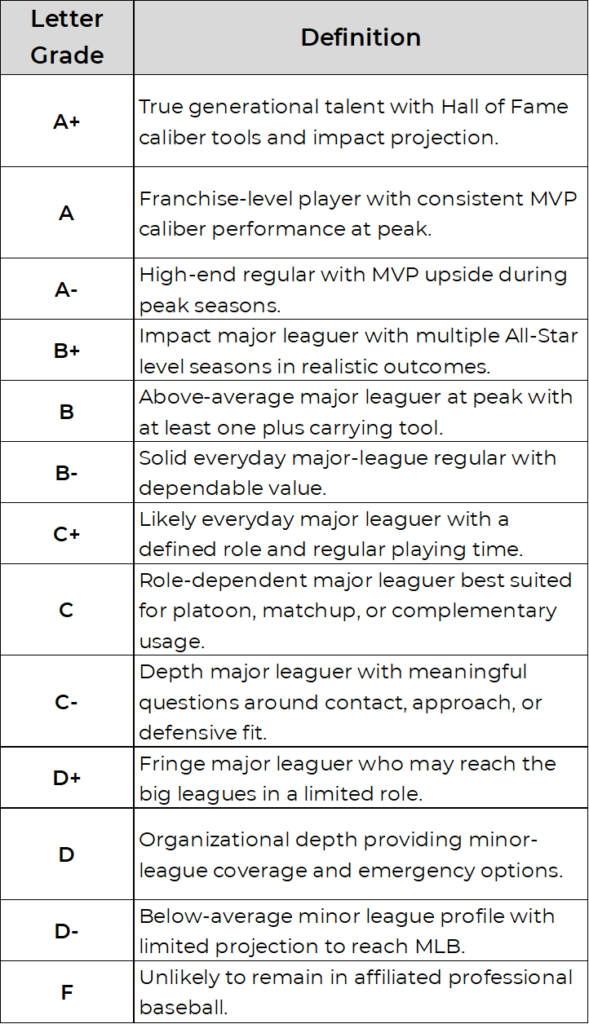
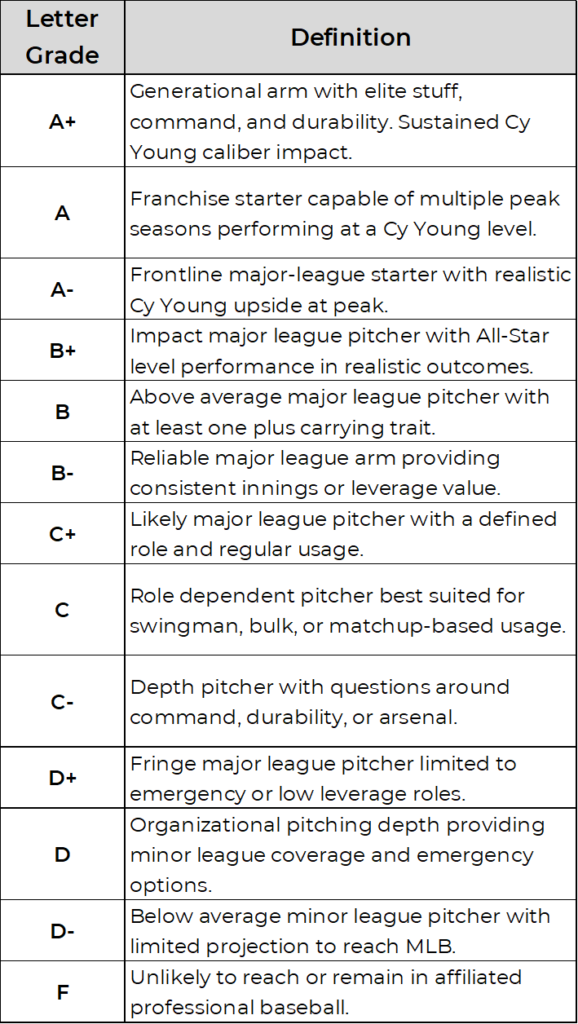
    Below is a revamped player grading key that is focused on pitchers.
    All AFL Statcast data was pulled using Prospect Savant, a valuable resource for MiLB Statcast data.

    Arizona Fall League video archives and GameDay data, including pitch velocities and exit velocities, are available on MLB.com.

    A Grades (MVP / Cy Young Potential)

    No AFL pitchers met the criteria this year.

    B Grades (Above-Average MLB Player)

    Anderson Brito – Tampa Bay Rays

    Brito showed some of the most electric raw stuff in the AFL, led by a plus fastball that touched 100 mph and a sharp low 80s curveball. He also mixed in a mid to high 80s sweeper and flashed a usable changeup, giving him the potential for four average to plus pitches if he can command the changeup more consistently. With that development, he has the ceiling of a No. 1 or No. 2 starter. At minimum, the fastball, sweeper, and curveball are all plus and will play at the big-league level.

    AFL Statcast Data

    • 100.1 Max Velo
    • 39.2% Whiff Rate
    • 61.3% Strike Rate

    Hagen Smith – Chicago White Sox

    Smith started the AFL All-Star Game and stood out with above average velocity from the left side, sitting mid-90s and touching 97 mph, with good vertical break on the fastball. His 83 to 85 mph slider featured more vertical break than horizontal break and consistently generated whiffs and takes. He did not consistently land a changeup for strikes, and further development of that pitch will be beneficial to sustaining long term success.

    AFL Statcast Data

    • 97.5 Max Velo
    • 34.7% Whiff Rate
    • 31.9% Chase Rate

    Luis De León – Baltimore Orioles

    De León showed a strong three pitch mix with a 94 to 97 mph sinker, an 83 to 87 mph slider, and an 86 to 89 mph changeup. While execution wavered at times with non-competitive misses, he showed feel for sequencing, particularly by leaning more on the changeup against right-handed hitters. The combination of stuff and pitch mix gives him a realistic path to a mid-rotation starter role if command continues to improve.

    AFL Statcast Data

    • 98.5 Max Velo
    • 37.9% Whiff Rate
    • 25.7% Hard-Hit Rate

    Aiden May – Miami Marlins

    May impressed across the two AFL starts I watched, working with a mid-90s cutter and sinker while throwing a heavy dose of sliders and sweepers from a three-quarter slot. He stood out for his ability to vary pitch usage and execute his plan, and he was one of the more complete pitchers I saw during the AFL. Health permitting, he projects as a viable major league starter.

    AFL Statcast Data

    • 98.2 Max Velo
    • 27.3% Whiff Rate
    • 61.4% Strike Rate

    C Grades (MLB Potential)

    Karson Milbrandt – Miami Marlins

    Milbrandt worked primarily as a two-pitch arm, leaning on a fastball that touched 96 to 98 mph and a firm mid to upper 80s breaking ball that was labeled as a cutter but may play closer to a slider. He used both pitches against right and left-handed hitters. As outings progressed, his fastball quality became less consistent, and he was more vulnerable when pitching without his best velocity, leading to hard contact and home runs. Without further development of his curveball or another secondary, he profiles better as a bullpen arm or swingman rather than a long-term rotation piece.

    AFL Statcast Data

    • 98.0 Max Velo
    • 45.0% Whiff Rate
    • 62.5% Hard-Hit Rate

    Chen-Wei Lin – St. Louis Cardinals

    Lin is a large framed right hander with a long, whippy arm from a lower three-quarter slot. His four-seam/sinker sat mostly 93 to 95 mph, while his changeup at 86 to 87 mph showed good arm side run and tunneled well off the fastball, particularly against left-handed hitters. The slider backed up at times and needs further refinement. He lost some fastball quality deeper into outings, but the fastball, sinker, and changeup mix gives him a chance to stick as a starter if the breaking ball improves.

    AFL Statcast Data

    • 98.4 Max Velo
    • 29.5% Whiff
    • 6.9 ft Extension

    Tucker Musgrove – San Diego Padres

    Musgrove came out of the bullpen during the AFL but opened /started a few games during the 2025 regular season. I saw him for the first time during the AFL All-Star Game and thought he was one of the most impressive arms from a pure stuff standpoint, standing out with a plus fastball and slider combination. With the level of raw stuff, he could be rising on prospect lists in 2026.

    AFL Statcast Data

    • 99.8 Max Velo
    • 27.1% Whiff Rate
    • 7.1 ft Extension

    Dennis Colleran – Kansas City Royals

    Colleran comes from a low arm slot and features a fastball and sinker in the mid to upper 90s, along with a low 90s cutter. His command wavered at times with stretches of bad misses and walks, but overall he limited walks across his AFL appearances. The low slot paired with his high velocity fastball mix gives him a strong chance to carve out a regular role in a major league bullpen.

    AFL Statcast Data

    • 99.5 Max Velo
    • 25.5% Whiff Rate
    • 37.9% K Rate

    Hudson Leach – Houston Astros

    Leach throws from a standard overhand slot and sat mostly 93 to 95 mph with his fastball when I saw him, touching higher during the AFL. His standout pitch was a high spin curveball that consistently generated whiffs and already projects as a plus offering. He also mixed in an 88-mph cutter and showed a clear plan of attack against hitters. Good chance we see Leach in the Astros bullpen soon.

    AFL Statcast Data

    • 98.0 Max Velo
    • 42.9% Whiff Rate
    • 18.2% Barrel Rate

    Najer Victor – Los Angeles Angels

    Victor comes straight over the top and showed power stuff, working primarily with a high 90s four-seam/sinker that he leaned on heavily. He mixed in a high 80s cutter that generated significant swing and miss along with an occasional low 80s slider. The velocity and whiff ability stand out, but he is heavily reliant on the fastball. He could get a chance in an MLB bullpen with potential for high-leverage situations.

    AFL Statcast Data

    • 99.7 Max Velo
    • 72.7% Whiff Rate on Cutter
    • 44.8% Whiff Rate

    David Hagaman – Arizona Diamondbacks

    Hagaman worked primarily with a three-pitch mix featuring a 93 to 95 mph fastball, an 85 to 88 mph slider, and an 82 to 84 mph curveball. The slider generated most of his swing and miss and tunneled well off the fastball. While the fastball plays closer to average, he showed a good feel for his breaking balls and creates good extension. Would like to see him use his changeup more in games as I only remember seeing one thrown. Projects as a back-end starter as he builds up innings.

    AFL Statcast Data

    • 96.9 Max Velo
    • 7.2 ft Extension
    • 62.1% GB Rate

    JoJo Ingrassia – Boston Red Sox

    Ingrassia has a deceptive delivery from a lower three-quarter arm slot on the left side. His sinker sat mostly 90 to 94 mph with arm side run, while his changeup averaged 85.2 mph and his slider averaged 84.7 mph, with both secondaries showing above average movement. He could lose control at times and may have a tough time executing pitches at the top of the zone, but the secondary movement gives him a chance to fill a depth starter or bulk relief role.

    AFL Statcast Data

    • 94.6 Max Velo
    • 48.3% Whiff Rate on Changeup
    • 31.3% Whiff Rate

    Corey Avant – The Athletics

    Avant throws from an overhand slot and showed a solid fastball at 95 to 98 mph paired with an 85 to 87 mph slider. He generated multiple called strikes and showed an ability to vary his approach, favoring the slider against right-handed hitters and leaning more on his curveball and changeup against left-handed hitters. He still needs to improve execution, but the fastball slider gives him a path to a back-end starter role or a bullpen conversion.

    AFL Statcast Data

    • 98.9 Max Velo
    • 17.8% Whiff Rate
    • 55.0% Hard-Hit Rate

    Jakob Wright – Los Angeles Dodgers

    Wright showed an impressive fastball at 94 to 96 mph with life during his time in the AFL. He mixed in a plus 84 to 86 mph slider, an 88 to 89 mph changeup, and a 78 to 79 mph curveball. His command was inconsistent, highlighted by the fact that he walked more hitters than he struck out during the AFL. The raw stuff and four pitch mix give him a chance to reach the majors, but his ability to execute consistently will determine whether he sticks as a starter or moves to a bullpen role.

    AFL Statcast Data:

    • 96.1 Max Velo
    • 27.7% BB Rate
    • 72.7% GB Rate

    Kannon Kemp – San Diego Padres

    Kemp has a large frame and showed power stuff in his brief AFL look, working with a 96 to 98 mph fastball and an 88 to 89 mph breaking ball that was labeled as a cutter. He features a simple delivery with a short arm action and does a good job hiding the ball. There are some questions about the fastball shape and overall pitch depth, and at this stage he looks better suited for a power bullpen role rather than a starting profile.

    AFL Statcast Data

    • 99.5 Max Velo
    • 26.2% Whiff Rate
    • 70.0% GB Rate

    Sayer Diederich – Baltimore Orioles

    Diederich has a smooth overhand delivery from the left side and worked primarily with a 91 to 92 mph sinker that showed good vertical depth. His 79 to 82 mph curveball featured strong horizontal break and consistently missed bats, standing out as his best pitch. He also mixed in a changeup around 87 mph with solid movement. With below average velocity but a true bat missing breaking ball, he profiles best as a bullpen arm capable of generating weak contact.

    AFL Statcast Data

    • 92.7 Max Velo
    • 39.1% Whiff Rate
    • 29.4% Hard-Hit Rate

    Bryce Cunningham – New York Yankees

    Cunningham is a large framed right hander with a smooth overhand delivery. He worked with a 94 to 96 mph fastball, an 83 to 85 mph slider, and an 85 to 87 mph changeup. He was hit hard when pitches leaked back over the plate, particularly when ahead in the count, and will need to refine how he attacks hitters in advantage counts. His size and pedigree suggest there could be more coming as he continues to refine his pitch mix and approach against both sides.

    AFL Statcast Data

    • 96.1 Max Velo
    • 15.1% Whiff Rate
    • 6.9 ft Extension

    Koen Moreno – Chicago Cubs

    Moreno featured a below average fastball at 91 to 93 mph and leaned heavily on his changeup as his primary swing and miss pitch. He mixed the fastball and changeup well by executing fastballs up and changeups down in the zone. He also mixed in a low to mid 80s slider that he used almost exclusively against right-handed hitters for chases. While the velocity is light for a right hander, the fastball shape, plus changeup, and ability to throw strikes give him a path to a depth role.

    AFL Statcast Data

    • 95.5 Max Velo
    • 40.7% Whiff Rate
    • 7.0 ft Extension

    Jack Mahoney – Colorado Rockies

    Mahoney is a short arm right hander with a deep pitch mix. His fastball sat 92 to 96 mph and included both a four-seam and sinker with arm side run. His slider and cutter tended to blend and were used more against right-handed hitters, while his 81 to 82 mph curveball showed more vertical depth than horizontal movement. His best secondary was an 84 to 87 mph changeup that tunneled well off the sinker. He varied usage against right and left-handed hitters but lacks a true standout pitch and will need to lean more on his secondaries to generate additional swing and miss.

    AFL Statcast Data

    • 97.1 Max Velo
    • 24.8% Whiff Rate
    • 30.2% Chase Rate

    James Hicks – Houston Astros

    Hicks worked with a low 90s fastball and mixed in two breaking balls, including a slider and a sweeper with strong horizontal movement. He also featured a changeup that tunneled well off the sinker and consistently attacked the zone during the outings I saw. Without a plus fastball, he will need to continue leaning on his secondaries to keep hitters off balance and carve out a depth role.

    AFL Statcast Data

    • 94.1 Max Velo
    • 31.8% Whiff Rate
    • 4.1% BB Rate

    Juan Sanchez – San Francisco Giants

    Sanchez has a deceptive delivery where he closes off heavily, turning his back to the hitter during leg lift. He worked with a 91 to 94 mph fastball and paired it with an 84 to 85 mph changeup that showed both horizontal and vertical movement. His fastball velocity dipped in his second inning of work as he continues building durability after missing the 2025 season. The deception should be particularly challenging for left-handed hitters and points toward a low leverage bullpen role.

    AFL Statcast Data

    • 94.7 Max Velo
    • 29.9% Whiff Rate
    • 5.7 ft Extension

    Welinton Hererra – Colorado Rockies

    Herrera showed a loose arm and good rhythm from the left side, working with a 95 to 97 mph fastball that he was not afraid to challenge hitters with. He mixed in an 85 to 87 mph changeup and showed the ability to miss bats with the fastball, highlighted by striking out Hendry Mendez on three straight fastballs. While the frame is not large and the secondary mix is still developing, the velocity and confidence attacking the zone point toward a future bullpen role.

    AFL Statcast Data

    • 97.8 Max Velo
    • 25.9% Whiff Rate
    • 76.2% GB Rate

    Jack Sellinger – Miami Marlins

    Sellinger has a unique rhythm in his delivery where he slows down a little on the arm swing, which can create timing issues for hitters. He worked with a fastball that topped out at 94.9 mph and showed below average extension, often missing arm side. His primary secondary was a breaking ball that he leaned on heavily and that generated significant horizontal movement. The combination of delivery disruption and a single bat missing pitch gives him a path to a low leverage bullpen role.

    AFL Statcast Data

    • 94.9 Max Velo
    • 35.6% Whiff Rate
    • 19.0% Chase Rate

    Yordin Chalas – Arizona Diamondbacks

    Chalas has a lanky and projectable frame with good extension from a three-quarter arm slot. He leaned heavily on a 96 to 97 mph fastball with arm side run, throwing it more than 70 percent of the time. His primary secondary was an 83 to 84 mph slider that he used as a chase pitch. While the velocity stands out, he will need to continue improving both the consistency and effectiveness of his secondary offerings to solidify a role.

    AFL Statcast Data

    • 98.3 Max Velo
    • 21.8% Whiff Rate
    • 8.6% BB Rate

    Johan Moreno – San Diego Padres

    Moreno throws from a high overhand slot and worked with a four-seam fastball that averaged around 95 mph and topped out near 97 mph, showing limited horizontal movement. He paired it with an 83 to 85 mph slider that featured good vertical depth and tunneled well off the fastball. He attacked the zone and generally limited hard contact, but concerns about fastball shape and the lack of consistent whiffs on the slider cap the overall profile.

    AFL Statcast Data

    • 96.8 Max Velo
    • 27.7% Whiff Rate
    • 38.9% Hard-Hit Rate

    D Grades (Organizational Depth)

    Jonathan Harmon – Cincinnati Reds

    Harmon attacked hitters with a 92 to 94 mph four-seam and sinker mix along with an 82 to 85 mph changeup from an overhand slot. He also showed a curveball in the low to mid 80s but it lacked vertical depth. He demonstrated an understanding of how to work arm side with the sinker and changeup and glove side with the breaking ball, though the overall stuff profile points toward depth rather than impact.

    AFL Statcast Data

    • 95.8 Max Velo
    • 50%+ Whiff Rates on Changeup and Curveball
    • 29.4% Chase Rate

    MiguelAngel Boadas – Minnesota Twins

    Boadas was building back up after missing the 2025 regular season and worked primarily with a 94 to 97 mph sinker that touched 98 mph and showed good horizontal movement. He mixed in an 87 to 88 mph cutter and an 82 to 84 mph slider that he used for swing and misses. He has a baby face, which gives me hope there could be more physical development, and he will need to work on his approach with his secondaries against left-handed hitters.

    AFL Statcast Data

    • 97.6 Max Velo
    • 23.8% Whiff Rate
    • 32.1% Hard-Hit Rate

    Justin Chambers – Los Angeles Dodgers

    Chambers is a deceptive left hander whose pitch tracking at times struggled to classify his arsenal correctly. His primary offering was labeled as a changeup but sat 89 to 91 mph with heavy arm side run, showing up to 20 inches of horizontal break. His fastball showed similar movement traits with comparable arm side run. He also mixed in a sweeping slider around 78 mph. The profile leans heavily on the changeup and deception, limiting his upside to a low leverage bullpen arm.

    AFL Statcast Data

    • 93.9 Max Velo
    • 35.6% Whiff Rate
    • 28.6% Hard-Hit Rate

    JP Wheat – Chicago Cubs

    Wheat stood out for his raw velocity, running his fastball/sinker up to triple digits during the AFL. He has a loose and quick arm that produces premium velocity, but he struggled to throw strikes consistently and did not show reliable feel for his cutter or changeup. The velocity is eye catching, but command and secondary development will determine whether he can carve out a bullpen role.

    AFL Statcast Data

    • 101.7 Max Velo
    • 20.0% Whiff
    • 43.2% BB Rate

    Brandon Downer – Baltimore Orioles

    Downer has a large frame and a short arm action and was used primarily in relief during the AFL after starting during the regular season. He showed a fastball in the 93 to 95 mph range and mixed in a slider and a changeup, with the changeup standing out as his better secondary due to its horizontal and vertical movement. While he varied his pitch-mix against right and left-handed hitters, the overall profile points toward organizational depth.

    AFL Statcast Data:

    • 95.4 Max Velo
    • 18.9% Whiff
    • 8.8% BB Rate

    Logan Martin – San Francisco Giants

    Martin attacked hitters with a 94 to 96 mph fastball and an 86 to 88 mph cutter. He hides the ball well in his delivery and showed confidence attacking early in counts with the fastball. He also mixed in a 75 to 77 mph curveball, but it did not show standout movement, and his slider and changeup were not featured heavily in the outing I saw. Without a carrying secondary pitch, the overall profile points toward organizational depth.

    AFL Statcast Data

    • 96.9 Max Velo
    • 21.6% Whiff Rate
    • 10.5% K Rate

    Jared Simpson – Washington Nationals

    Simpson has a long arm swing that gets deep behind him but does not appear to disrupt his timing. He worked with a 93 to 95 mph fastball and paired it with a hard slider that reached 88 mph, though the slider showed little vertical and horizontal movement. His command varied across appearances, and when it was off he tended to miss up and arm side with both the fastball and changeup. While the fastball gives him something to build on, improvement to his secondaries and overall execution will be necessary to elevate his role.

    AFL Statcast Data

    • 96.0 Max Velo
    • 24.8% Whiff Rate
    • 35.6% Chase Rate

    Darlin Saladin – St. Louis Cardinals

    Saladin has a smaller build and a noticeable hitch in his arm swing, where his arm can get stuck in the back portion of the delivery. He worked with a 92 to 96 mph fastball and leaned on an 84 to 85 mph changeup that showed vertical depth as his primary secondary. His slider and curveball sit in the low 80s and lack distinctive shape. While the pure stuff does not stand out, he showed some feel to execute his pitches within his approach.

    AFL Statcast Data

    • 96.6 Max Velo
    • 31.6% Whiff Rate
    • 70% Hard-Hit Rate

  • 2025 Arizona Fall League Hitters: Scouting Notes & Prospect Grades

    2025 Arizona Fall League Hitters: Scouting Notes & Prospect Grades


    After spending time at First Pitch Arizona in November, including the Arizona Fall League All-Star Game and Home Run Derby, I continued to follow the league throughout the playoffs. Once the postseason concluded, I went back and re-watched multiple earlier AFL games to get a better feel for the hitters across the league.

    Going forward, I plan to continue reviewing the Arizona Fall League annually and publishing scouting reports on the top names and standout performers.

    To keep evaluations consistent and easy to interpret, I used the grading key below to assign player grades.

    All AFL Statcast data was pulled using Prospect Savant, a valuable resource for MiLB Statcast data.

    Arizona Fall League video archives and GameDay data, including pitch velocities and exit velocities, are available on MLB.com.

    With that context in place, let’s dive into the 2025 Arizona Fall League hitter recap.

    A Grades (MVP / Cy Young Potential)

    None this year. While Kevin McGonigle was a close call, he did not quite make the cut.

    B Grades (Above-Average MLB Player)

    Kevin McGonigle – Detroit Tigers

    The top prospect in the AFL, McGonigle consistently put together quality at-bats, making good swing decisions and drawing plenty of walks. One of the more impressive moments during my time in Arizona was a foul ball he hit out of Mesa Stadium during the All-Star Game that reportedly registered at 118 mph. In another game, he just missed a home run to deep center field against Najer Victor, who featured one of the better fastballs in the AFL. He runs well, profiles as a multi-position defender, and lived up to the top-prospect hype, though there could be an adjustment period against top-end breaking stuff.

    AFL Statcast Data

    • 15.8% Barrel Rate
    • 13.2% K-Rate
    • 20.3% BB-Rate

    Esmerlyn Valdez – Pittsburg Pirates

    Valdez was the standout performer behind only Tony Blanco Jr. at the derby. Larger than his listed 181 pounds, Valdez sets up deep into his back leg with a low hand setup. In one at-bat on a 1-1 hanging slider, he punished a pitch for a 114 mph home run against Pablo Aldonis. After that at-bat, he walked three straight times and often saw pitchers avoid the zone, highlighted by a 23.2% walk rate. He has shown improved contact rates which may help him be an above average bat in the corner OF.

    AFL Statcast Data

    • 73.3 Bat Speed
    • 114.4 Max EV
    • 92.3% Z-Contact Rate

    Seaver King – Washington Nationals

    An athlete who runs well, King showed great balance in his swing with minimal head movement. I liked his approach in most at-bats, as he consistently drove the ball the other way. This included an inside-out home run hit at 103 mph against Najer Victor and a 109 mph double against JoJo Ingrassia. He also showed a two-strike approach by removing his leg lift. A good profile to bet on.

    AFL Statcast Data

    • 72.0 Bat Speed
    • 62.5% Hard-Hit Rate
    • 89.8% Z-Contact Rate

    Alfredo Duno – Cincinnati Reds

    Duno is physically mature for his age and appears larger than his listed frame. He was aggressive in the zone and may have overswung at times, leading to some off-balance swings. Overall, I was impressed with his at-bats for such a young player and enjoyed the energy he brought. He just missed a home run on a hanging curveball and showed solid defensive actions behind the plate.

    AFL Statcast Data

    • 74.0 Bat Speed
    • 18.3% BB-Rate
    • 20.8% Chase Rate

    Charlie Condon – Colorado Rockies

    Condon has a slightly crouched stance that takes away some of his height at the plate. His swing currently produces more line-drive contact than over-the-fence power. He makes consistent hard contact, but the home run power he showed in college at Georgia has yet to fully translate. He should get plenty of runway in Colorado, though expectations may need to be tempered from draft-day projections.

    AFL Statcast Data

    • 71.4 Bat Speed
    • 50.8% Hard-Hit Rate
    • 76.5% Z-Swing Rate

    Cam Collier – Cincinnati Reds

    Collier has been a hyped prospect since being taken in the first round out of junior college after taking the Bryce Harper route out of high school. He shows multiple positive tools, including good defense, a strong arm, plus power, and a patient approach. He recorded the third-highest exit velocity of the AFL season at 115.3 mph and doubled on a 109 mph 1-1 slider. The biggest critiques are that his contact currently plays more to ground balls than game power, and he can get overly patient in early counts.

    AFL Statcast Data

    • 74.5 Bat Speed
    • 63.1% Z-Swing Rate
    • 6.6° Avg. LA

    C Grades (MLB Potential)

    Braden Montgomery – Chicago White Sox

    One of the top hitting prospects at the AFL, Montgomery showed a patient approach and limited chase. This approach gives him a strong offensive foundation, though I did note multiple whiffs on pitches on the outer half of the plate. How the bat plays against higher-quality pitching will ultimately determine his ceiling. Overall, Montgomery’s best trait seems to be his willingness to take his walks. Have him as a player I need to watch more in 2026 to get a better feel for his bat.

    AFL Statcast Data

    • 71.1 Bat Speed
    • 13.0% Chase Rate
    • 17.9% Barrel Rate

    Sam Antonacci – Chicago White Sox

    Antonacci has an incredibly balanced swing with an open stance and loose hands. He consistently put the ball in play early in counts and showed a strong feel for using the whole field. The offensive profile carries a high floor, but the ceiling is capped by limited power output unless the approach changes.

    AFL Statcast Data

    • 69.8 Bat Speed
    • 92.7% Z-Contact Rate
    • 11.5% Whiff Rate

    Luke Adams – Milwaukee Brewers

    Adams was a fun player to watch. Despite his size and unique stance, he stayed short to the ball and consistently put together good at-bats. One standout moment was an 0-2 count he worked into a 10-pitch plate appearance, ending with a two-run home run in the ninth. He also showed good instincts as a baserunner.

     AFL Statcast Data

    • 73.3 Bat Speed
    • 13% Whiff Rate
    • 19.5% Chase Rate

    Blake Mitchell – Kansas City Royals

    Mitchell impressed as an overall hitter. He did not look overmatched against a left-handed matchup against Hagen Smith and showed more gap-to-gap power than home run power, though his 116.5 Max EV suggests more could come. He has enough juice in the bat to move off catcher if needed.

    AFL Statcast Data

    • 73.0 Bat Speed
    • 116.5 Max EV
    • 35.7% Whiff Rate

    Tony Blanco Jr – Pittsburg Pirates

    A monster among men physically, Blanco stole the show at the AFL Home Run Derby with a record 122.9 mph home run. The power is real, but so is the swing-and-miss. He profiles as a true three-outcome bat and likely fits best as a DH at the next level.

    AFL Statcast Data

    • 75.4 Bat Speed
    • 120.4 Max EV
    • 41.3% Whiff Rate

    Thomas Sosa – Baltimore Orioles

    Sosa, larger than his 160 listing on FanGraphs, has natural tilt in his swing and drove low pitches well. He homered at 107.5 mph and just missed another on a changeup, but better velocity and fastballs up in the zone may challenge the swing as he moves up. Already has a plus arm and bat speed.

    AFL Statcast Data

    • 77.3 Bat Speed
    • 18.0° Avg. LA
    • 36% Whiff Rate

    Jonny Farmelo – Seattle Mariners

    Farmelo is a unique athlete with a strong, well-built frame. He generally does not chase much, though I did see him expand the zone on a 2-1 slider from Milbrandt. His standout hit during the time I watched was a 109.2 mph opposite-field single. On the basepaths, he looked jumpy and was nearly picked off multiple times, often relying more on raw speed and athleticism than refined instincts. He profiles to have above average power and speed along with solid walk rates, but I would expect volatility in his batting averages.

    AFL Statcast Data

    • 72.8 Bat Speed
    • 20.4% Chase Rate
    • 36.2% Whiff Rate

    Ethan Petry – Washington Nationals

    Petry has power traits, but head movement during the load may affect consistency. He. crushed a single at 114.6 mph and has tools worth monitoring as he gets more reps in 2026 (only 101 MiLB PA in 2025).

    AFL Statcast Data

    • 75.4 Bat Speed
    • 114.8 Max EV
    • 74.6% Contact Rate

    Max Anderson – Detroit Tigers

    Anderson was one of the standout performers, slashing .447/.609/.809 in 69 plate appearances. He has a compact swing and found consistent hard contact. His in-game power may be closer to average given a contact profile built more on line drives than lift. He is likely to end up at a corner defensively, though he lacks the typical power.

    AFL Statcast Data

    • 68.5 Bat Speed
    • 71.1% Hard-Hit Rate
    • 8.8° Avg. LA

    Parks Harber – San Francisco Giants

    A big-bodied hitter who still looks athletic for his size, Harber showed a patient approach and put together multiple quality at-bats in the limited time I saw him. I was impressed by an opposite-field home run that came on a 10-pitch at-bat. He has been on a tear since being traded from the Yankees and will get his first taste of the upper minors soon. He is an older prospect for the lower minors, but will be an interesting name to monitor as he gets tested against upper-minors pitching given the underlying power metrics.

    AFL Statcast Data

    • 72.9 Bat Speed
    • 114.3 Max EV
    • 25.6% Barrel Rate

    Johanfran Garcia – Boston Red Sox

    Garcia is an offense-first catcher with quick hands and plus raw power. He consistently produced hard contact including a line-drive single to right-center field (109 EV) and a lineout to left field a(111 EV). Still yet to play above High-A, I think Garcia’s bat will get him to the MLB even with some contact concerns.

    AFL Statcast Data

    • 73.3 Bat Speed
    • 112.3 Max EV
    • 68.6% Contact Rate

    Aidan Smith – Tampa Bay Rays

    Smith showed steady bat to ball ability and athleticism. The speed and defensive skills are present, but the power has yet to show up consistently in games. How the bat develops will determine whether he settles into an everyday role or depth option.

    AFL Statcast Data

    • 70.8 Bat Speed
    • 92.8% Z-Contact Rate
    • 3.1% Barrel Rate

    Chris Suero – New York Mets

    Suero is strong for his size and is a plus runner. He uses a big leg kick that he turns into aggressive swings at the plate, which can lead to hard contact but also results in chases and whiffs. I saw two line drives (112 & 105.3 EVs) on 0-2 counts showing his ability to capitalize on mistakes. Suero has tools across the board and athleticism that gives him multiple role pathways if the contact improves.

    AFL Statcast Data

    • 74.6 Bat Speed
    • 112.5 Max EV
    • 32.8% Whiff rate

    Josh Adamczewski – Milwaukee Brewers

    Adamczewski showed aggression in the zone with a smooth left-handed swing. He showed strong at-bats and confidence, highlighted by a 3-0 grand slam after striking out twice earlier in a game as well as a game-tying double in the AFL Championship. He may struggle against left-handed breaking pitches but profiles as a versatile role bat.

    AFL Statcast Data

    • 68.3 Bat Speed
    • 17.1% Chase Rate
    • 68.1% Z-Swing Ring

    Charlie Pagliarini – Seattle Mariners

    Pagliarini’s swing generates elite bat speed, but the mechanics come with contact tradeoffs. He has a twitchy swing, and his body starts in a closed, loaded stance, with his load mostly a leg lift and forward drift. The power shows up in flashes, though contact inconsistency and defensive fit limit his role projection.

    AFL Statcast Data

    • 78.1 Bat Speed
    • 15.6% Barrel Rate
    • 18.8° Avg. LA

    Logan Wagner – Los Angeles Dodgers

    Wagner showed a good feel for the strike zone and hunted fastballs early. He has a smooth swing with a small leg kick and a neutral stance. Wagner spent most of his time at first base during the AFL and has also spent time in the past at 2B/3B/SS. The bat itself may not profile strongly enough for a corner-only role, but his plate discipline and contact could make him an utility infielder.

    AFL Statcast Data

    • 70.8 Bat Speed
    • 19.8% Chase Rate
    • 21.3% Whiff Rate

    Josh Kasevich– Toronto Blue Jays

    Kasevich was one of the more experienced prospects at the AFL having already played in the upper minors. He has a simple setup and makes consistent quality contact by getting the barrel on plane early. He does not consistently create lift or backspin to generate over-the-fence power and profiles best as a second baseman or infield depth.

    AFL Statcast Data

    • 67.3 Bat Speed
    • 83.3% Contact Rate
    • 0.0% Barrel Rate

    Dylan Campbell – Philadelphia Phillies

    Campbell doesn’t have your typical projectable frame, but still hit the ball hard consistently. Campbell showed feel for pitches up and down the middle of the zone and drove the ball to all fields including homeruns to center field and right field. He is an average to above-average runner with a limited ceiling as his body does not project well.

    AFL Statcast Data

    • 73.6 Bat Speed
    • 72.0% Contact Rate
    • 38.6% Swing-rate

    Owen Ayers – Chicago Cubs

    Ayers showed quality at-bats and strong defensive actions, including catching multiple runners stealing. Had multiple quality at bats and EVs over 100 including a 110.6mph lineout. He is older for his level, but will be an interesting name to watch as he faces upper-minors competition given the combination of defensive value and strong underlying metrics.

    AFL Statcast Data

    • 74.2 Bat Speed
    • 15.8% Chase Rate
    • 18.3% Whiff Rate

    D Grades (Organizational Depth)

    Daniel Vasquez – Kansas City Royals

    Vasquez showed athleticism and opposite-field contact, but the offensive profile does not project to meaningful MLB impact. He looks to have put on more muscle than the 150 would have you think. He did put together some strong at bats against top pitching including a 107 mph single against Hagen Smith.

    AFL Statcast Data

    • 67.5 Bat Speed
    • -2.0° Avg. LA
    • 88.6% Z-Contact Rate

    Enrique Bradfield – Baltimore Orioles

    Bradfield showed a new and unorthodox setup in the AFL, with his hands in front of his face and the knob pointing at the pitcher. He also has a good amount of loft in his swing for a player with his kind of speed, which led to a lot of routine fly outs. Fouled off and missed balls in the middle of the zone, showing less contact than expected. The flyball heavy approach and holes in the swing limit how often his speed can impact the game.

    AFL Statcast Data

    • 66.4 Bat Speed
    • 78.8% Contact Rate
    • 0.0% Barrel rate

    Brailer Guerrero – Tampa Bay Rays

    Guerrero has plus bat speed and raw power but showed swing-and-miss tendencies in his limited 29 plate appearances. At the plate he has a simple setup with his hands on his shoulders but can possibly lose his timing with a large leg kick. He is already physically mature and do not expect more physical projection. He remains a long-term development project.

    AFL Statcast Data

    • 73.5 Bat Speed
    • 64.2% Contact Rate
    • -30.5° Avg. LA

    Jansel Luis  – Arizona Diamondbacks

    Luis made plenty of contact but without impact. The bat projects below average, and he remains raw defensively. At the AFL he primarily played 3B and SS but hss also mixed in at 2B. Needs time to physically mature and find a long term position

    AFL Statcast Data

    • 69.6% Bat Speed
    • 91.6% Z-Contact Rtae
    • 0.5°  Avg. LA

    PJ Morlando – Miami Marlins

    Morlando looks the part physically but did not consistently impact the ball. His standout at bat I saw was a 10 pitch walk that started off 0-2 against Jakob Wright (LHP). He needs more offensive and defensive reps after limited pro experience.

    AFL Statcast Data

    • 73.0  Bat Speed
    • 39.8% Whiff Rate
    • 27.2% Chase Rate

    Brayden Taylor – Tampa Bay Rays

    Taylor worked deep counts and drew walks but struggled to square up pitches consistently. His lofty swing with flyball tendencies and limited contact significantly impacts his ability to hit for a decent average. Mixing in time at 3B and 2B, the profile fits organizational depth.

    AFL Statcast Data

    • 70.4 Bat Speed
    • 31.1% Whiff Rate
    • 24.5° Avg. LA

    Maui Ahuna – San Francisco Giants

    Ahuna struggled to make quality contact and was frequently beaten inside by AFL pitching. Though fine defensively at SS and 2B, the bat does not currently project to stick at the MLB level.

    AFL Statcast Data

    • 36.4% Whiff Rate
    • 29.2% Chase Rate
    • 0.0% Barrel Rate

    Travis Honeyman – St. Louis Cardinals

    Honeyman put the ball in play frequently but lacked consistent quality contact. There is a lot going on in his swing with his head and body movement which I think will be an issue against top level pitching. He primarily played CF and does not have the bat to profile in the corner outfield. He profiles as organizational depth.

    AFL Statcast Data

    • 70.2 Bat Speed
    • 30.3% Hard-Hit Rate
    • 20.7% Whiff Rate

    Brandon Winokur– Minnesota Twins

    Winokur’s long levers create challenges against higher-level pitching. He likely shifts to a corner role, with the bat being the main question.

    AFL Statcast Data

    • 73.5 Bat Speed
    • 43.2% Whiff rate
    • 37.2% Chase rate

    Billy Amick – Minnesota Twins

    Amick showed significant swing-and-miss and struggled to impact hittable pitches. The profile faces steep challenges moving forward as he gets ready to test the upper minors.

    AFL Statcast Data

    • 67.6 Bat Speed
    • 46.6% Whiff Rate
    • 10.0% Hard-Hit Rate

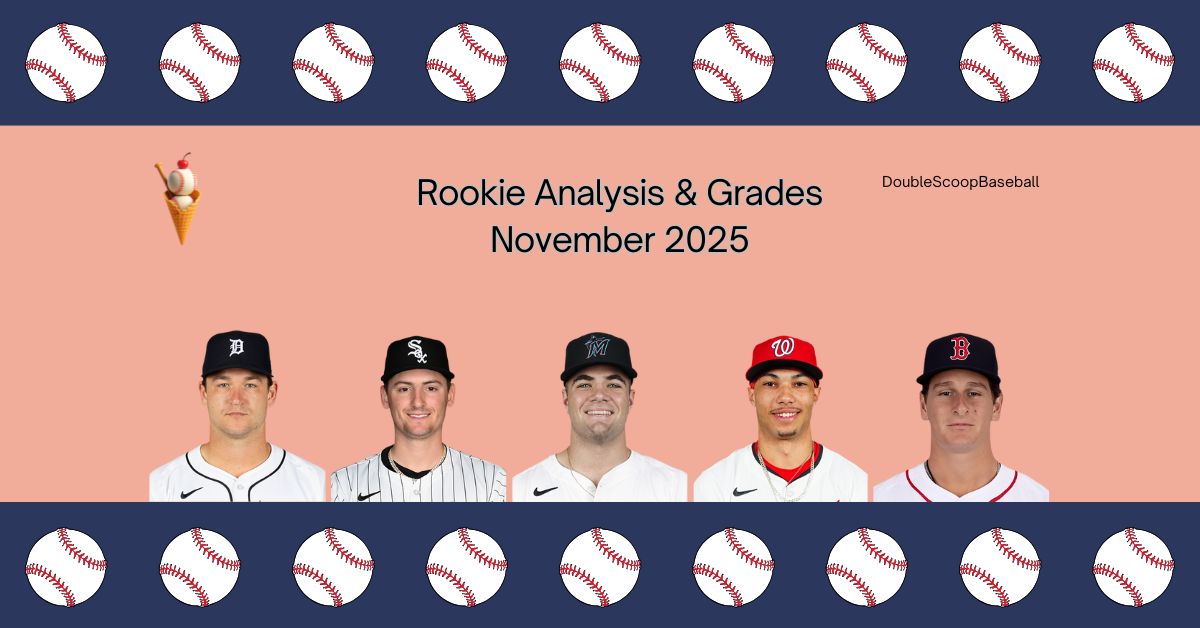
  • Rookie Analysis & Tool Grades: November 2025

    Rookie Analysis & Tool Grades: November 2025


    After missing the October update, we are back with the November Rookie Review and continuing our look at the 2025 rookie class. This month is a hitters focused breakdown that highlights tool grades, player comps, and long-term outlooks for bats like Roman Anthony, Jakob Marsee, Colson Montgomery, and other 2025 rookies.

    I will follow up with another review in December to close out the year, so feel free to shout out any rookies I have not covered yet. Links to all previous Rookie Reviews can be found below.

    Now let’s dive in!

    Roman Anthony

    Roman Anthony was the #1 prospect headed into the season by MLB pipeline. He started the season in Triple-A and was called up on June 9th. Anthony played 71 games, slashing .292/.396/.463, before having to be shut down in September for the rest of the season due to an oblique injury.

    In just under half of a season, Anthony had strong underlying metrics with great quality of contact metrics as well as a low chase rate which supports his high BB rates.

    His 94.5 average EV in 2025 ranks him in the top 5 with hitters with more than 100 batted ball events in 2025 along with Oneil Cruz, Aaron Judge, Shohei Ohtani, and Yordan Alvarez. His 60.3% hard-hit rate is also one of the highest of the Statcast era, only behind Aaron Judge (min. 300 PA).

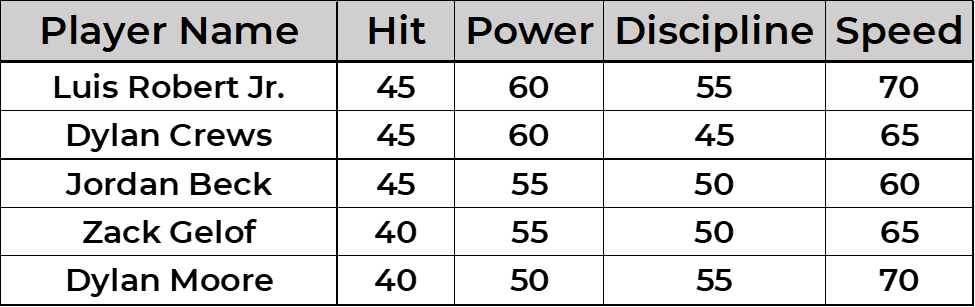
    Dynasty Tool Grades

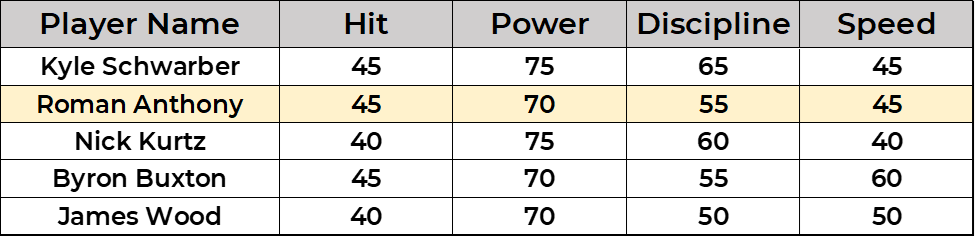
    Roman Anthony has great player comps on his dynasty tool grades at an early age, drawing comparisons to sluggers like Kyle Schwarber, Byron Buxton, among others.

    His combination of plus-plus power and plus discipline gives him a toolset that is proven to work at the MLB level. I would not be surprised to see his Hit tool take another step forward as he continues to adjust to the MLB level.

    Fantasy Outlook

    At his young age he has plenty of time to improve his game and it’s all about staying on the field. He is an All-Star caliber outfielder for the Red Sox who can hit 30+ HR yearly with strong OBPs. Buy-in on Anthony now where you can!

    Jakob Marsee

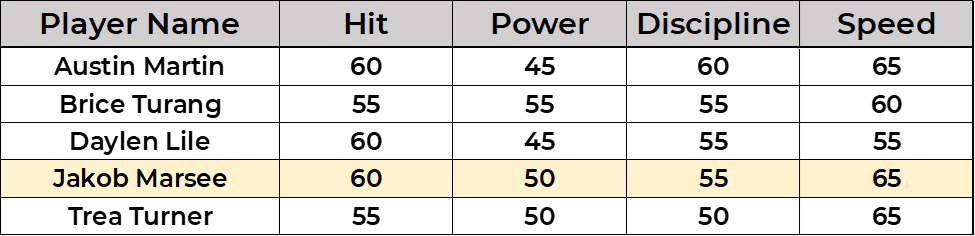
    Jakob Marsee is one of the more underrated rookie breakouts of the 2025 season. He impressed slashing .292/.363/.478 with 5 HR and 14 SBs in 55 games. This works out to a 15/40 HR/SB pace over 162 games.  From the time Marsee debuted on August 1st through the end of the season, Marsee led all rookies in fWAR at 2.2, ahead of Colson Montgomery (1.9), Daylen Lile (1.8), and Nick Kurtz (1.6).

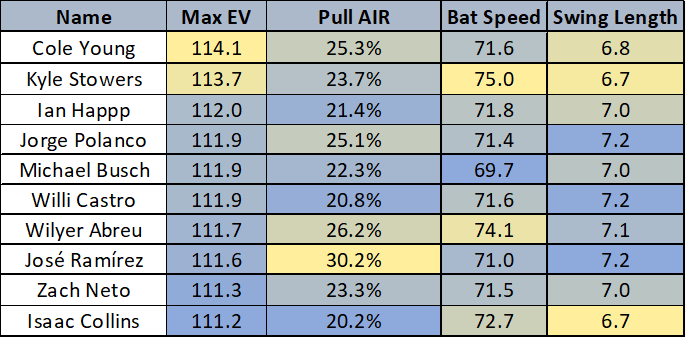
    Marsee has solid underlying data to back up his production. He posted better than average squared up %, chase %, and whiff % pointing to strong Hit tool. While never known for his power, he did enjoy a power surge in 2025 with 19 HRs across Triple-A and the MLB, the most of his professional career. His max EV of 111.1 and 70.5 mph average bat speed point to average raw power, but that could play up given his strong hit tool if he can start pulling the ball in the air more.

    Dynasty Tool Grades

    Below is a look at our custom dynasty tool grades as well as other players with similar skill profiles. He has an excellent 55-game sample in 2025, though there could be some skill regression with more sample size.

    Overall Marsee showed average to above average tools across the board which very few players are able to showcase making Marsee an important name to know for 2026.

    Fantasy Outlook

    Put Marsee on your watchlist and buy him where you can. His mix of all-around tools make him an exciting fantasy option and is someone I will be targeting in 2026 drafts/auction. Marsee has all-star potential and will be a strong source of runs and stolen bases in 2026 batting at the top of the Marlins improving lineup.

    Colson Montgomery

    Colson Montgomery, a former first round pick by the White Sox in 2021, went on a power surge after his callup. In his first 71 games he hit 21 homeruns with 55 RBIs, slashing .239/.311/.529. He has been a bright spot in the White Sox rebuild that is desperately searching for core parts of its future.

    Montgomery has shown glimpses of his raw power in the minors at Triple-A, posting max EVs of 113.8 and 115.3 in 2024 and 2025. This power though has come with consistent high K-rates in the upper minors with a 28.6% K -rate in Triple-A in 2024 and 33.0% in Triple-A in 2025.

    Dynasty Tool Grades

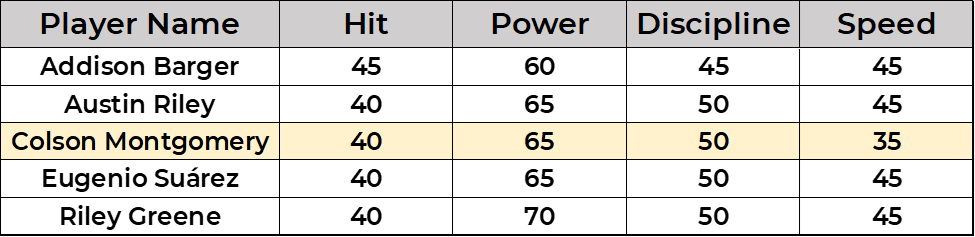
    Montgomery’s stand out tool is his power. He has hit tool concerns; however, he has strong defense will help him stay in the lineup throughout any prolonged slumps.

    Montgomery has a package showcasing elite bat speed from the left-side. This elite bat speed gives Montgomery strong power potential similar to Austin Riley, Eugenio Suarez, and Riley Greene, though there will be plenty of strikeouts.

    Fantasy Outlook

    Montgomery is just 23 years old, has elite bat speed, and plays solid defense at a premium position which in sum should lead to strong yearly homerun totals. He has batting average risk and could find himself turn into a streaky hitter given the swing and miss, but when things click, he can help carry a team. Montgomery is currently ranked as the #37 shortstop on our dynasty rankings and will find himself climbing up our rankings in our next update.

    Daylen Lile

    Daylen Lile was not on many prospect lists that I saw before the 2025 season, but you would never have known based on his rookie year. In 91 games he slashed .299/.347/.498 with 9 HRs and 8 SBs. He was also able to improve as the year went on and was a huge help to fantasy managers in late 2025.

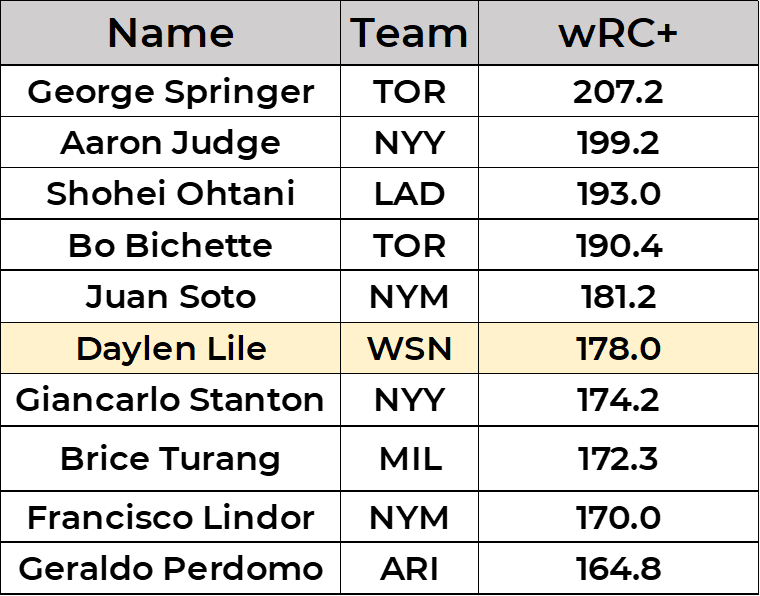
    From August to the end of the season there weren’t many better hitters than Lile. His 178 wRC+ was in the top 10 hitters in the MLB during that time (Min. 100 PA).  

    While it’s unrealistic to expect this level of production to continue, he has solidified his spot in the Nationals plans for the near future.

    Dynasty Tool Grades

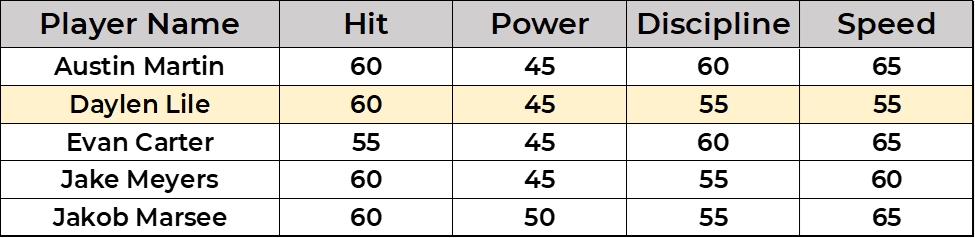
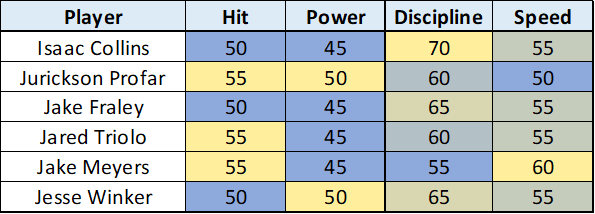
    Lile’s best tool is his hit tool (60), with his whiff (18.9%) and k-rates (16.0%) better than league average. His player tool comps are below and include hitters like Jake Meyers and Evan Carter.

    He currently profiles as a 12-15 homerun hitter with potential who could put up 20 during a peak year. His all-around skills and locked in playing time for the rebuilding nationals give him a high floor to be a fantasy contributor, but the lack of power will cap his upside.

    Fantasy Outlook

    Lile is useful young bat in fantasy leagues with double digit homerun and steal ability. His late season surge is likely to inflate his price going into draft season and could even be a sell high in dynasty leagues during the offseason. In redraft leagues be wary of the price as draft season gets closer. If Lile goes early, keep an eye on players like Jake Meyers, Austin Martin, and Evan Carter who may be able to provide similar skill profiles at lower draft prices.

    Kyle Teel

    Teel, part of the Crochet trade, held his own in his 2025 debut slashing .273/.375/.411 with 8 HRs and 3 SBs over a half season sample size (78 games). His success was mostly against RHP and showed drastic splits in his 78 games.

    With Edgar Quero, a switch-hitting catcher on the White Sox roster, he could continue to find himself on the bench against left-handed pitchers.

    Dynasty Tool Grades

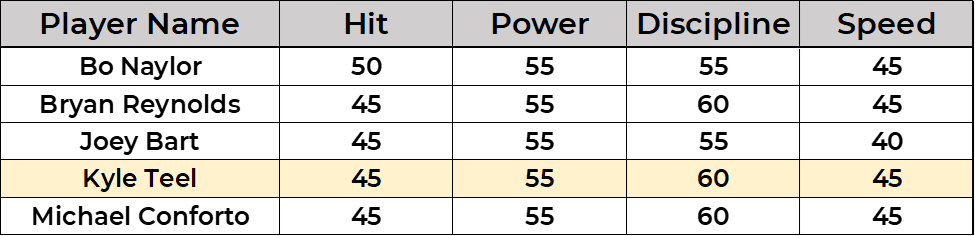
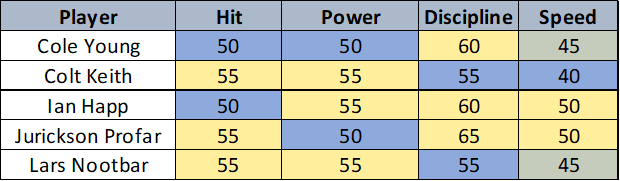
    His dynasty tool grade comps relate to other catchers such as Bo Naylor and Joey Bart. There is a mix of above-average power and plus discipline which can help make up for the 45 hit tool. A common trend on this list (Bryan Reynolds the exception) is that these players are platoon roles.

    Fantasy Outlook

    Teel should be a part of the White Sox lineup given his success against RHP as he splits time between catcher and DH (made 1 appearance in LF in 2025). He is currently ranked as our #17 dynasty catcher and can be left off most 12-man rosters with one catcher. In two catcher leagues Teel serves as a solid C2 option, just keep in mind he is likely limited to a strong side platoon role.

    Dillon Dingler

    Dillon Dingler stepped into a regular catching role for Detroit in 2025 and rewarded the Tigers with a Gold Glove and steady two-way production. His defense was his biggest strength and his offense provided enough impact to keep him in the lineup most days.

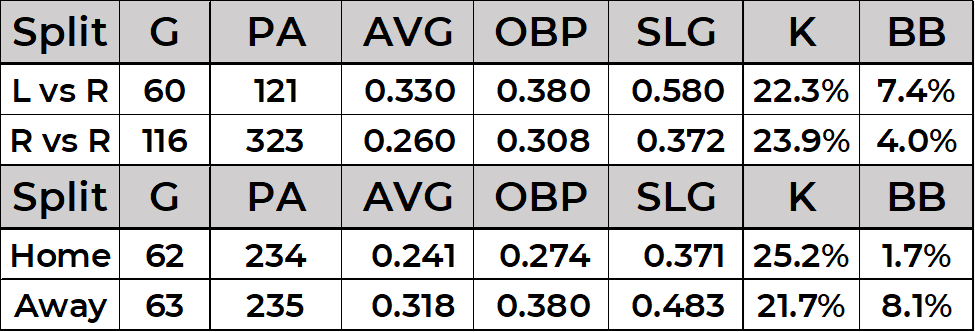
    What really stood out were his extreme splits, both against LHP and on the road. Dingler crushed lefties with an OPS above .900 but had an OPS below .700 against RHP. His biggest weakness against RHP came on breaking balls where he had a 34.7% whiff rate and a .225 wOBA. He also showed a tendency to swing at RHP sweepers and other breaking balls outside the zone.

    This is only one year of data, so these splits should not be weighed too heavily. He posted strong results away from Comerica Park and had real issues hitting at home. It will be worth watching if that trend continues in 2026.

    Dynasty Tool Grades

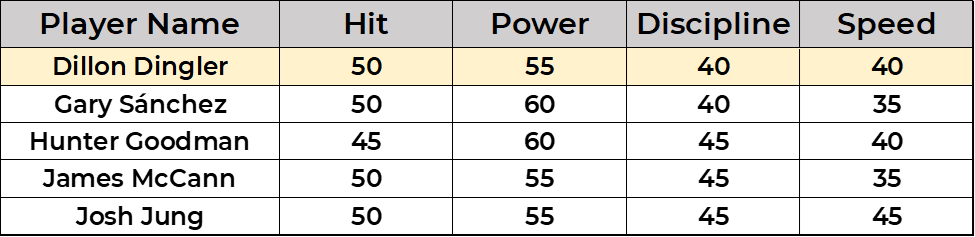
    Dingler’s tool grades line up with profiles similar to Josh Jung and James McCann. He does not offer a plus offensive tool, but he brings passable Hit/Power tools for the catcher position. An increase in his Power or Discipline could help elevate his offensive profile.

    Overall, his strong defensive value mixed with his average offensive profile should help him keep the starting role in Detroit for the near future.

    Fantasy Outlook

    Dingler is solidified as the Tigers’ starting catcher which provides fantasy usefulness in two catcher formats. He is currently ranked as our #27 dynasty catcher, showing he can be swapped out for another option if managers looking for a 2026 in-season upgrade.

    Nathan Lukes

    Nathan Lukes is in his age-30 rookie season and made an impact on a Blue Jays team that reached the World Series. He played 135 games and finished around a league-average with a 103 wRC+. Lukes kept both his K-rate and whiff rate under 15%, but outside of that he did not show many standout underlying metrics in 2025.

    His value came from being in the lineup consistently with 438 PAs (385 of those against RHP). He also provided steady run production with 55 runs and 65 RBI. Playing time could be harder to come by in 2026 depending on what direction the Blue Jays choose to go.

    Dynasty Tool Grades

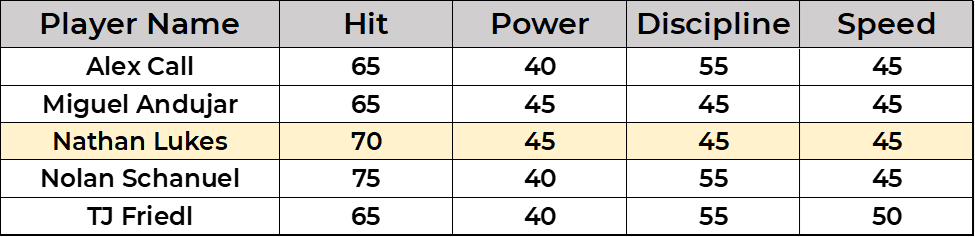
    Lukes is a contact-first hitter with a plus hit tool, graded at 70. That mark is likely a bit inflated since most of his matchups came against right-handed pitching.

    Based on his profile, the closest matches are outfielders Miguel Andujar and Alex Call. Entering his age-31 season, there is not much room for additional growth in either the hit or power tool, although he could continue to refine his approach.

    Fantasy Outlook

    Lukes is already entering his age-31 season and lacks the power and speed needed to be a true fantasy asset. His value is tied directly to everyday playing time. He is best viewed as a bench option in deep formats such as Draft Champions or AL-only leagues, where you hope he holds a similar role to last year.


    Follow us on X @2BScoopBaseball and @DoubleScoopBaseball on IG and let us know any feedback or questions you have.

  • Prospect Review: The Athletics

    Prospect Review: The Athletics


    We’re turning our attention to the Athletics, a system that has quietly reshaped its farm through a mix of trades, international signings, and recent draft picks. Over the past few years, the A’s found success developing position players including Nick Kurtz, Shea Langeliers, Brent Rooker, among others. The same level of success has not yet extended to the pitching side, but that trend could soon change.

    With the 2025 additions of arms like Jamie Arnold, Braden Nett, and Henry Baez, the Athletics now have a diverse group of young pitchers that can come up and compliment their hitting core.

    Let’s dive into the Athletics’ top prospects below.

    Leo De Vries

    Leo De Vries was the top international signee of the 2024 class, earning a $4.2 million bonus from the San Diego Padres. He quickly climbed prospect rankings before being traded to the Athletics in the Mason Miller deal, where he immediately became the centerpiece of the farm system.

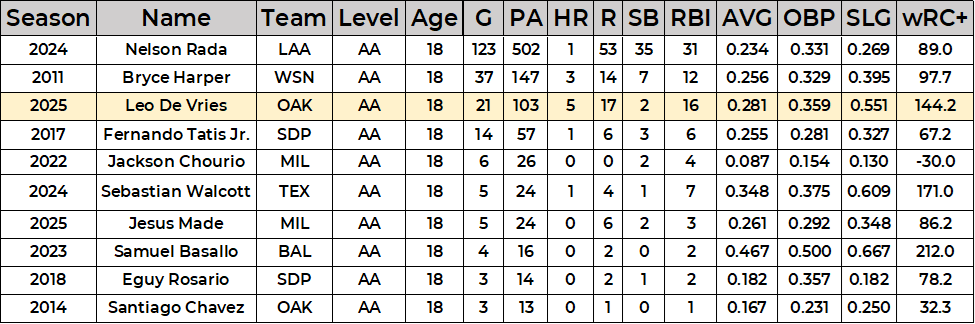
    A switch-hitting shortstop from the Dominican Republic, De Vries joins a very small group of prospects who have reached Double-A at age 18 including Bryce Harper, Fernando Tatis Jr., and Jackson Chourio.

    List of hitters aged 18 to play in Double-A (min. 10 PA)

    Since joining the Athletics, De Vries has produced at every level. In 2025, he posted an ISO at or above .250 across High-A and Double-A while facing competition that was, on average, four to six years older. He finished the season slashing .255/.355/.451 with 15 home runs and 11 stolen bases, showing a promising blend of power and speed. Reports of plus bat speed and impressive exit velocities have followed him since his amateur days. The power is already evident in his highlight-reel home runs and should continue to improve as he matures physically.

    According to our Prospect Barrel Rate Tool, De Vries recorded a 10.2% barrel rate in Double-A this season, showcasing the level of game power he can already produce.
    For De Vries to reach his ceiling as a top-tier shortstop, his hit tool will need to be at least average. Encouragingly, he has improved both his contact rate and swinging-strike rate at each level. With his bat speed, approach adjustments, and performance relative to age, he projects to carry an average to above-average hit tool in the majors.

    Tool Comparison

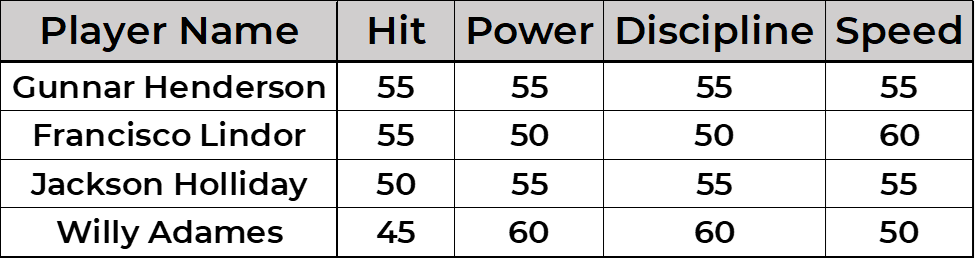
    Using our internal tool grades, De Vries profiles similarly to a mix of established MLB shortstops in terms of balance across hit, power, discipline, and speed grades.

    DoubleScoopBaseball Tool Grades showring potential floor/ceiling for Leo De Vries

    De Vries currently grades in the 50–55 range across most tools, with a ceiling similar to Gunnar Henderson as he matures. His athleticism and switch-hitting skill set also draw comparisons to Francisco Lindor, though De Vries shows more power at a younger age.

    Fantasy Outlook

    De Vries is a premium dynasty prospect with All-Star upside. His age-relative production, raw power, and shortstop profile place him among the best prospects of the past decade. At his peak he projects as a 25+ home run hitter with a .260 to .280 batting average and balanced five-category potential. While not a burner on the basepaths, he should be capable of stealing double-digit bases. Expect De Vries to begin 2026 in Double-A with the goal to have him eligible for a 2027 ROTY award.

    Gage Jump

    Gage Jump was selected by the Oakland Athletics in the second round of the 2024 MLB Draft out of LSU. Since joining the organization, Jump has quickly emerged as one of Oakland’s most exciting young arms, blending deception and power stuff from the left side.

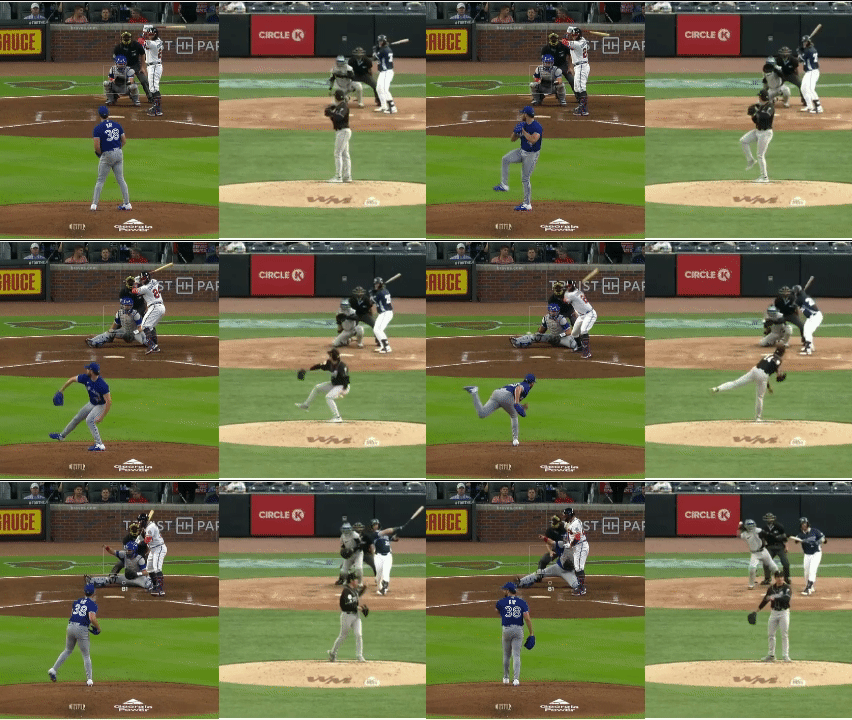
    Jump may not have a prototypical workhorse frame at 6-foot, 200 pounds, but he still generates high-end velocity. Working from an over-the-top arm slot, he drops deep into his back leg to create strong velocity and ride on his fastball. He does an excellent job keeping his front side closed and hides the ball until release, making it difficult for hitters to pick up the ball. The deception adds to his pitch effectiveness and helps his entire arsenal play up.


    His fastball is a true plus pitch, sitting in the mid-90s and topping out at 99–100 mph. It looks to have little to no horizontal tail and is a likely a plus IVB fastball. His slider and curveball are two other potential plus pitches to compliment his fastball. His curveball has a mix of good vertical and horizontal movement while the slider sits in the mid-80s seems with different shapes at times.

    Across High-A and Double-A in 2025, Jump posted a 3.28 ERA with 131 strikeouts in 112.1 innings, holding opponents to a .213 batting average while maintaining a 7% walk rate. His combination of velocity, command gains, and mound poise has made him one of the most advanced arms in Oakland’s system.

    Comparison

    With his arm angle, fastball life, and advanced breaking stuff, Jump draws comparisons to Robbie Ray. Both stay closed early in their deliveries and create natural deception by hiding the ball through release. While Jump’s slider velocity is lower than Ray’s 87–88 mph average, it still projects as a plus offering.

    Robbie Ray (right) & Gage Jump (Left)

    Fantasy Outlook

    From a fantasy perspective, Jump fits the mold of a high-strikeout lefty with impact potential. His fastball velocity, breaking ball depth, and deception suggest a pitcher capable of above-average strikeout rates with solid ratios once fully developed. His trajectory and likely 2026 ETA make him a sneaky dynasty target in deeper formats. If his curveball and slider continue to sharpen and his changeup becomes a reliable fourth option, Jump could grow into a top-of-the-rotation arm for a franchise currently seeking high-upside starters.

    Henry Bolte

    Henry Bolte was selected by the Oakland Athletics in the second round of the 2022 draft out of Palo Alto High School for a $2 million bonus. Standing 6-foot-3 with a lean frame and twitchy movements, he quickly became one of the most toolsy outfielders in Oakland’s system.

    In 114 games across Double-A and Triple-A, Bolte slashed .284/.385/.427 while stealing 44 bases and hitting nine home runs. At Triple-A, his 11.3% walk rate and 24.9% chase rate showcased improved zone discipline, though his 32.6% strikeout rate raises legitimate hit tool concerns. Even with the contact issues, Bolte’s production earned him a Futures Game appearance and the honor of being named Athletics 2025 Minor League Player of the Year.

    Bolte has an explosive swing with great torque that should help him maximize his power, though the aggressiveness in his swing can lead to swing and miss. Watching his video brings to mind former Brewers prospect Joey Wiemer. Both possess plus raw power and speed, but their limitations with contact have dictated how far their profiles carry. Bolte’s elite speed and athleticism should allow him to stay in center field and handle all three outfield spots when needed.

    Tool Comparisons

    Using our internal tool grade, Bolte profiles similarly to a mix of power-speed players who impact the game in multiple ways.

    DoubleScoopBaseball Tool Grades showring potential floor/ceiling for Henry Bolte

    Bolte’s range of outcomes depends heavily on how his hit tool develops. His ceiling resembles Luis Robert Jr., a player capable of great peaks but who has struggled with year-to-year consistency with his floor being that of a part-time or platoon player.

    Fantasy Outlook

    In dynasty leagues, Bolte is a boom-or-bust prospect. He offers multi-category upside with power and speed but remains a risk due to contact concerns. If he can trim the strikeouts and maintain his plate discipline, he could develop into an exciting everyday contributor. If not, his role may settle into a platoon or part-time player. Expect Bolte to spend most of 2026 in Triple-A and be on the call-up radar if injuries or performance struggles open a spot in Oakland’s outfield.

    Braden Nett

    Originally signed by the Padres as an undrafted free agent out of community college, Braden Nett was acquired by the Athletics in the Mason Miller trade. Listed at 6-foot-3, 185 pounds, Nett has a projectable frame and an athletic arm action that continues to trend in the right direction.

    His fastball and curveball are both plus offerings, forming the foundation of his arsenal. The fastball touches the high 90s while the curveball is a high-spin breaker with sharp vertical depth. Together they form a legitimate two-pitch mix capable of missing bats at any level. Nett also mixes in a slider and cutter, both of which project as future major-league pitches. His changeup is used sparingly but flashes as a usable pitch when he commands it effectively. Once Triple-A pitch data becomes available we should get a clear picture idea about his pitch shapes.

    In 2025, Nett logged a career-high 105.2 innings, putting him in position to handle a full starter’s workload in 2026. With another year of development, Nett could be on track to make a late-season debut in 2026 if the Athletics need reinforcements down the stretch in the rotation or the bullpen.

    Fantasy Outlook

    From a fantasy standpoint, Nett has the ceiling of mid-rotation starter and floor of a reliever and needs to prove he can handle a season’s workload. The fastball-curveball pairing already plays at a major-league level out of the bullpen. Refinement of the slider-cutter combination gives him a wider arsenal to succeed as a starter. If his changeup gains consistency and command continue to improve, Nett could grow into one of the more valuable young arms in the As’ system. Fantasy managers should monitor him throughout 2026, as he has the potential to emerge as a late season streaming option.

    Wei-En Lin

    Wei-En Lin is an under-the-radar arm in the Athletics organization. The Taiwanese right-hander combines advanced pitchability and a refined three-pitch mix built around one of the best changeups in the system. At just 19 years old and listed at 6-foot-1, 179 pounds, Lin has a loose and repeatable delivery that should allow him to add velocity as he matures.

    Lin’s pitch mix features a fastball, changeup, and curveball, with the changeup standing out as his best offering. It features strong velocity separation from the fastball and heavy arm-side fade, allowing him to miss barrels and neutralize right-handers.

    Overlay of Wei-En Lin fastball and changeup

    His fastball sits 91–93 mph with late arm-side life, and there is room for added velocity as his strength develops. His curveball has moderate depth and shape, serving as a usable third pitch to change eye levels, though it is not currently projected as a plus pitch.

    The fastball-changeup pairing gives Lin a solid foundation and helps him generate weak contact even without premium velocity. His smooth mechanics and command help him fill the strike zone consistently. For Lin to take another step forward and become fantasy-relevant, he will need either a velocity bump or a sharper breaking ball to better handle left-handed hitters and generate more swing and miss.

    Fantasy Outlook

    From a fantasy perspective, Lin profiles as a command-first starter with back-end rotation potential. The fastball-changeup combination is advanced enough to carry him up the minors. If the fastball velocity ticks up or the curveball gains more bite, Lin could rise quickly on organizational rankings. For now, he remains a developmental arm who can be monitored but left off fantasy rosters.


    Follow us on X @2BScoopBaseball or @DoubleScoopBaseball on IG and reach out with any comments, feedback or questions!

  • Rookie Analysis & Tool Grades: September 2025

    Rookie Analysis & Tool Grades: September 2025


    The 2025 season has been a showcase for electric rookie arms. Jacob Misiorowski, Chase Burns, Nolan McLean, Jonah Tong, Peyton Tolle, and Bubba Chandler have all made their debuts and flashed excellence at times. But beyond the headline prospects, a deeper group of rookie pitchers has quietly carved out meaningful roles.

    This month’s Rookie Review shifts focus to some of the arms we haven’t covered yet this season, pitchers who’ve logged enough innings to graduate from prospect status and now deserve a closer look. We’ll dive into their season performance, pitch mix, and dynasty comps to help you assess their long-term value.

    If you missed our earlier rookie breakdowns, you can catch up below:

    Now let’s dive in!

    Cade Horton

    Cade Horton entered 2025 as the Cubs top pitching prospect. After a dominant stretch in Triple-A Iowa to open the season (1.24 ERA, 0.86 WHIP, 30.6% K-rate), Horton earned his call-up in late May and has been one of the top performing rookies in the National League since.

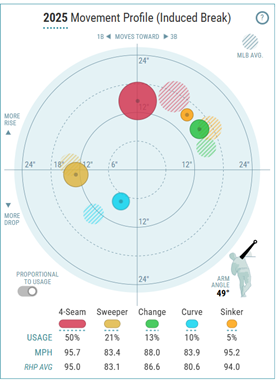
    Through his first 22 MLB starts, Horton has posted a 2.67 ERA, 1.08 WHIP, and 97 strikeouts across 118 innings. His arsenal is headlined by a cut-ride four-seam fastball averaging 95.7 mph, a sweeper, and a changeup. Below is his full pitch movement profile courtesy of Baseball Savant:

    • His sweeper and changeup are his best pitches, generating whiff rates of 36.9% and 47.7%, respectively.
    • The changeup’s success is amplified by the difference in horizontal movement with his four-seam.

    Since the start of August, Horton has taken his game to another level:

    • 1.28 ERA, 0.77 WHIP, .154 AVG against
    • K-rate jumped from 17.3% to 25.1%
    • BB-rate improved from 7.6% to 5.9%

    He’s also begun tweaking his pitch mix, increasing the usage of his sinker. Against righties, he leans on the four-seam, sweeper, and sinker; against lefties, he mixes in the four-seam, changeup, and curveball. There’s room to incorporate the sinker and changeup more against both splits, especially to keep hitters off balance the third time through the order.

    Horton has similarities with Kyle Bradish who also features a cut-ride fastball and a strong sinker/slider combo. Bradish leans more heavily on his sinker, and it’ll be interesting to see if Horton follows suit and leans further into his sinker in 2026. Below are some other similar pitchers in terms of arsenal and skill grades:

    At age 23, Horton still has a wide range of outcomes for his career, but he is in the middle of his best MLB stretch to date. Heading into 2026, expect him to continue refining his pitch mix. Horton is a solid rookie pitcher with the upside of a No. 2 starter and the floor of a reliable mid-rotation arm.

    Jacob Misiorowski

    Jacob Misiorowski, nicknamed “The Miz”, took the league by storm in his debut, tossing five no-hit innings in his first start and following it up with six more before surrendering his first hit. Drafted by the Brewers in the second round of the 2022 draft out of Crowder College, Misiorowski has quickly become one of the most electric pitchers in baseball. At 6’7″ with long limbs and elite velocity, he’s one of the most entertaining arms to watch.

    Misiorowski features an elite arsenal and draws strong pitch comps. His fastball is nearly identical to Hunter Greene’s, sitting above 99 mph, but it falls into the “expected movement” bucket, meaning it lacks standout ride or run. Without precise location, it can be vulnerable to hard contact and home runs, especially if hitters are sitting on it.

    His slider is a true outlier, over two mph harder than any other slider in the league. While it doesn’t generate much movement or velocity separation from the fastball, the velocity alone makes it a plus pitch against righties. His changeup, however, might be the most underrated weapon in his arsenal. Despite his elite velocity, Misiorowski‘s changeup has held hitters to a .050 batting average and a .075 wOBA, while generating a 37.8% whiff rate. Heading into 2026, expect him to lean more heavily on the changeup given its elite results.

    When healthy and in the rotation, the Miz has some of the highest upside of any pitcher in MLB. One of the only concerns is his command. He’s posted walk rates between 11–15% in the minors, and while he’s improved to 10.8% in the majors, any regression could lead to rough stretches. Increased baserunners combined with a fastball with poor shape, if not well located, could expose him to damage.

    Still, the ceiling is immense. If the command holds and he continues to refine pitch usage, the Miz could emerge as a top-tier fantasy starter with elite strikeout upside.

    Cam Schlittler

    Cam Schlittler is a 6’6” hard-throwing rookie who was selected in the 7th round of the 2022 draft out of Northeastern University. While his fastball topped out in the mid-90s during college, it now sits at 98 mph in the majors.

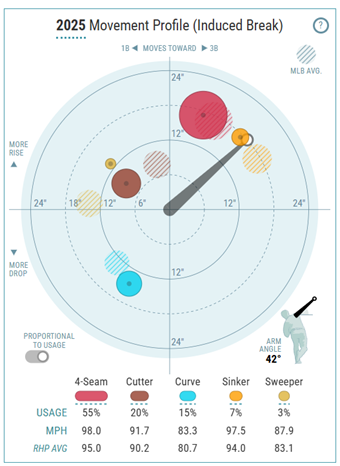
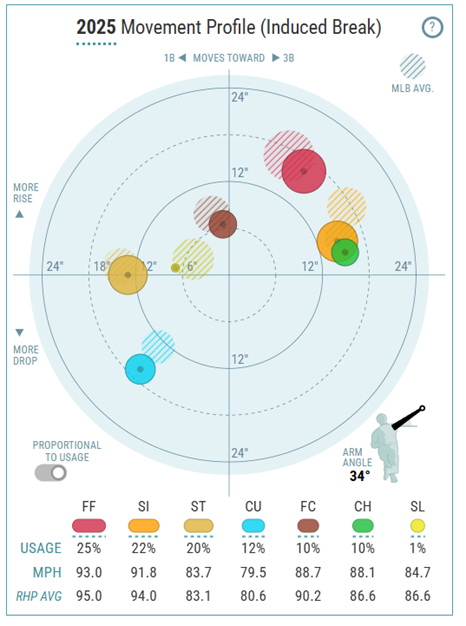
    Despite the velocity, Schlittler features a loose, smooth delivery that should aid both strike throwing and long-term durability. In addition to his high-velocity fastball, he primarily mixes in a cutter, curveball, and sinker. His 2025 pitch movement profile from Baseball Savant shown below:

    • His cutter operates more like a hard slider, with a velocity gap from the fastball that mirrors traditional slider usage. It also features plus glove-side movement.
    • The curveball serves as his primary breaking pitch against lefties, showing solid depth and above-average velocity.
    • The sinker is used sparingly but adds a different look down in the zone

    To take the next step, Schlittler would benefit from developing a true off-speed pitch, ideally a changeup or splitter. This would help keep hitters off his fastball and breaking ball combo, which can become predictable for major league hitters. A viable bridge pitch would elevate his ceiling and push him toward top-tier starter potential.

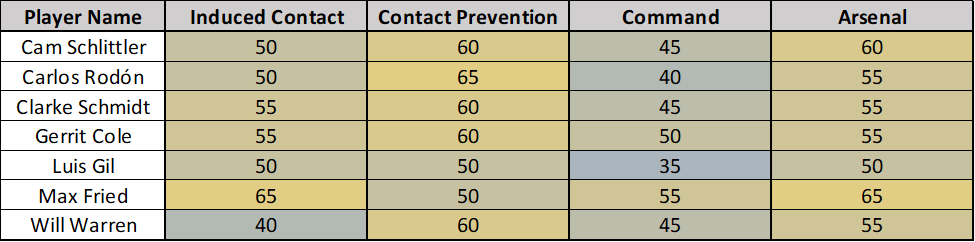
    Schlittler has stepped up alongside fellow rookie Will Warren, filling in admirably for Gerrit Cole and Clarke Schmidt, who’ve spent much of the season on the IL. With their emergence, the Yankees now boast an abundance of MLB-caliber starters: Max Fried, Carlos Rodón, Gerrit Cole, Luis Gil, Clarke Schmidt, Will Warren, and Cam Schlittler.

    Looking ahead, the Yankees could trade Clarke Schmidt or Luis or consider moving them to the bullpen given their past struggles staying healthy over a full season. He has the floor of a dependable mid-rotation arm and the upside of a No. 2 behind Max Fried if he improves his breaking ball command and/or adds a viable off-speed pitch to round out the arsenal.

    Braxton Ashcraft

    Braxton Ashcraft has been one of the best comeback stories of 2025. After missing three seasons recovering from multiple surgeries, including Tommy John, a torn meniscus, and a left shoulder procedure, he has made an immediate impact with the Pirates in his rookie season. Over 65.1 innings split between the bullpen and starting rotation, he has posted a 2.62 ERA and 1.19 WHIP.

    In his eight starts this year, he has an elite 2.16 ERA and a 1.14 WHIP. He is limiting hitters to a .226 average against while showing modest K (25.9%) and BB (7.4%) rates. One thing to note is he has averaged just over four innings per start, showing the Pirates are going to be cautious with his innings, with good reason.

    His arsenal grades out well among rookie starters, highlighted by two high-velocity breaking balls. Both his slider (92.0 mph) and curveball (84.3 mph) sit well above average in velocity, giving him a power profile. He compares similar with other rookie pitcher Cam Schlittller, as well as the other power pitchers below in terms of their arsenals and skill grades.

    Ashcraft will face stiff competition for a rotation spot in 2026 with a Pirates rotation that is currently top 5 in starters ERA on the season. Paul Skenes and Mitch Keller are locked in, while Bubba Chandler, Mike Burrows, Johan Oviedo, and Jared Jones will all be competing for spots at some point during the season.

    Outside of Paul Skenes and Bubba Chandler, Ashcraft looks like he can be the highest upside pitcher in the Pirates organization. If he wins the job and stays healthy, he profiles as a useful fantasy arm with strikeout potential and strong ratios. The Pirates rotation could quietly continue to be one of the stronger staffs in the MLB and would keep Ashcraft on your draft radar.

    Joey Cantillo

    Joey Cantillo has been a prospect in the Guardians system since 2021, arriving via trade after being drafted by the Padres out of high school in 2017. He made his pro debut at age 17 and has quietly been climbing the organization ladder, posting 30% K-rates at most stops.

    Cantillo began the 2025 season in the bullpen but has been a fixture in the Guardians rotation since July. Over 12 starts, he’s posted a 2.93 ERA, 1.27 WHIP, and 64 strikeouts across 61.1 innings.

    He throws from a high arm slot, which helps generate strong vertical break, especially on his off-speed pitches. While he doesn’t have plus velocity, his changeup is a true plus pitch. It’s held hitters to a .168 batting average and generated a 49.1% whiff rate, making it one of the most effective changeups among in the majors.

    Cantillo also features a big 12–6 curveball with 18 inches of induced vertical break and roughly five and a half feet of total vertical drop. He bridges his arsenal with an 84.9 mph slider, which he uses more frequently against left-handed hitters.

    Here’s how Cantillo stacks up against similar left-handed starters using our dynasty skill tools:

    Cantillo owns a borderline elite changeup and average-to-above-average breaking balls. His four-seam fastball remains his weakest pitch, allowing a .358 wOBA against. If he can add velocity it would elevate his ceiling significantly.

    Without a premium fastball, Cantillo will rely on sequencing and off-speed command to maintain his strikeout rates. His strong second half gives him momentum heading into 2026, where he’ll compete with Parker Messick, Logan Allen, and Slade Cecconi for a rotation spot. Keep a close eye on his Spring Training velocity, any uptick in velocity would greatly improve his outlook.

    Michael McGreevy

    Michael McGreevy, known for his polish and command, has carved out a rotation role in St. Louis, posting a 4.08 ERA, 1.20 WHIP, and 53 strikeouts across 86 innings through mid-September. We previously mentioned him in a previous Dynasty Buy-Low post back in June.

    While he doesn’t light up radar guns, his fastball averages 93.0 mph, McGreevy thrives on a deep pitch mix and plus command shown below from Baseball Savant:

    Against right-handed hitters he leans on a sinker/sweeper combo that’s been effective career to date, holding right-handed hitters to a .247 wOBA. However, left-handed hitters have been a challenge early in his career, with a .349 wOBA against.

    The only pitch generating a sub-.300 wOBA against left-handed hitters is his cutter, which he throws 18.3% of the time to lefties. Refining his arsenal against opposite-handed hitters will be key to unlocking more consistency.

    Using our custom tool grades, McGreevy profiles similarly to Zach Eflin, Miles Mikolas, and Bailey Ober, pitchers who rely on command and sequencing over raw stuff.

    McGreevy will likely remain below average in terms of bat-missing ability, but his deep mix and strike-throwing give him value. With Miles Mikolas set to hit free agency, McGreevy is almost guaranteed a rotation spot heading into 2026, where he’ll have a chance to log his first full MLB season.

    He fits the mold of a reliable innings eater who can anchor the back of a rotation. While his results may fluctuate based on defense and batted-ball luck, he’s capable of posting sub-4.00 ERA seasons and will be useful in formats where innings and consistent starts matter.

    Jacob Lopez

    Jacob Lopez has emerged as one of the more surprising rookie arms of 2025. After bouncing between Tampa Bay and Oakland in recent seasons, Lopez finally earned a consistent rotation spot with the A’s and has made the most of it.

    Through 92.2 innings, the 27-year-old rookie has posted a 4.08 ERA, 1.27 WHIP, and 113 strikeouts. His 28.3% strikeout rate ranks in the 85th percentile, though his 9.3% walk rate remains below league average.

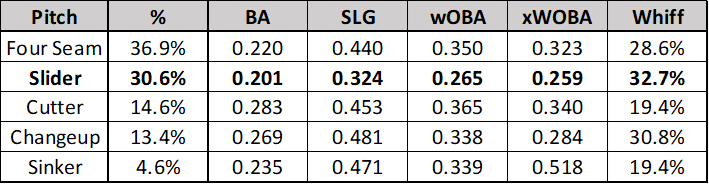
    Lopez throws from a low three-quarters arm slot and relies heavily on his four-seam fastball and slider, while mixing in a cutter and changeup primarily against right-handed hitters. His slider features plus separation from the fastball and is his best pitch by nearly every metric, wOBA, xwOBA, AVG, SLG, whiff%, you name it. His changeup flashes above-average movement but functions more as a chase pitch than a reliably commanded offering.

    Lopez has enough swing-and-miss to carve out a role in Oakland’s thin rotation. However, his below-average velocity limits his long-term projection. Improving his command will be the clearest path to another step forward. Pitch comps include Andrew Heaney and Sean Manaea, both of whom share similar arm slots and fastball shapes.

    Here’s how Lopez stacks up using our dynasty skill tools:

    At age 27 and lacking league-average velocity, Jacob Lopez is likely close to maxed out skill-wise. Command improvement will be key to sustaining his success. With a Grade 1 flexor strain and the Athletics out of playoff contention, he’s unlikely to pitch again in 2025. Flexor strains can be precursors to Tommy John surgery, but Lopez should have a full offseason to rehab and prepare for 2026. Be cautious on draft day, Lopez carries real injury risk and could see some strikeout regression. Expectations should be tempered accordingly.

    Brad Lord

    Brad Lord entered pro ball as a low-end prospect, drafted in the 18th round of the 2022 draft with a 35+ future grade from FanGraphs. He’s beat expectations, posting a 2.43 ERA across Double-A and Triple-A in 2024 and earning an Opening Day roster spot in 2025.

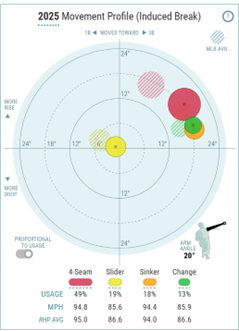
    Lord has split 126.2 innings across the bullpen and rotation with a 4.12 ERA, 1.28 WHIP, and 12.0% K-BB. He operates from a low three-quarters arm slot (20 degrees) and generates noticeable arm-side run on both his four-seam fastball and changeup, as shown in his 2025 movement profile via Baseball Savant:

    Despite the plus movement on the four seam, Lord’s pitches have been hit hard this year with the xwOBA against of all pitches all above .300. Adding a bigger breaking ball, such as a curveball or sweeper, would help him generate more strikeouts and improve his overall effectiveness.

    Using our dynasty skill grades, here’s how Lord compares to similar starter profiles:

    Lord needs to improve his arsenal to stick as a long-term starter. A sweeper or curveball would be the most impactful addition, and if he’s able to develop a cutter as well, it could round out his pitch mix. Without those improvements, he profiles more as a spot starter or multi-inning bullpen arm.

    With a fully healthy Nationals rotation, Lord is likely headed back to the bullpen and will serve as a depth piece moving forward. He can be left off most fantasy rosters headed into 2026 outside mono-leagues.


    Follow us on X @2BScoopBaseball and @DoubleScoopBaseball on IG and let us know any feedback or questions you have.

  • Prospect Review: Arizona Diamondbacks

    Prospect Review: Arizona Diamondbacks


    In our July prospect review, we covered breakout names such as Konnor Griffin, Jonah Tong, and Eduardo Quintero who have been making noise across the minors. Moving forward, we’re shifting to team-prospect reviews, giving us space to dive deeper into intriguing prospects throughout each organization.

    We’re kicking things off with the Arizona Diamondbacks. This system is currently top-heavy with hitters and MLB Pipeline’s top five D-backs prospects are all position players. In 2025, the front office made a concerted effort to bolster pitching depth, acquiring Kohl Drake, Mitch Bratt, and David Hagaman from Texas, and selecting Patrick Forbes 29th overall out of Louisville. While the pitching group still lacks true frontline upside, it’s a meaningful step for a franchise looking to retool after trading away MLB talent like Josh Naylor, Eugenio Suárez, and Merrill Kelly.

    Let’s dive into Arizona’s top prospects below.

    Ryan Waldschmidt

    Ryan Waldschmidt is quickly emerging as one of the most exciting outfield prospects in the minors. Ranked 66th overall by MLB Pipeline, he has showcased an impressive all-around skill set, slashing .283/.417/.460 with 16 home runs and 28 stolen bases across High-A and Double-A in 129 games. As a college draftee, expect him to move swiftly through the system if he continues to perform at this level.

    Waldschmidt is a right-handed hitter with a simple setup. He forgoes a leg kick in favor of a small toe tap that launches into an aggressive swing. His swing features noticeable tilt, which helps him tap into his plus raw power. To better understand his in-game power, we examined his modeled barrel rates:

    Both marks are above average for their respective levels, even after adjusting for our average absolute difference.

    What stands out most about Waldschmidt is his combination of plate discipline and batted ball profile. Walking as often as you strike out while hitting for power reflects his advanced approach. In 2025, he showed a patient approach with a swing rate below 40% while keeping his strikeout rate below 20%. He also consistently elevates the ball, with 63.2% of his batted balls hit in the air. For reference, the MLB average is 55.7%.

    Looking ahead, Waldschmidt projects for a 2027 debut. While Corbin Carroll is the only long-term outfield lock on the roster, the Diamondbacks have several options with remaining service time. This includes Alek Thomas, Jake McCarthy, and even Blaze Alexander who has played some outfield this season. Triple A depth like AJ Vukovich, Kristian Robinson, and Cristian Pache could also get looks in 2026 but have more risk in their profiles. Waldschmidt has the best blend of approach and contact skills to fully capitalize on his power and speed.

    Currently ranked as our 70th overall dynasty outfielder, Waldschmidt will be under closer evaluation in 2026 once Triple-A Statcast data becomes available. He profiles as a potential 20 home run and 20 stolen base contributor with a stable batting average and a strong on-base percentage. View him as a buy now in dynasty leagues and one of the top outfield prospects in the game.

    Slade Caldwell

    Slade Caldwell is closing out his first professional season after being selected in the first round of the 2024 draft out of high school. He was a fascinating pick, older than most prep draftees and undersized at just 5 feet 9 inches and 182 pounds, but the early returns have been encouraging.

    Across 114 Single-A and High-A games, Caldwell is slashing .260/.408/.369 with 3 home runs and 25 stolen bases. Given that the average hitter in High-A is around 22 years old, these are solid numbers for a teenager adjusting to pro ball.

    His most notable tools right now are speed and plate discipline. Caldwell owns a 17.6% walk rate and has swiped 25 bags, showing a sharp understanding of the strike zone and an ability to impact the game on the bases. He has also displayed impressive bat-to-ball skills, with a 6.9% swinging strike rate and a 79.5% contact rate. Typically, those metrics align with lower strikeout rates, but Caldwell’s passive approach, reflected in a 33.0% swing rate, has likely led to deeper counts and more strikeouts than expected.

    There is room for growth. If Caldwell becomes more assertive in the zone, he could better capitalize on his contact ability and speed. Even if his walk rate dips slightly, his discipline would still be a strength. His short, compact swing is built for contact, and he often lets the ball travel deep, which supports his all-fields profile but limits his power ceiling. His modeled barrel rates this year show he struggled to hit for power at his first taste of High-A.

    Caldwell remains a young hitter with time to adjust. With a full offseason ahead, he will have the chance to refine his approach and unlock more of his skillset. He brings to mind other left-handed outfielders like Alek Thomas and Evan Carter, athletic players with strong instincts and feel for the game. Below is a comparison of some of their metrics from their age 19 seasons:

    Caldwell has stronger contact and walks rates than Thomas at the same age and expect Caldwell to lower his strikeout rate as he develops. While I project below average power, Caldwell’s combination of contact skills, speed, and discipline gives him a real chance to become the Diamondbacks’ center fielder of the future, but lacks star upside.

    Daniel Eagen

    Daniel Eagen, currently ranked as the Diamondbacks’ 13th overall prospect by MLB Pipeline, is one of the most exciting arms in their system. Drafted out of Presbyterian College in 2024, Eagen dominated in his final collegiate season, striking out 121 hitters over just 77.2 innings with a 2.67 ERA and a 0.99 WHIP.

    On video, Eagen attacks hitters primarily with a fastball and curveball from a high arm slot. His four-seam fastball sits in the mid-90s and shows strong horizontal movement. His best offering is a low 80s curveball with sharp downward break, a true plus pitch that should be effective against both righties and lefties. He also mixes in a mid-80s slider that adds horizontal shape to his arsenal.

    Since entering pro ball, Eagen has kept the momentum going. In 2025, he posted a 33.0 percent strikeout rate and reached Double-A in his first full season. He has been impressive, logging a 2.65 ERA, 1.10 WHIP, and holding opponents to a .183 batting average. He will likely begin 2026 back in Double-A, where he will have a chance to build on the 11.3% K-BB he posted in his first three starts at the level.

    Eagen has the potential to contribute in Arizona thanks to his plus fastball and curveball. To round out a starter’s arsenal, it would be beneficial for him to develop an average off speed pitch, such as a splitter or changeup variation, to complement his current mix. Eagen has some of the higher upside of the Arizona arms. With his current fastball and curveball mix he could be a late inning bullpen arm. But if he can develop an average off-speed pitch to compliment his current mix, he has mid-rotation upside.

    Kohl Drake

    Originally drafted by the Rangers in the 11th round of the 2022 draft out of Walters State Community College, Kohl Drake was traded to the Diamondbacks in the deal that sent Merrill Kelly to Texas. After a few starts at Triple-A Reno, he was shut down at the end of August with a shoulder strain.

    Listed at 6 feet 5 inches and 220 pounds, Drake features a deceptive delivery with strong extension that makes him feel like he is jumping at hitters. He throws his fastball and sinker more than 50% of the time in Triple A this season, sitting around 93 mph and occasionally touching 95 to 96 mph. His primary breaking ball is a slider that averaged 82.4 mph, and he mixes in a changeup with good separation from his fastballs. His pitch movement chart from his Triple-A appearances highlights the diversity and shape of his arsenal.

    While posting strong results with a 2.44 ERA and 0.98 WHIP in 55.1 innings in Double-A, nearly all his stats took a hit upon a promotion to Triple-A. I think some of the decline can be attributed to pitching in the hitter friendly Pacific Coast league.

    Drake could likely step into the big-league bullpen in 2026 and find success using just his sinker and slider, which could play up in shorter stints. If the Diamondbacks choose to keep him in a starting role, he will likely begin the season in Triple-A, where his workload can be managed. His only season throwing more than 100 innings was in 2023, when he reached 106 innings.

    At 25 years old, Drake profiles more as a future bullpen weapon, with the potential to serve as an emergency starter. If he continues to develop complementary pitches to support his fastball and slider, there is still a path to remaining in the rotation.

    Demetrio Crisantes

    Demetrio Crisantes is a lean-framed infielder listed at 6 feet tall and 178 pounds. He has spent most of his time at second and third base, with occasional reps at first. Drafted in the seventh round of the 2022 draft out of an Arizona high school, Crisantes has consistently performed at a high level since entering pro ball. However, 2025 marks the first season where he has not been on pace to hit over .300.

    Unfortunately, he did not get the chance to rebound, as a shoulder injury in May required surgery and ended his season early.

    Despite the career-low batting average, Crisantes continued to show advanced contact skills and plate discipline, walking more than he struck out. His strikeout rate improved alongside career-best marks in contact rate at 87.1% and swinging strike rate at 5.5%. His modeled barrel rate came in just below the High A average at 4.7%:

    These modeled barrel rates are still encouraging given his age relative to the level and suggest he may be able to tap into league average power as he matures.

    With most of 2025 lost to injury, it will be important to monitor how he rebounds in 2026. His contact ability and approach give him a high floor, but his upside as an everyday starter will depend on how much power he can unlock. If everything clicks, Jonathan India represents a realistic comp for Crisantes.

    Yu-Min Lin

    Yu-Min Lin signed with the Diamondbacks out of Taiwan in December 2021 for $525,000 and has steadily climbed the ranks since. Now 22 years old, Lin spent 2025 in Triple-A Reno, where he posted a 6.68 ERA and a 1.79 WHIP. Reno, like much of the Pacific Coast League, is known for its hitter friendly environments, with higher elevations that allow the ball to carry more. His home run per fly ball rate spiked in his first full season at the level:

    Lin is a 5-foot 11-inch, 160-pound lefty with a deep arsenal and advanced feel for spin. His fastball is not overpowering, averaging 90.8 mph and topping out at 94.8 mph, but it is his secondaries that define his profile. He throws a low 80s changeup that has served as his primary pitch in past seasons and generated a 41.4% whiff rate in Triple-A this year. Lin also shows excellent feel for spin with a mid-70s curveball that exceeds 3,000 revolutions per minute and a sweeper around 2,900 revolutions per minute. Both pitches rank as above average to elite in terms of spin rate.

    While his arsenal is not overpowering, Lin’s command of his off-speed and breaking pitches gives him the profile of a crafty left-handed starter.

    Lin would likely benefit by getting out of Reno where he could see his HR/FB normalize and Lin would likely benefit from leaving Reno, where his home run rates could normalize and his breaking pitches might play more effectively. For him to succeed, he will need to limit walks, as he does not project to post high strikeout rates. His strikeout numbers have declined each year as he has advanced through the organization.

    Still, Lin’s deep pitch mix and feel for spin give him a strong chance to stick in the rotation as a back-end starter.

    Mitch Bratt

    Mitch Bratt, 21, was acquired by the Diamondbacks in July 2025 as part of the trade that sent Merrill Kelly to Texas. Originally drafted in the fifth round of the 2021 draft out of high school, Bratt has thrown a career high 122.1 innings this year in Double-A. Across his time with the Rangers and Diamondbacks, he has posted a 3.38 ERA and 1.17 WHIP, with an 29.3% strikeout rate against an impressive 4.2% walk rate.

    Bratt is a 6-foot 1 inch, 190-pound left hander who has steadily climbed the minor league ladder. His arsenal includes a low 90s fastball, low 80s slider, curveball, changeup, and a newly added cutter that serves as a bridge pitch. While none of his offerings are overpowering, it is his command and pitchability that allow him to maximize his repertoire. His pitches appear to tunnel well off each other, and he repeats his mechanics and release point consistently.

    Expect Bratt to begin 2026 in Triple-A, where he will be pitching in the Pacific Coast League and facing some of the same hitter friendly environments that challenged Kohl Drake and Yu Min Lin this year. Keep that context in mind when evaluating his stats and home run rates next season.

    Overall, Bratt fits the mold of a back end starting pitcher but does not carry the same immediate bullpen risk that Drake does, thanks to better command and mechanical consistency.

    JD Dix

    JD Dix was drafted 35th overall in 2024 and made his professional debut in 2025. He began in complex ball and has since been promoted to Single-A, where he has posted a 113 wRC plus to date. Listed as a switch hitter, Dix has primarily played second base in pro ball. In pre-draft video, he appears more comfortable swinging from the left side and could eventually transition to hitting left-handed full time.

    He has shown a strong hit tool with impressive contact rates and low swinging strike rates in the minors. However, his modeled barrel rate has been below league average, sitting at 1.6 percent in CPX and 1.1 percent in Single-A:

    While he has not displayed much in-game power yet, there is room for growth as he continues to mature.

    Although his ceiling may be limited due to modest power and a likely long-term fit at second base, Dix could turn himself into a infield utility type. He does not have much swing and miss in his game, and a refined approach in 2026 could unlock another level of production. If he takes a step forward in the power department, he could develop into a valuable contributor in the mold of Jake Cronenworth.


    Follow us on X @2BScoopBaseball or @DoubleScoopBaseball on IG and reach out with any comments, feedback or questions!

  • Rookie Analysis & Tool Grades: August 2025

    Rookie Analysis & Tool Grades: August 2025


    Rookie pitchers have dominated headlines in recent weeks with Nolan McLean proving himself on the big stage and top prospects Jonah Tong, Peyton Tolle, and Bubba Chandler making their MLB debuts. Some of these arms will get their own rookie spotlights later in the season, assuming they stay up and rack up enough innings.

    In this month’s Rookie Review article, we’re shifting focus to a group of rookie hitters who have carved out meaningful roles on their respective teams. These are names we haven’t covered yet this season, and each brings a distinct profile worth tracking.

    If you missed our earlier rookie breakdowns, you can catch up below:

    May Rookie Analysis & Grades

    June Rookie Analysis & Grades

    July Rookie Analysis & Grades

    Now let’s dive in!

    Matt Shaw

    Matt Shaw, a 2023 first-round pick out of Maryland, earned his way onto the Cubs’ Opening Day roster after a strong showing in the minors and an impressive 2025 spring training. But since cracking the big leagues, it’s been a rocky road for the former top prospect. He slashed just .172/.294/.241 in March and April, prompting a demotion to Triple-A. After re-establishing himself there, Shaw was recalled to Chicago in May.

    Though he doesn’t fit the traditional third base mold at 5-foot-10 and 185 pounds, Shaw has shown he can impact the game in multiple ways. In 2024, he hit 21 home runs and stole 31 bases across 121 minor league games, while maintaining solid plate discipline with an 11.9% walk rate and 18.2% strikeout rate. His standout tools are his speed and contact ability. With an average sprint speed of 29.0 mph, he ranks in the 89th percentile per Baseball Savant and has stolen bases efficiently with over an 80% success rate this season. His 20.9% whiff rate is well below the league average of 25%, showing his ability to put bat to ball.

    However, Shaw’s bat speed averages just 69.5 mph, placing him in the bottom 20th percentile among major leaguers. His exit velocity and hard-hit metrics also both sit below major league average.

    Dynasty-wise, Shaw profiles similarly to Spencer Steer, with power that stems more from pulling fly balls than raw strength. If his hit tool continues to develop, he could follow a trajectory akin to Brice Turang or Andy Pages who contribute across categories and offer fantasy value.

    Shaw’s combination of speed and contact skills give him a strong foundation, especially in roto formats. If the power or hit tools develop more, he could become a multi-category contributor with sneaky upside.

    Chandler Simpson

    Chandler Simpson made a name for himself in the minor leagues by stealing 94 bases in 2023 and an eye-popping 104 in 2024. His game is built around elite speed, and he enters every season as a favorite to lead the league in stolen bases with full playing time. Had he played a full season in 2025, Simpson might have challenged Esteury Ruiz’s for the most stolen bases for a rookie since 2000.

    Simpson is no slouch with the bat either. He’s hit over .300 at every level in the Rays system and posted a sub-10% strikeout rate in the minors, showcasing an ability to consistently put the ball in play. His combination of a plus-plus hit tool and elite speed makes him one of the most unique profiles in the game today

    From a dynasty perspective, Simpson compares favorably to players like Xavier Edwards, Nico Hoerner, and teammate Jake Mangum. But none of them match Simpson’s top-tier speed, which grades out as an 80 on our dynasty tool grades. Here’s how he stacks up against similar profiles.

    In standard points leagues, Simpson’s lack of power limits his ceiling as he’s a near-zero in home runs and RBIs. But in category formats, he’s a potential game-changer. With the ability to lead the league in stolen bases and contribute meaningfully to batting average and runs, Simpson offers upside in the right roster build.

    Defensively, the metrics haven’t been kind, but he is young, athletic, and could improve his defensive with more experience. If Simpson can become even an average defender, he should lock down every day playing time. And with that, he could not only lead the league in steals but could even contend for a batting title down the line.

    Cole Young

    Cole Young, a rookie middle infielder for the Seattle Mariners, officially graduated from prospect status this season. While his current slash line of .228/.317/.335 and 91 wRC+ doesn’t jump off the page, his plate discipline tells a more encouraging story. With a 10.6% walk rate and just an 18.6% strikeout rate, Young is showing he’s not overmatched by big-league pitching.

    At just 21 years old, Young is developing at the major league level, and the underlying metrics suggest some untapped potential. His bat speed sits right around league average at 71.6 mph, and his bat path length is just shorter than average at 6.8 feet. What is more intriguing is his power potential. Despite not being known for his power, Young has already posted a max exit velocity of 114.1 mph and a pull air rate of 25.3%, both well above average. These traits align with several established hitters who’ve turned similar profiles into legitimate power threats.

    Young’s skill set draws favorable comps to players like Ian Happ, Jurickson Profar, and Colt Keith, versatile contributors with solid discipline and some pop. Here’s how he currently tacks up in our dynasty tool grades:

    Young makes for a compelling buy-low candidate in dynasty formats. His surface stats may be underwhelming, but the underlying data points to a player with above-average discipline, average to plus hit tool, and emerging power. If his bat continues to develop, there is a path to becoming a well-rounded contributor in both real life and fantasy.

    Isaac Collins

    Isaac Collins is a late bloomer, playing his rookie season at age 27. He has made the most of his opportunity, posting a 2.6 fWAR through his first 110 games while slashing .271/.370/.420 with 15 stolen bases. His 12.4% walk rate is backed by an elite 19.7% chase rate, ranking in the 90th percentile, which gives him a stable OBP floor and added value in OBP formats

    While Collins doesn’t flash standout power, he has shown just enough pop to stay relevant. He hit double-digit home runs in both 2023 and 2024 in the Brewers’ minor league system, and projects for 10–15 homers annually at the major league level. Interestingly, he appeared on the same swing metric list as Cole Young, suggesting there may be slightly more untapped power potential.

    Collins profiles more as a versatile fourth outfielder, with the potential for more if he can tap into consistent in-game power. His dynasty tool grades mirrors players like Jared Triolo and Jake Fraley, part-time players who have not carved out everyday roles.

    Heading into his age-28 season in 2026, it’s unlikely Collins takes a major developmental leap. What we’re seeing now is probably close to his true talent level. For fantasy purposes, he is best viewed as a late-round flier or a bench piece in deep redraft leagues. He can be useful in-season, especially in Draft Champions or formats where playing time is king, but his long-term outlook is murky. Without prospect pedigree or youth on his side, Collins will need to keep producing to hold onto his role.


    Follow us on X @2BScoopBaseball and @DoubleScoopBaseball on IG and let us know any feedback or questions you have.

  • Roto Fantasy Baseball Saves Strategy: Top Non-Closers and Bullpen Roles to Watch – July 2025

    Roto Fantasy Baseball Saves Strategy: Top Non-Closers and Bullpen Roles to Watch – July 2025


    If your Roto fantasy team is desperately hunting for saves, like mine, this post is for you. We’ll spotlight shifting bullpen situations across the MLB and break down the top 15 non-closer relievers to roster who could step into ninth-inning roles. Here is a link to the May Fantasy Baseball Saves strategy post to review earlier callouts.

    In fantasy terms, a “handcuff” refers to the next man up for saves, similar to backup running backs in fantasy football whose value spikes if the starter goes down. These rankings were built by analyzing bullpen usage, skill sets, and speculating the likelihood of future save chances. To qualify for the list, each pitcher must currently not be serving as their team’s designated closer.

    For a full look at MLB bullpen depth, including closers, setup men, middle, and long relievers by team, check out FanGraph’s Closer Depth Chart tool. It’s a must have resource for fantasy owners trying to stay ahead of the save market.

    Top 15 Closer Handcuffs

    1. Griffin Jax – High-leverage usage, elite K–BB%, and next in line behind Duran
    2. Randy Rodríguez – Dominant since mid-June, rising leverage usage, and Doval insurance
    3. Cade Smith – Electric stuff, rising usage, and potential closer of the future for Guardians
    4. Dennis Santana – breakout year, could earn saves if Bednar is traded
    5. Jose A. Ferrer – Top candidate to replace Finnegan if traded, elite changeup/sinker mix
    6. Abner Uribe – Triple-digit velocity, elite strikeout upside, and setup role
    7. Matt Brash – High K-rate and swing-and-miss stuff, insurance for Munoz
    8. Bryan Abreu – Setup man behind Hader, with closer-worthy metrics.
    9. Lucas Ercerg – Veteran with closing experience, better underlying skills than Estevez
    10. Phil Maton – Veteran with closing experience and strong command
    11. Garret Cleavinger – High-leverage lefty with strong whiff rates and committee appeal
    12. Jason Adams – Proven closer skills, insurance for Robert Suarez
    13. Luke Weaver – Versatile arm, insurance for Devin Williams
    14. Matt Strahm – Versatile lefty with strong ratios and committee save potential
    15. Reed Garrett – Strong ratios and usage trends, insurance for Edwin Diaz

    Team Reviews

    Arizona Diamondbacks

    Current Closer: Kevin Ginkel

    Next Up: Kendall Graveman

    Injured List: AJ Puk, Justin Martinez, Shelby Miller

    The Diamondbacks have been hit hard with bullpen injuries this season with AJ Puk, Justin Martinez, Shelby Miller, Ryan Thompson, and Jalen Beeks all landing on the IL. With their top three closer options on the IL, the team has now turned to Kevin Ginkel in save situations. Anthony DeScalfini has also recently acquired a pair of three inning saves but would not expect consistent save opportunities.

    Ginkel, who played a key bullpen role in their 2023 postseason run to the World Series, has previous closing experience with 15 career saves. However, this year has been rough. He has posted a 7.99 ERA and a 1.73 WHIP, with this his K percent dipping down to 23.7% this year and his BB percent doubling to 11.4%. His four-seam fastball has lost velocity, dropping from an average of 96.0 mph to 94.9 mph, and his slider has slowed from 87.4 mph to 84.8 mph. He started the season late due to shoulder inflammation and should keep an eye on his four-seam velocity trends.

    Kendall Graveman and Anthony DeSclafani remain names to watch in this bullpen. Graveman would likely get the first shot at 9th inning duties if Ginkel is removed from the role. Meanwhile, DeSclafani’s recent multi-inning saves, two since June 23rd, suggest the team might use him creatively depending on game flow and depth issues.

    In NFC and other roto formats, Ginkel should be rostered for save upside. But his struggles and diminished velocity make him a risky hold, and Arizona’s bullpen could undergo more changes soon.

    Chicago White Sox

    Current Closer: Grant Taylor

    Next Up: Jordan Leasure/Steven Wilson

    Grant Taylor has been with the White Sox since June 10th and already leads the bullpen in saves this season with three. Although he was used as a starter in the majority of his brief minor league stint, just 46 innings, Taylor now finds himself anchoring the ninth inning. While this role change may not last his full career given his previous work as a starter, it seems the White Sox plan to use him exclusively out of the bullpen for the 2025 season.

    Taylor’s arsenal is electric. His four-seam fastball averages 99.0 mph with cut movement and has generated a 33.7 percent whiff rate. If qualified, that would place him among the top ten in the league for four-seam whiff rate. His 85.6 mph 12–6 curveball, along with a cutter and slider, rounds out a set of high-velocity, sharp-breaking pitches that profile well for late-inning work.

    Jordan Leasure and Steven Wilson currently back up the rear of this bullpen. If Taylor needs rest or hits a rough patch, Leasure is the likeliest candidate to get the next shot at closing.

    Taylor’s stuff is filthy and could make a fast impact, hopefully more fantasy impact if the White Sox win more games in the second half. In Roto formats, he’s a must-add if still available and looking for saves. Dynasty managers should also take notice, Taylor brings legit upside as a long-term relief option if he stays in the closer role, especially for rebuilding teams looking to take a flyer on an emerging arm at a fair price.

    Los Angeles Dodgers

    Current Closer: Alex Vesia

    Next up: Kirby Yates

    IL: Tanner Scott, Michael Kopech, Brusdar Graterol, Blake Treinen, & Evan Phillips

    Tanner Scott led the Dodgers with 19 saves before landing on the injured list due to elbow inflammation. With Scott sidelined, Alex Vesia and Kirby Yates are the top candidates handling ninth-inning duties.

    Vesia has been the more effective pitcher in 2025 and appears to be the top option while Scott is out. Yates picked up the most recent save on July 21stagainst the Twins and has logged a higher percentage of high-leverage appearances,47 percent compared to Vesia’s 44 percent (factoring save opportunities and holds over total outings). Though Yates did follow up on July 23rdin an 8th inning appearance in which Vesia had to come in and finish the inning due to Yates struggles.

    Statistically, Vesia holds an edge across the board:

    Dodgers RP 2025 stats

    With better overall efficiency, Vesia is the recommended pickup while Scott remains sidelined. That said, Yates is a viable contingency bid and may get the occasional save opportunity in the right matchup.

    If Scott’s absence stretches deeper into the season, expect both to be in the mix, but bet on the talent and pickup Vesia if searching for saves.

    Miami Marlins

    Current Closer(s): Ronny Henriquez, Anthony Bender, & Calvin Faucher

    Miami’s bullpen has been a headache for fantasy managers, with six pitchers recording at least a save and four pitchers with three or more saves. The lack of clarity makes this one of the least secure closer situations in baseball.

    The best way to forecast save opportunities is by examining recent performance and high-leverage usage. Here’s how the trio stacks up since June 16th:

    Marlins RP stats since 6/16/25

    Henriquez is the strongest option moving forward. He leads the team in saves over the past few weeks, generates elite strikeouts with a high-riding four-seam fastball, and just beats out Bender in high-leverage deployment. His secondary mix of a sweeper, slider, and changeup gives him a complete arsenal for late-inning success.

    Bender is next in line. He has been sharp recently and frequently used in high-leverage spots, but his strikeout rate has slipped below typical closer standards. The Marlins are likely to ride his hot streak for now, and his sinker-sweeper combo has helped him limit walks and rack up soft contact.

    Faucher, despite leading the club in saves this season, has faded from the ninth-inning conversation of late. His stuff is respectable, but lower whiff rates and the emergence of Henriquez have put his closing opportunities in jeopardy.

    Take a shot on Henriquez in Miami if looking for saves but note that the Marlins could keep a closer by committee approach with Bender getting opportunities as well.

    San Francisco Giants

    Current Closer: Camilo Doval

    Next up: Randy Rodríguez & Ryan Walker

    The Giants are 53–49 and sitting just a few games back of a Wild Card spot. With playoff ambitions running high under Buster Posey’s leadership, the Giants bullpen will remain under tight watch. Ryan Walker started the season with the closer role, but Doval has taken over ninth-inning duties over the past few months.

    Doval has done a serviceable job with 15 saves out of 19 chances and a 2.89 ERA with a 1.21 WHIP. Recently the Giants closer position looks a little more open for discussion, keeping in mind the Giants having removed Doval from closer duties in the past.

    Randy Rodríguez is emerging as a strong case for closer duties. Since mid-June, he has been lights out and has outperformed Doval across almost any metric. Here is a high-level breakdown of how the trio has performed since June 16th:

    Giants RP stats since 6/16/25

    Rodríguez is a speculative add in roto leagues. If he continues to earn trust in big spots, save chances may follow. Ryan Walker also remains in contention for possible save opportunities if Doval’s struggles continue, however I would take the bet on Rodríguez whose been performing the best and who’s use has been trending up. For fantasy managers chasing end-of-season saves, Randy Rodríguez makes for a potential stash.

    Washington Nationals

    Current Closer: Kyle Finnegan

    Next Up: Jose A. Ferrer

    Kyle Finnegan has quietly built a solid career in Washington, racking up 107 saves and ranking fifth on the franchise’s all-time leaderboard. With the Nationals sitting at 41–60 and Finnegan set to hit free agency this offseason, he’s a prime trade candidate ahead of the deadline.

    If Finnegan is dealt, his new team may view him more as a setup option than a true closer. His 3.68 career ERA and 23.0 percent strikeout rate are respectable but not elite, and there’s no guarantee he’ll retain ninth-inning duties in a new bullpen.

    That opens the door in Washington for Jose A. Ferrer. Ferrer leads the team with 18 holds, far ahead of the next guy, Brad Lord (7), and has consistently been deployed in high-leverage spots. While he doesn’t boast a high strikeout rate, Ferrer excels at limiting walks and home runs, and his pitch mix is built for late-inning success:

    • Sinker (71%): A 97.4 mph power sinker that generates ground balls and keeps hitters off balance
    • Changeup (22%): Used primarily against righties, it carries a 42.4 percent whiff rate and a .213 opponent batting average
    • Slider (7%): Thrown almost exclusively to lefties, it’s held hitters to a .154 average with a 40.0 percent whiff rate

    With Jorge López released in June, Ferrer stands as the most likely successor if Finnegan is moved. He is not a prototypical strikeout-heavy closer, but his command and pitch efficiency make him a strong speculative add in Roto formats ahead of the deadline.

    Fantasy managers should consider stashing Ferrer before the deadline, if Finnegan is traded, Ferrer’s value could spike overnight. If Finnegan stays in Washington, Ferrer can go back to waivers.


    Follow us on X @2BScoopBaseball or @DoubleScoopBaseball on IG and reach out with any comments, feedback or questions!

  • Rookie Analysis & Tool Grades: July 2025

    Rookie Analysis & Tool Grades: July 2025


    The 2025 rookie class continues to show out, with Shane Smith, Jacob Wilson, and Jacob Misiorowski being named to this year’s All-Star Game. Smith was spotlighted in our May Rookie Review and now will turn the focus to other rising stars.

    From the Athletics’ exciting rookies, Jacob Wilson and Nick Kurtz, to emerging names to know like Agustín Ramírez and Noah Cameron, we’re breaking down season-to-date stats, custom tool grades, and long-term outlooks.

    Please reference past rookie posts if wanting to learn more about the DoubleScoop tool grades.

    Jacob Wilson

    We flagged Jacob Wilson as an honorable mention in our April breakout list, noting:

    “Elite hit tool comparable to Arraez and Kwan. Think there could be a little more power to develop in Wilson’s bat vs the others but would still cap Wilson at 15 homeruns at his peak.”

    Now, just months later, Wilson has skyrocketed from sleeper status to superstar, voted as the starting shortstop for the American League in this year’s All-Star Game. He’s also emerged as the frontrunner for the AL Rookie of the Year, thanks to a slash line of .332/.375/.462 over 87 games, with 9 HR / 44 R / 42 RBI / 5 SB.

    Wilson’s calling card is his 80-grade hit tool, rivaling Arraez in bat-to-ball precision. He’s posted an elite 91.2% contact rate and trimmed his strikeout rate down to 7.7%, both top-five metrics among qualified hitters. Beyond his hit tool, the rest of his profile is modest; his power, discipline, and speed grade out as below average which limit his fantasy upside.

    Jacob Wilson Dynasty Tool Grades

    Wilson has benefitted from Sacramento’s hitter-friendly dimensions. His HR/FB rate is notably higher at home, and Baseball Savant’s park-adjusted HR total suggests he is slightly overperforming in the long ball category. His average expected HR across all parks sits at 6.6 vs his actual 9.

    Jacob Wilson home vs road splits

    Wilson should benefit the next few seasons from a good ballpark but long-term temper expectations on the power as it is currently an extreme contact first approach.

    At 23 years old, Wilson has room to grow, but his current value hinges on his hit tool. He is unlikely to offer much help in power, speed, or fielding (currently sitting at -2 OAA and a .971 fielding percentage), though improved defense may be in his genes thanks to his father’s glove-first profile. He will continue to have a good home park and bat at the top of the core Athletics’ sluggers for the next few years which can help his run production.

    Wilson is a potential sell-high candidate in dynasty formats. The All-Star nod and Rookie of the Year buzz are driving peak interest, making this a prime moment to shop him in your league. Long term, we view him as a borderline top 10 dynasty shortstop, but still lean toward more well-rounded options like Corey Seager, Gunnar Henderson, Francisco Lindor, Zach Neto, Mookie Betts, and CJ Abrams.

    Agustín Ramírez

    Rookie Agustín Ramírez has been a bright spot for a Marlins team searching for franchise building blocks. Splitting time between catcher and designated hitter, he has launched 14 homers and driven in 40 runs across just 66 games, posting a slash line of .249/.296/.487 with a 113 wRC+.

    Ramírez burst onto the scene with a red-hot debut, delivering 3 homers and a 1.043 OPS in his first 8 games. Since then, his production has normalized with a .748 OPS and 103 wRC+, aligning more closely with 2025 expectations.

    Ramírez boasts plus raw power thanks to above-average max exit velocity, bat speed, and barrel rates. That kind of pop allows him to earn extra time at DH, which boosts his volume and fantasy relevance.

    While his OBP leaves room for improvement, Ramírez makes average contact and pairs it with strong quality of contact. He should not drag you down in batting average formats and projects comfortably in the .250 to .275 range.

    He shares similar tools to Junior Caminero and Yandy Díaz. Like Díaz, Ramírez hits the ball hard consistently. The difference lies in batted-ball shape, with Ramirez posting a 46% ground ball rate compared to Díaz’s 50%. That added loft fuels his power upside.

    Agustín Ramírez player comp

    With a foundation of quality contact skills, plus exit velocity, and hard-hit rates, Ramírez ranks as a top 10 dynasty catcher. His dual usage behind the plate and at DH allows for expanded playing time, resulting in strong counting stats. While he doesn’t offer much speed at the moment and the plate discipline is still developing, his offensive skill set is useful with catcher eligibility.

    Make sure he is rostered in dynasty and redraft formats. Ramírez has the tools to settle in as a reliable 20-plus homer contributor who will not tank your batting average, while also taking advantage of lineup versatility in Miami.

    Nick Kurtz

    Nick Kurtz wasted no time announcing his arrival, torching the minor leagues with a .344/.440/.712 line across just 33 games from Single A to Triple A. A standout bat from Wake Forest, Kurtz was always viewed as an advanced hitter, but his quick rise has still been amazing.

    Now fresh off being named the AL Rookie of the Month for June, Kurtz owns a 139 wRC+ with 17 home runs through 58 games. Projected over a full season, that power pace translates to a 47-homer campaign.

    One of the most impressive aspects of Kurtz’s rookie season is his steady improvement. His OPS has ticked up each month so far, showing a positive development that validates his prospect pedigree and quick promotions. While the upward trend can’t last forever, early signs point to a slugger who is learning on the fly and evolving.

    Nick Kurtz 2025 month to month splits

    Kurtz checks every power box. With elite bat speed, barrel rate, and hard-hit metrics, he looks ready to join the league’s top tier of home run threats. His bat speed averages almost 78 miles per hour, which places him in rare territory for exit velocity potential.

    This is the one concern in his profile. Kurtz carries a contact rate of 69%, well below the league average of 77%, and a strikeout rate north of 30%. Like many sluggers with big power and fringe contact skills, streaks and slumps may follow as pitchers adjust. Fortunately, Kurtz shows strong plate discipline and doesn’t chase, which will keep his on-base value afloat through cold spells

    Kurtz profiles as the next-generation version of Matt Olson. Both bring elite slugging and mature approaches, but Kurtz may carry more risk in batting average due to his current contact limitations. That said, his raw power and bat speed could allow Kurtz power grade to play up more.

    Nick Kurtz vs Matt Olson Player Comp

    Kurtz slots in as a top 10 dynasty first baseman, anchored by his role in a young Athletics’ lineup featuring Jacob Wilson, Lawrence Butler, Tyler Soderstrom, Shea Langeliers, and Brent Rooker. Expect strong yearly RBI and homerun totals, even if the batting average fluctuates year to year.

    Noah Cameron

    Noah Cameron is quietly putting together an impressive rookie campaign, posting a 2.31 ERA and 1.00 WHIP through his first 12 starts. His early-season performance has helped him secure a spot in a surprisingly strong Royals rotation that ranks third in starter ERA at 3.37 for the season.

    Cameron is a crafty left-hander with a deep pitch mix. He features a four-seam fastball (29%), changeup (20%), slider (17%), cutter (17%), and curveball (17%). His fastball velocity sits at just 92.3 miles per hour and lacks standout shape, resulting in the lowest four-seam usage rate among lefties with 30 or more innings pitched.

    His changeup is his bread and butter, showing a 10+ mph separation from the fastball and delivering elite results with a 38.6 percent whiff rate and a .163 opponent batting average. While his slider and curveball are average in velocity and movement, they are serviceable weapons that each generate whiff rates around 30%.

    Screenshot from Baseball Savant, MLB Advanced Media
    Screenshot from Baseball Savant, MLB Advanced Media

    Through his early MLB outings, Cameron has displayed reverse splits, with left-handed hitters having more success against him than righties.

    Noah Cameron L vs R 2025 splits

    As a changeup-first lefty, his fastball and changeup combo naturally play better against right-handed hitters, which could sustain this reverse split trend. His lack of a good fastball to get hitters out will make commanding his breaking balls and off-speed pitches extremely important. Adding a sinker into his mix could possibly help his left-handed splits.

    Cameron is a strong sell-high candidate. His current 2.31 ERA is unlikely to stick, with almost all projection models expecting an ERA north of 4 the rest of season. His .218 BABIP also signals regression is coming. Still, with Ragans and Lorenzon on the IL and an organization that’s biggest internal rotation challengers are Rich Hill and Dallas Keuchel, Cameron is likely safe for now.

    In shallow fantasy leagues, ride the hot hand but view him more as a matchup-dependent pitcher vs a set and forget. In deeper formats, consider trading him while his numbers look great, especially as a secondary piece in a two-for-one deal.

    Chase Dollander

    Entering 2025 as one of baseball’s most promising pitching prospects, Chase Dollander was rated as the number 25 overall prospect by MLB Pipeline. But his rookie campaign has been far from smooth, posting a 6.68 ERA and 1.56 WHIP over 15 starts which led him to be demoted to Triple-A. As a member of the Rockies organization, Dollander faces the unique challenge of mastering his arsenal in the unforgiving environment of Coors Field.

    Pitch Arsenal:

    • Four-Seam Fastball: Thrown nearly half the time (48%) and averaging 97.7 miles per hour, this pitch has strong velocity and gets some arm-side run/sink.
    • Curveball: Dollander’s most effective weapon. He throws it 22% of the time and generates strong horizontal break which has limited opponents to a .152 batting average with a 30.7 percent whiff rate.
    • Cutter: At 89.5 miles per hour, his cutter features an intriguing mix of extra vertical and horizontal break compared to other similar pitches. The pitch acts as a hybrid cutter-slider, though it could be better converting into a true hard slider, similar to Jacob Degrom’s slider.
    • Sinker and Changeup: The sinker and changeup are used at 9% and 8% respectively, with the changeup almost exclusively being used against LHB. Neither have generated strong results this season and are in need of some adjustment.
    Chase Dollander Pitch Statistics

    On the road this season, Dollander has been an around average starting pitcher with a 4.25 ERA and a 1.19 WHIP showing signs of a serviceable major league pitcher. At Coors it has been messy this season with over a 9 ERA. Coors can impact pitches, such as breaking balls typically lose movement. The hitter friendly environment and the Coors effect on his breaking ball could be a big reason why Dollander is struggling at home.

    Chase Dollander home vs road splits

    It’s hard to understand the Rockies sending Dollander back to AAA given their rebuilding status and his prospect pedigree. He is better off learning how to pitch in Coors and developing with the Rockies coaches. He has the arsenal foundation to be a capable starter but will need to develop stronger command/control of his breaking balls and off-speed and make some pitch mix tweaks.

    Chase Dollander custom dynasty tool grades

    In all fantasy formats, it is best to keep him on the waiver wire for now. Even if called up again his starts carry risk due to his home/road splits and poor team context. Until he makes some needed adjustments and can better handle Coors, Dollander remains a watch-list arm with more name value than usable fantasy value.


    Follow us on X @2BScoopBaseball or @DoubleScoopBaseball on IG and reach out with any comments, feedback or questions!

  • Prospect Review: July 2025

    Prospect Review: July 2025


    In this edition of the DoubleScoopBaseball Prospect Review, we shine a light on prospects from every corner of the minor leagues. Some of these prospects are generating buzz, while others flying under the radar but are worthy of some attention. From Dominican Summer League and Complex League long shots with intriguing tools to upper-level talents knocking on the big-league door, we round up the names you need to know.

    Konnor Griffin

    Konnor Griffin was just elevated to the No. 13 spot on MLB Pipeline’s updated Top 100 released July 2nd.  It was a well-earned jump that still feels conservative from a fantasy perspective.

    In his first pro season, Griffin is steamrolling through minor league competition. Not even a promotion to High-A has cooled him off as he’s improved both his walk rate (11.2%) and strikeout rate (20.6%). If he keeps this pace, another promotion to Double-A may not be far off, joining fellow young standouts like Sebastian Walcott and Nelson Rada as one of the few 19-year-olds at Double-A.

    Griffin has stood out in our modeled barrel rate leaderboard and has been amongst the leaders at Single-A and High-A.

    At 6’4”, 225 lbs., Griffin is physically mature and blends raw power with speed. Given the Pirates’ current rebuild, there’s no urgency to rush him to the bigs. Expect him to earn a Double-A promotion sometime in 2025, with a late 2026 MLB debut within reach if he continues to produce at a high level. With minimal internal competition for the future shortstop role in Pittsburgh, the runway is wide open.

    Griffin is one of the only position players in the minors with legitimate 40/40 upside. If you’re in dynasty formats, he should be a top-tier target. Don’t be surprised if he’s a front-runner for the 2027 Rookie of the Year race.

    Sebastian Walcott

    One of my personal favorite prospects in the minors, I got the chance this year to get video of Walcott in Spring Training during live at bats against Nate Eovaldi and Jacob Webb, link to post here. Sebastian Walcott is a 6’4” shortstop from the Bahamas who kicked off the 2025 season in Double-A at just 19 years old. As the youngest qualified hitter at the level, he’s holding his own with a .243/.342/.382 slash line, a 106 wRC+, 8 home runs, and 19 stolen bases through 75 games.

    Walcott is on track to post career bests in strikeout rate (21.7%) across a full minor league season. The age-to-level production is the real headline here and puts him in elite company. For comparison, here’s how current MLB stars performed during their age-19 seasons in Double-A:

    Although the power output is down a bit from previous years, it’s encouraging to see him improve his plate approach against more advanced pitching. He’s flashed 115+ mph max exit velocities in the past and while his current modeled barrel rate (5.8%) is about league average, that’s still an impressive mark for a teenager in Double-A. There’s reason to believe the raw power will translate into more game production with time.

    Walcott possesses a unique blend of plus speed, discipline, and top-grade power potential. That said, there’s some risk baked into his profile. His contact rate sits at 70.9%, and his called-strike-plus-whiff rate (CSW) hovers around 30% which suggests a potential for a 25–30% K-rate in the majors. It is also worth monitoring his defensive development, as he’s already seeing reps at third base and may ultimately shift off shortstop.

    With hot years from Konnor Griffin and Kevin McGonigle, I have not seen Walcott’s name thrown around as often. He profiles as a consensus top 10 fantasy prospect and has the tools to become a future fantasy star regardless of whether he sticks at shortstop or finds a permanent home at the hot corner.

    Eduardo Quintero

    The Dodgers’ farm system continues to burst with top-end talent with Josue De Paula, Zyhir Hope, Alex Freeland, Mike Sirota, and Eduardo Quintero drawing plenty of attention. But the youngest of the bunch, 19-year-old Eduardo Quintero, might have the highest ceiling of them all.

    Through 71 games, Quintero has slashed an eye-popping .305/.419/.541 with 13 HRs and 33 SBs, a 162-game pace of 30 HRs and 75 SB.s. The power and speed aren’t his only assets either. His contact rate sits at a healthy 78.4%, and his 8.1% swinging strike rate shows a strong bat to ball skill as well. His 9.3% modeled barrel rate, more than double the A-ball average of 4.1%, points to a polished blend of contact and power.

    That said, Quintero’s approach at the plate is something to monitor. Though I haven’t seen him live, data suggests a passive approach: a 38.1% swing rate and a 21.1% called strike rate. To put that in perspective, both marks would rank top 10 in MLB among qualified hitters this season. That’s not necessarily a red flag, some of the best hitters in baseball (Juan Soto, Kyle Schwarber, James Wood) thrive with patient approaches. But as Quintero faces tougher pitching, he could possibly benefit from some more selective aggressiveness.

    The Dodgers’ High-A outfield is crowded with talent (Hope, De Paula, Mike Sirota, and Kendall George) so Quintero may need to wait for some organizational movement to see his next test.

    Only ranked as MLB Pipelines 90th ranked prospect, now is the time to strike. In dynasty leagues, he is a must-roster on your leagues prospect spot/roster, particularly in roto formats, where his blend of speed and power gives him 20/40 upside. If you’re making trade deadline pushes, Quintero is the perfect “throw-in” target with star-level upside.

    Jonah Tong

    Couldn’t write my first prospect spotlight without including my biggest pitching crush, Jonah Tong. Drafted in the 7th round out of Georgia Premier Academy in 2022, Tong made his pro debut in 2023 and has been nothing short of electric since. He’s posted a 30%+ K-rate at every stop, and in 2025 he’s taken it to another level, leading all qualified minor leaguers with a jaw-dropping 40.5% strikeout rate

    Tong attacks hitters with a four-seam, curveball, cutter-slider hybrid, and changeup. He operates from a high arm slot with a loose, whip-like delivery that’s drawn comparisons to Tim Lincecum. Listed at 6’1”, 180lbs, Tong maximizes every bit of his frame: dropping into his back leg and exploding through a firm lead leg. Check out him pitching below:

    While his four-seam velocity is average for a right hander, it plays up thanks to great shape. MLB Pipeline reports he averages 20+ inches of induced vertical break (IVB) on the heater, pairing beautifully with a hammer curveball that boasts 65+ inches of vertical drop. That north-south movement tunnels well and dominates both righties and lefties. Tong has also added a Vulcan-grip changeup that’s made big strides in 2025, generating whiffs against RHB and LHB.

    His numbers have been video game like. His combination of elite K%, GB%, and average against (AVG) is practically unprecedented at the Double-A level.

    Nick Pivetta came up when searching for other four-seam/curveball heavy pitchers with high arm slots. Both throw from a steep arm slot and lean on a four-seam/curveball combo. Yet, Tong’s release height is lower, with greater pitch movement, and he’s already flashing a plus changeup, an edge Pivetta never quite developed.

    The Mets may turn to Tong as a late-season call-up if their playoff push intensifies, and time is running out to grab shares in dynasty formats. Pitchers with 30%+ K-rates and 45%+ groundball rates in the majors since 2021 include Corbin Burnes, Garrett Crochet, Shane McClanahan, Tarik Skubal, and Hunter Brown.

    Currently rated MLB Pipeline’s No. 10 pitching prospect and No. 59 overall, Jonah Tong still feels underrated. If he converts even 80% of his current performance to the big leagues, we are looking at another rookie phenom.

    Juneiker Caceres

    Signed out of Venezuela in 2024, Juneiker Caceres wasted no time jumping into pro ball at 16 and dominating both the DSL and Complex levels. Now 17, Caceres is flashing one of the most polished offensive approaches in rookie ball, posting .900+ OPS marks at both stops while walking more than he strikes out.

    In the Florida Complex League, he’s posted an 11.7% strikeout rate, backed by a strong 84.5% contact rate and 6.6% swinging strike rate, showcasing strong bat to ball skills for someone his age. His modeled barrel rate sits just above league average, an encouraging sign for a teenager still maturing physically, listed on FanGraphs as 5’10” and 168 lbs.

    While he’s likely an average runner, Caceres has primarily played left and rightfield, projecting long-term as a corner outfielder. What he may lack in premium defensive value, he makes up for with an intriguing offensive foundation: plus hit tool, high OBP profile, and average power. As he continues to build out, the power could uptick which would make him a more exciting profile.

    These are the types of CPX-level bats that can catch fire quickly in the public eye, just ask anyone who was early on Luis Peña or Jesus Made. While Caceres may not have their defensive versatility or speed, his high-contact, high-discipline bat gives him a high-floor trajectory that could take off with growth in his power.

    For dynasty managers with deep benches or open prospect slots, Caceres is exactly the type of early dart throw that could yield major returns.


    Follow us on X @2BScoopBaseball or @DoubleScoopBaseball on IG and reach out with any comments, feedback or questions!